
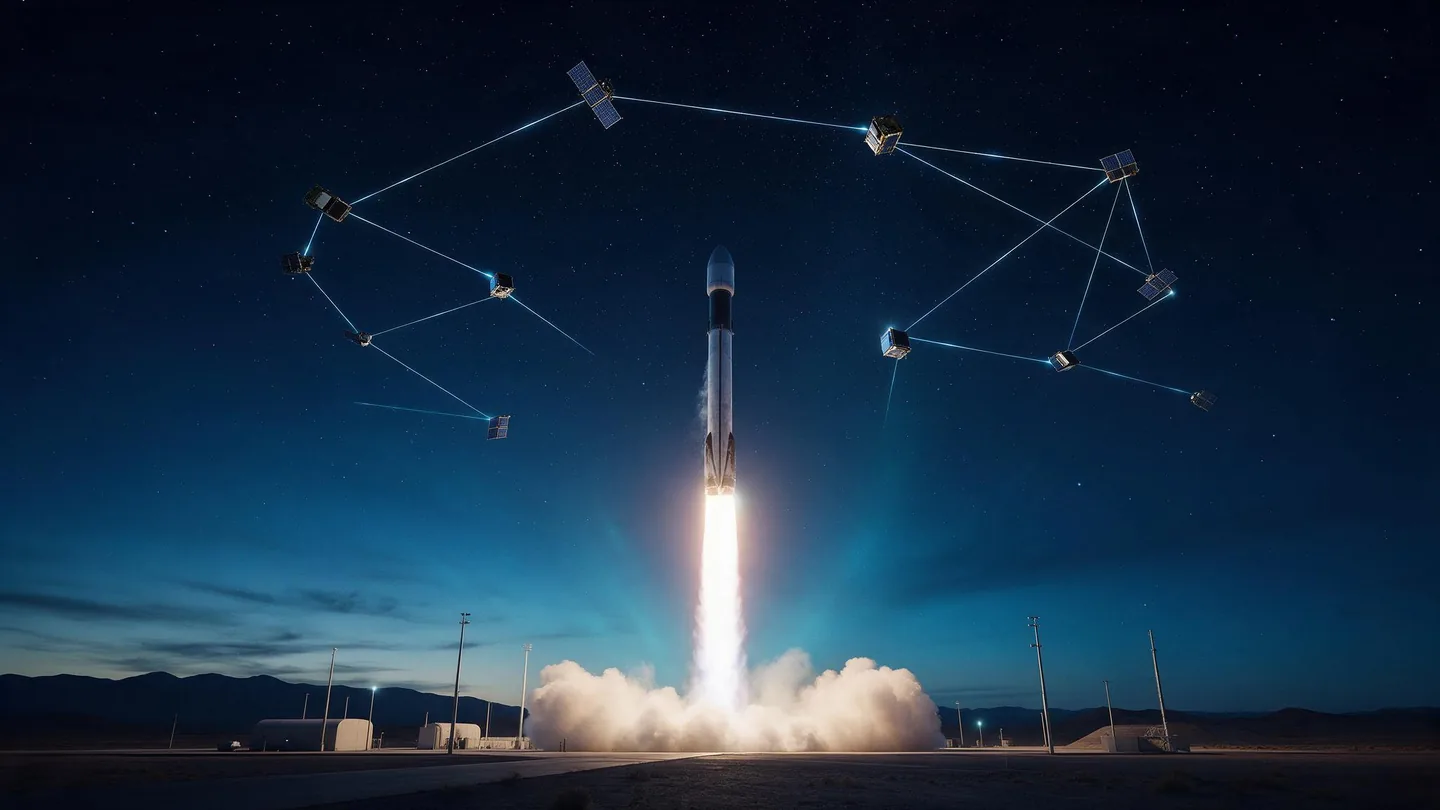
At 19:40 Beijing time on Oct. 14, LandSpace's Zhuque-2E Y4 rocket lifted off from the Dongfeng Commercial Space Innovation Pilot Zone and delivered ten satellites to their planned orbits in a rideshare configuration, a mission the company declared a complete success. It was the 10th flight of the Zhuque-2 series, and only 29 days had passed since the vehicle's previous mission.
Computing satellites and laser relay hardware on one rocket
The ten payloads came from two different customers. Eight were Xingsuan-era satellites built by Chengdu-based Guoxing Aerospace — XingshiDai-39 and XingshiDai-44 through -50 — the first dawn-dusk orbit satellites of the company's “Xingsuan” computing-constellation plan. They will validate high-performance computing payloads, high-speed inter-satellite and satellite-to-ground laser communications, and large deployable radiator wings, all aimed at an autonomous space-computing infrastructure. A precursor satellite for the “Mingzhu Constellation” programme, Dongfang Tiansuan (XingshiDai-44), flew on the same rocket, and six satellites in the batch carried space-computing payloads developed in-house for running and inferencing AI models in orbit.
The other two spacecraft, Guangchuan-03 and -04, were built by Lantai Intelligent as next-generation laser data-relay test satellites, validating highly integrated onboard processing units, large-aperture high-speed laser links, integrated laser-routing communication modules and new solar-array power systems.
Tailoring a rideshare mission
The Zhuque-2E is a two-stage cryogenic rocket burning liquid oxygen and methane, capable of lifting 6 tonnes to low Earth orbit and 4 tonnes to a 500-kilometre sun-synchronous orbit, with a 4.2-metre fairing. Ma Haijing, general manager of LandSpace's marketing department, said the hard part of rideshare is that customers' satellites differ in mass, dimensions and separation requirements. The team arranged them on a square load-bearing cylinder, supporting both side-mounted and stacked flat-panel satellites, and coordinated installation positions, separation sequences and the flight profile with customers.
For small-satellite operators, ridesharing means not having to wait for a dedicated mission: they can launch on their own schedule while the rocket's capacity and fairing volume are used more fully, helping to spread overall cost.
From single flights to a scheduled service
Within less than a month the Zhuque-2E has flown two very different mission profiles. LandSpace says it will keep refining multi-customer rideshare and pair the Zhuque-2E with the Zhuque-3 to form a tiered capacity system — a medium-lift workhorse for fast, flexible batch missions and a large reusable vehicle with more than 20 tonnes of LEO capacity for mega-constellations and deep-space work.
Hanxing take
When commercial rockets shift from being merely powerful to running frequent, reliable services, small-satellite customers benefit first. Two launches in 29 days, each carrying ten satellites, means small satellites no longer have to wait long for a dedicated slot. As Hanxing — a global small-satellite launch service advisor for China — we see a full spectrum of Chinese capacity emerging, from rideshare to dedicated flights and from medium-lift liquid rockets to large reusable vehicles, offering customers a broader set of China launch solutions. Hanxing will keep tracking capacity, windows and pricing across these vehicles to match customers' constellation plans with the right Chinese launch opportunity.