
← Back to news
One satellite every 30 hours: Xiongan's assembly line industrialises satellite production
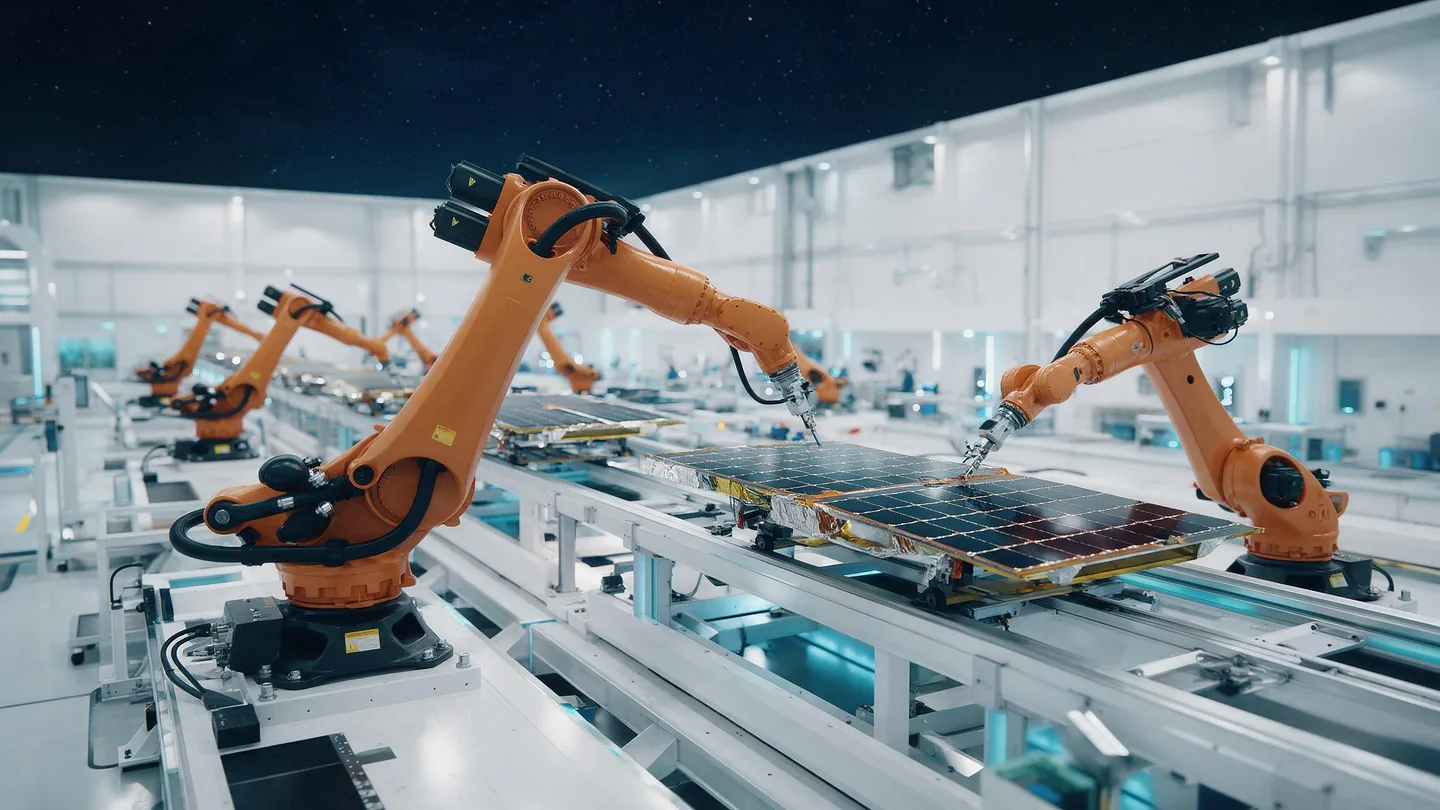
Satellite manufacturing is going through its own version of the automotive revolution. A Securities Times report published on October 21 describes the satellite production line running inside the Xiongan facility of LandSpace Hongqing: China's first flow-line automated satellite production line, commissioned in 2025, which borrows automotive assembly-line logic and breaks whole-satellite integration into standardised workstations.
## Three numbers that matter
- **Over 70 percent automation**: four robotic arms handle repetitive tasks such as panel assembly, cutting manual intervention between material loading and roll-off.
- **Roughly 80 percent shorter build time**: the old model of bespoke, dispersed assembly has been replaced, with a satellite going from components to final assembly in about 30 hours.
- **100 satellites a year**: the line currently has the delivery capacity for 100 flat-panel satellites annually.
The first satellite off the line, Xiongan-1 (also known as Honghu-03), reached orbit on August 19 this year — the first "Xiongan-built" satellite in space, closing the loop from R&D and manufacturing to on-orbit application.
## Why batch production is harder than a first flight
For a satellite company, building one spacecraft that flies is a technical problem; building a hundred with consistent performance is an engineering and supply-chain problem. Batch production requires three things at once: modular design, parallel testing and a standardised supply chain.
Modularity lets different stations work simultaneously. Parallel testing removes the test bench as a bottleneck — Xiongan has built a shared satellite test centre that turns what used to be dedicated infrastructure into a bookable public service. Standardisation moves suppliers from "build to drawing" to "deliver to specification".
## An industrial cluster with anchors
The production line is only one piece of Xiongan's space ambitions. China SatNet registered in the new area in 2021 and moved its headquarters there in 2024, becoming the first central SOE headquartered in Xiongan. Around anchors such as China SatNet and China Spacetime, satellite manufacturing, phased-array antennas, terminal applications and TT&C operations have followed. Xiongan now hosts 69 space-information and satellite-internet companies and nine innovation platforms; the China Space Information and Satellite Internet Innovation Alliance has gathered more than 240 members.
On capacity, Xiongan is pursuing a "311" programme: three satellite lines (a super-factory line, the LandSpace Hongqing LEO batch line, and a shared manufacturing line), plus a commercial satellite integration support base and a shared test centre.
## Pressure moves to the launch side
When satellites are built fast, the constraint shifts to rockets and launch sites. Batch production means satellites are delivered in lots rather than one at a time, and launch demand moves from occasional dedicated flights to scheduled service. Rockets then need predictable annual output and bookable pad slots more than one-off extreme performance — which is precisely why Chinese commercial launchers have spent the past year betting on multi-satellite rideshares and high-cadence operations.
## Hanxing View
The real significance of batch satellite production is that constellation deployment stops being a project and becomes manufacturing. Once a satellite's roll-off cycle is measured in hours, constellation operators can genuinely plan insertion cadence by quarter and by year — and that requires launch services to be schedulable in the same way. Hanxing, the global small-satellite China launch service advisor, tracks the matching between domestic satellite output and rocket capacity, and supports customers at home and abroad with batch-insertion planning, launch window scheduling and executable China launch solutions, so that the speed of the production line becomes the speed of the constellation.