
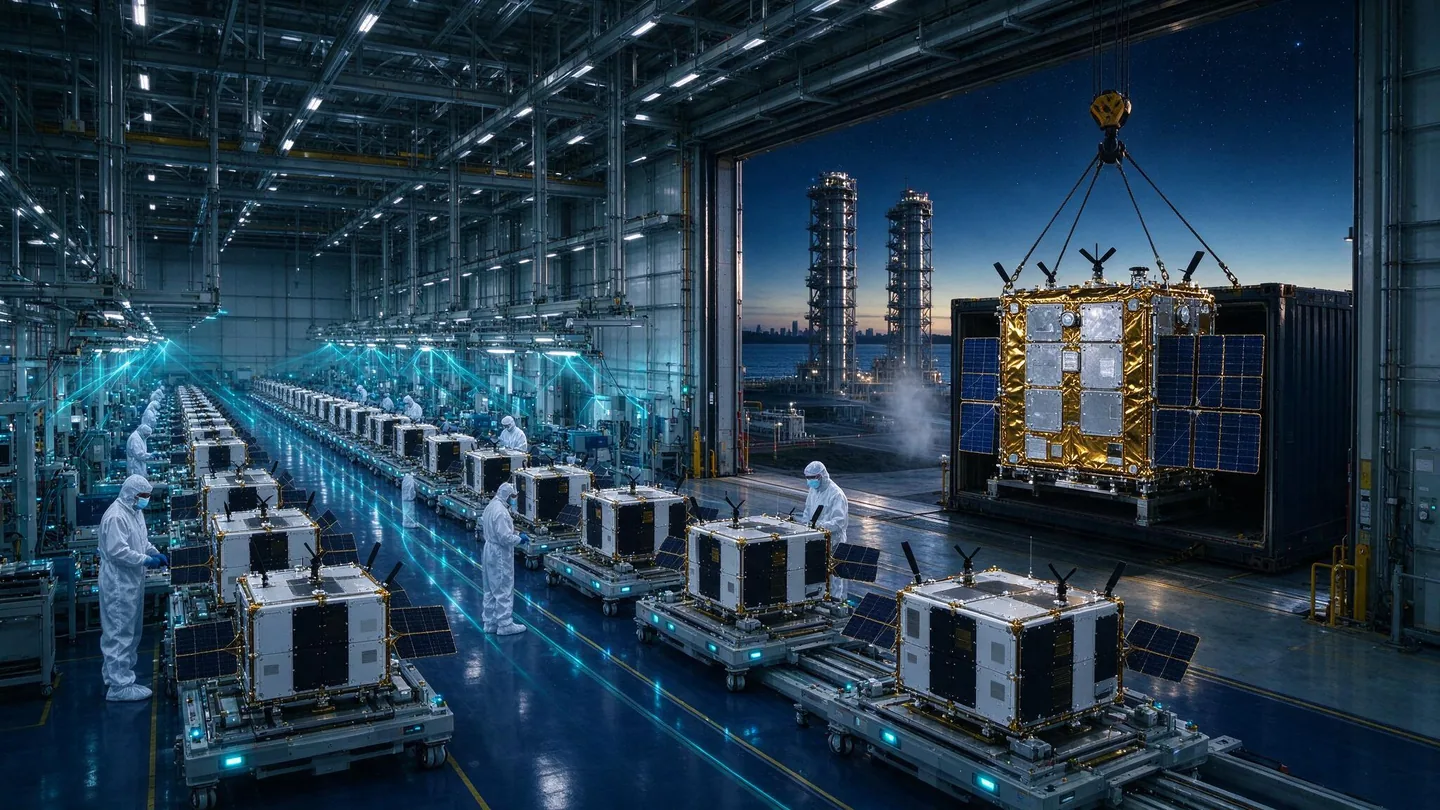
In Wenchang on the coast of Hainan, a factory designed to build 1,000 satellites a year is moving from "completed" to "shipping." The Wenchang International Aerospace City administration confirmed on August 17 that its satellite superfactory had entered trial production; a Xinhua research visit in late October added the milestone that matters: the line has been commissioned end-to-end and is now in trial production, with the first satellite scheduled to roll off the line before the end of this year. China's LEO constellation bottleneck is shifting — from "can we build them" to "can we launch them the moment they are built."
Three gates, not one leap
The line did not jump straight into mass production. On June 29-30, 2026, the superfactory's satellite production line passed a through-line test review, the gate that certifies equipment choreography, takt time and process stability rather than the specs of any single machine, and was cleared to enter trial production. On August 17, Yuan Shiying, deputy director of the Wenchang International Aerospace City administration, told a provincial press conference that launch pads 1 and 2 at the commercial spaceport were already in routine operation, the superfactory was in trial production, and an offshore recovery platform and tracking network were under accelerated construction; pads 3 and 4 are to be launch-capable before year-end, with the superfactory's first satellite coming off the line in the same window. During Xinhua's late-October visit the official line was unchanged: line commissioned, trial production running, first satellite by year-end.
Read together, the three gates form a classic manufacturing ramp: installed equipment is not a working line; a passed through-line review is not a stable takt; and a first satellite is the only proof the factory can actually deliver. By late October, more than 700 supply-chain companies had moved into the adjacent rocket-and-satellite industrial park.
What "factory-to-pad" actually removes
The plant sits in Dongjiao town, represents about 1.091 billion yuan of investment and 60,000 square meters of floor space, and is organised as a "1+1+8" cluster: one superfactory, one test and verification centre, and eight core component development centres. It is repeatedly described as the only facility in China able to complete both satellite assembly and encapsulation with the launch vehicle, with a designed capacity of 1,000 satellites per year.
Encapsulation used to be the launch site's job. A finished satellite had to be packed, trucked long distances, retested on arrival, and finally mated with its fairing at the assembly building or the pad. The superfactory sits next door to both the Wenchang spaceport and the Hainan commercial launch site — a few kilometres from cleanroom to pad, hours instead of days. For a satellite of a few hundred kilograms, that removes a disassembly, a round of environmental retesting and a stretch of overland risk.
The bigger prize is not freight savings but schedule coupling. In the old model, building a satellite and booking a launch were two almost independent progress bars, and a slip on one forced a re-plan of the other. "Factory-to-pad" merges them into a single bar.
The capacity arithmetic
Demand is measurable. After the Lier-2 Y2 rideshare put 18 Qianfan satellites into orbit on November 3, the Qianfan constellation reached 274 satellites in orbit, against a first-phase target of 648 and a plan of 324 in orbit by the end of 2026, with a long-term architecture of more than 15,000. That is precisely the kind of customer that needs monthly deliveries in batches.
Supply is equally specific: with all four pads in service, the Hainan commercial spaceport is designed for roughly 60 launches a year. Zhang Xiaojun, deputy general manager of the Wenchang launch support company, told Xinhua: "Launch orders for this year are full, next year is full, and you can now only book the year after."
Put the three numbers side by side and a structural conclusion follows: once satellite output reaches a thousand a year, the binding constraint becomes pads, windows and launch-campaign tempo. The point of factory-to-pad is to pull launch-schedule certainty forward — what a customer buys is not a capacity promise but a launch slot that can be entered into a calendar.
The second chain: data processed on the same coast
Downstream data is also being processed in Wenchang. The Wenchang space supercomputing centre, in operation since 2023, has integrated resources from 161 satellites in orbit and built a sub-metre commercial remote-sensing data library; using the free-trade port's cross-border data rules, it completed its first remote-sensing data export to Singapore in May and is now in talks with Thailand, Cambodia and several European countries. Hainan's 15th five-year plan for high-tech industry targets 50 billion yuan of commercial-space revenue by 2030.
That matters to overseas customers: if data can land, be processed and be re-exported inside one park, the compliance path for remote-sensing services is far shorter than a data-repatriation loop — and that path's cost and lead time eventually show up in a constellation operator's business model.
Hanxing view
For an overseas small-satellite customer planning a Chinese launch, "factory-to-pad" ultimately reduces to a plainer question: can the total span from contract signature to orbit be shortened, and can the total cost come down? Plant capacity, pad count, encapsulation capability and downstream data processing are all variables on that critical path — and if they are not joined up, even a strong single node remains isolated capacity.
Hanxing — the global small-satellite China launch service adviser — exists to string those variables into one executable path: launch consulting and orbit-solution design, batch scheduling and lot delivery for small-satellite constellation build-out, and end-to-end execution of China launch solutions with the right interfaces. When building and launching happen on the same stretch of coastline, what a customer buys is no longer just a launch — it is a compressed delivery cycle.