
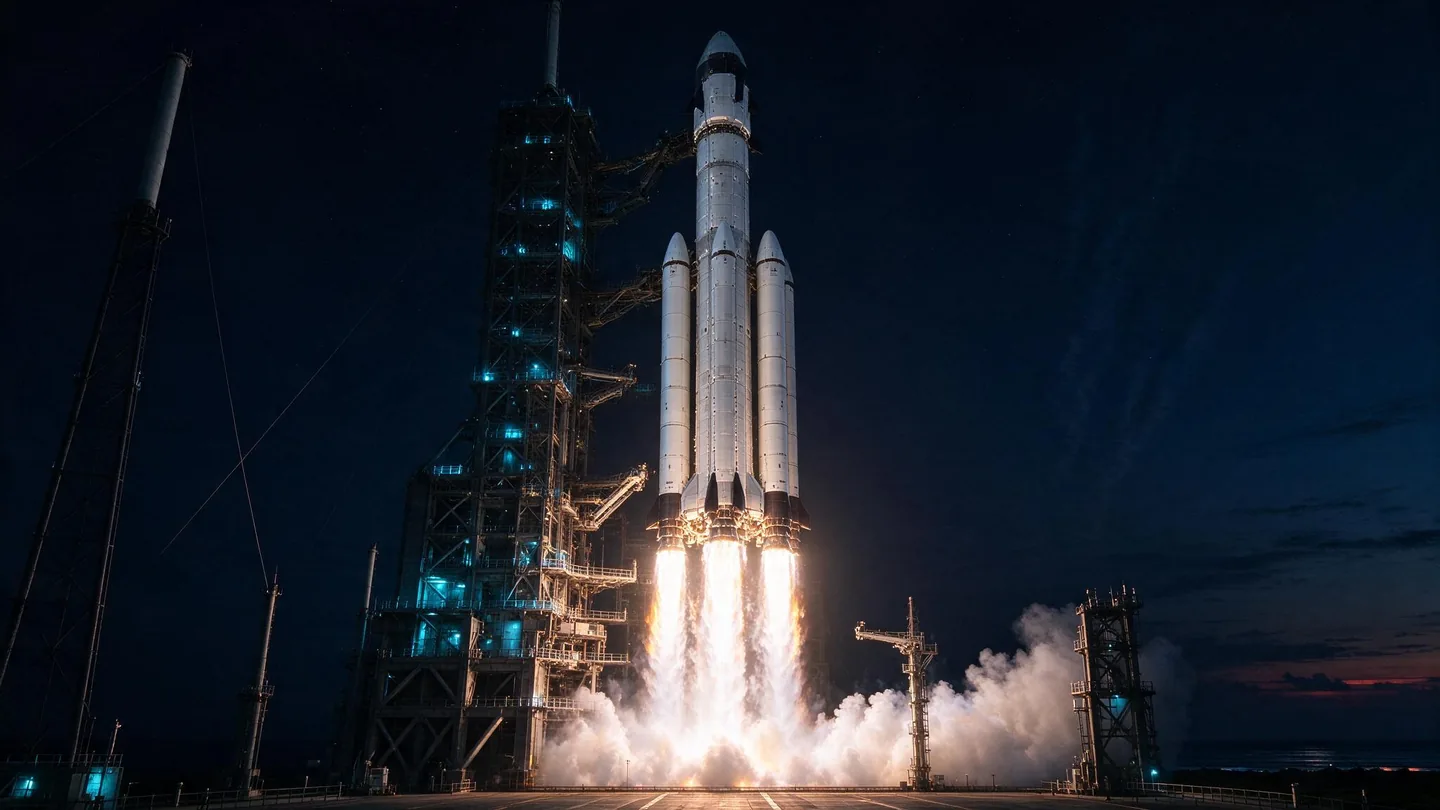
United Launch Alliance announced on October 28 that its Vulcan Centaur will return to flight on November 13, nine months after a solid rocket booster nozzle anomaly grounded the vehicle in February. The return mission will carry 40 Amazon Leo broadband satellites — the first of 38 Vulcan flights Amazon has booked, and the first real operational mission on that contract.
One return flight touches two things at once: ULA's credibility, and the schedule of Amazon's largest single block of launch capacity.
Nine months on the ground, and the nozzle
Vulcan is ULA's replacement for the Atlas V and Delta IV, with two Blue Origin BE-4 methane engines on the first stage and up to six GEM 63XL solid boosters. The problem sat in the boosters: on two of the rocket's first four flights, a booster nozzle failed. In the first case, during the October 2024 certification flight, a nozzle came off about 37 seconds after liftoff; the booster burned to completion, but asymmetric thrust tilted the vehicle before guidance and the core stage extended their burn by roughly 20 seconds and still reached an acceptable orbit.
A second nozzle failure in February pushed matters to a breaking point. Both missions saved their payloads, but the U.S. Space Force — ULA's primary customer — lost confidence in Vulcan, and the rocket was grounded.
ULA said engineers "made great strides," have "identified several potential contributors, which have been mitigated through design and process improvements to the nozzle." The return mission will fly the improved nozzle design while additional testing and analysis continue in parallel, using flight data to validate the changes. ULA and Northrop Grumman, which builds the boosters, have not publicly identified the root cause of the February failure.
Forty satellites and 38 flights
The mission will lift off from Cape Canaveral Space Force Station in Florida with 40 Amazon Leo satellites, with the date pending range approval. Amazon has booked 38 Vulcan flights — the largest block among the five launch providers in its Leo manifest — and Vulcan carries one of the highest satellite counts per mission in that manifest.
Amazon's first-generation Leo license covers 3,236 satellites, with full deployment due by July 2029. The FCC removed the interim milestone requiring half the constellation (1,618 satellites) by July 2026, but the full-constellation deadline stands. Leo's in-orbit count remains in the hundreds, and the company needs all five providers running to build cadence.
Why this is bigger than ULA
For ULA this is more than a commercial mission. The Pentagon has assigned Vulcan roughly half of its major launches through the early 2030s; the Space Force certified the rocket for national security launches in 2025, flew two missions, then stood it down after the February booster incident. The return flight will be scrutinized closely — it is at once the first flight on a commercial contract and a public test of whether Vulcan can reliably carry national security payloads.
For Amazon the math is blunter. Leo's capacity is spread across Atlas V (retiring), Falcon 9, Ariane 64, Vulcan and New Glenn. New Glenn's pad was severely damaged in a May static-fire explosion, and Blue Origin's target of returning before year-end has no firm date; Ariane 6 has capped its 2026 manifest at six or fewer flights after a turbopump anomaly. Two of the five legs are contracting, so whether the thickest leg — Vulcan — returns on time directly shapes Leo's deployment curve.
Hanxing take
A constellation operator's launch risk is rarely "do we have a rocket"; it is "when will the rocket we depend on most actually fly." Amazon put its biggest block on Vulcan and still lost nine months to a component-level nozzle problem — which is precisely why multi-provider, multi-batch manifests matter.
Hanxing — your China launch advisory for small satellites worldwide — typically structures a client's capacity into a primary and a backup line, with batch timing aligned to satellite delivery and frequency milestones so a single point of failure cannot drag the whole deployment schedule down. For Chinese commercial rockets, overseas willingness to pay for predictable scheduling is rising: when Western primary capacity is grounded, a China launch solution that reliably delivers windows becomes a form of risk hedging in itself. Hanxing will keep tracking Vulcan's return and Leo's deployment cadence to help clients read the next turn in global capacity tightness.