
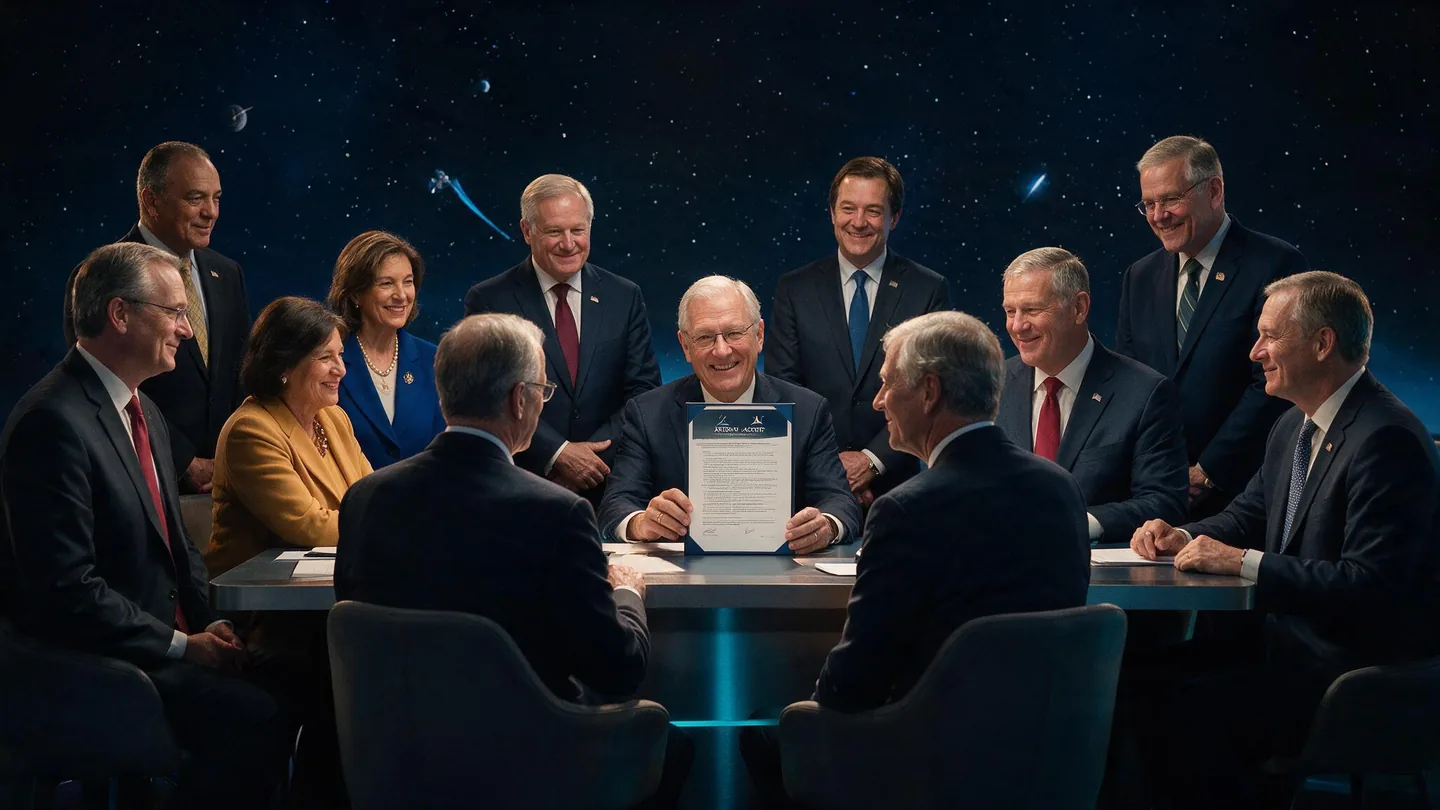
On August 31, during a ceremony at NASA Headquarters in Washington, the Republic of Türkiye formally signed the Artemis Accords, becoming the 71st signatory nation. NASA Administrator Jared Isaacman hosted the ceremony, with Turkish Minister of Industry and Technology Mehmet Fatih Kacır signing on behalf of Türkiye. Turkish Space Agency President Yusuf Kıraç and U.S. Deputy Assistant Secretary of State for Space and Environment Connor Tomlinson also participated in the event.
Background and Significance
Isaacman stated at the ceremony: “It is my privilege to welcome the Republic of Türkiye as the 71st signatory of the Artemis Accords. Last year, President Trump directed NASA to accelerate its return to the lunar surface and establish humanity’s first enduring presence on another world, a Moon Base, as well as lay the foundation for the manned exploration of Mars.” He emphasized that NASA never undertakes these grand endeavors alone, and that the Moon Base program is putting Artemis Accords principles into practice on the lunar surface, with all signatories invited to contribute major hardware, scientific payloads, technology demonstrations, CubeSats, and other capabilities.
The Artemis Accords were established in 2020 by NASA and the U.S. State Department together with seven other founding nations, in response to growing interest in lunar activities by both governments and private companies. They introduced the first set of practical principles aimed at enhancing safety and coordination among nations exploring the Moon, Mars, and beyond. Core commitments include: peaceful and transparent exploration, rendering aid to those in need, enabling access to scientific data, ensuring activities do not interfere with others, and preserving historically significant sites and artifacts.
Türkiye’s Space Progress
Türkiye has recently made notable strides in human spaceflight. In 2024, the country’s first astronaut, Alper Gezeravci, traveled to the International Space Station aboard Axiom Mission 3, conducting scientific research alongside NASA astronauts. That same year, a second Turkish astronaut, Tuva Atasever, flew on Virgin Galactic’s suborbital mission, conducting experiments and physiology research.
Additionally, Türkiye is preparing to launch its first lunar mission, AYAP-1, joining the small but growing group of countries building and launching their own satellites to the Moon. This October, Türkiye will host the International Astronautical Congress in Antalya, where dozens of Artemis Accords signatories are expected to attend and discuss the future of peaceful and transparent space exploration.
Industry Impact
Türkiye’s accession brings the total number of Artemis Accords signatories to 71, spanning 32 European nations, 16 Asian nations, 8 South American nations, and more. This expansion demonstrates that the framework has evolved from its 8 founding members into a broadly representative international space governance mechanism. As more nations join, the Accords’ role in regulating lunar resource development, space activity transparency, and orbital coordination will continue to strengthen.
Hanxing Perspective
Hanxing follows developments in international space governance and cooperation frameworks. The continued expansion of Artemis Accords signatories reflects a global shift in space cooperation from bilateral to multilateral, from low-Earth orbit to deep space. For satellite operators and space service providers, the maturation of multilateral frameworks means clearer compliance pathways for cross-national space projects. Hanxing looks forward to supporting more nations and enterprises with launch services and technical expertise within international cooperation frameworks.