
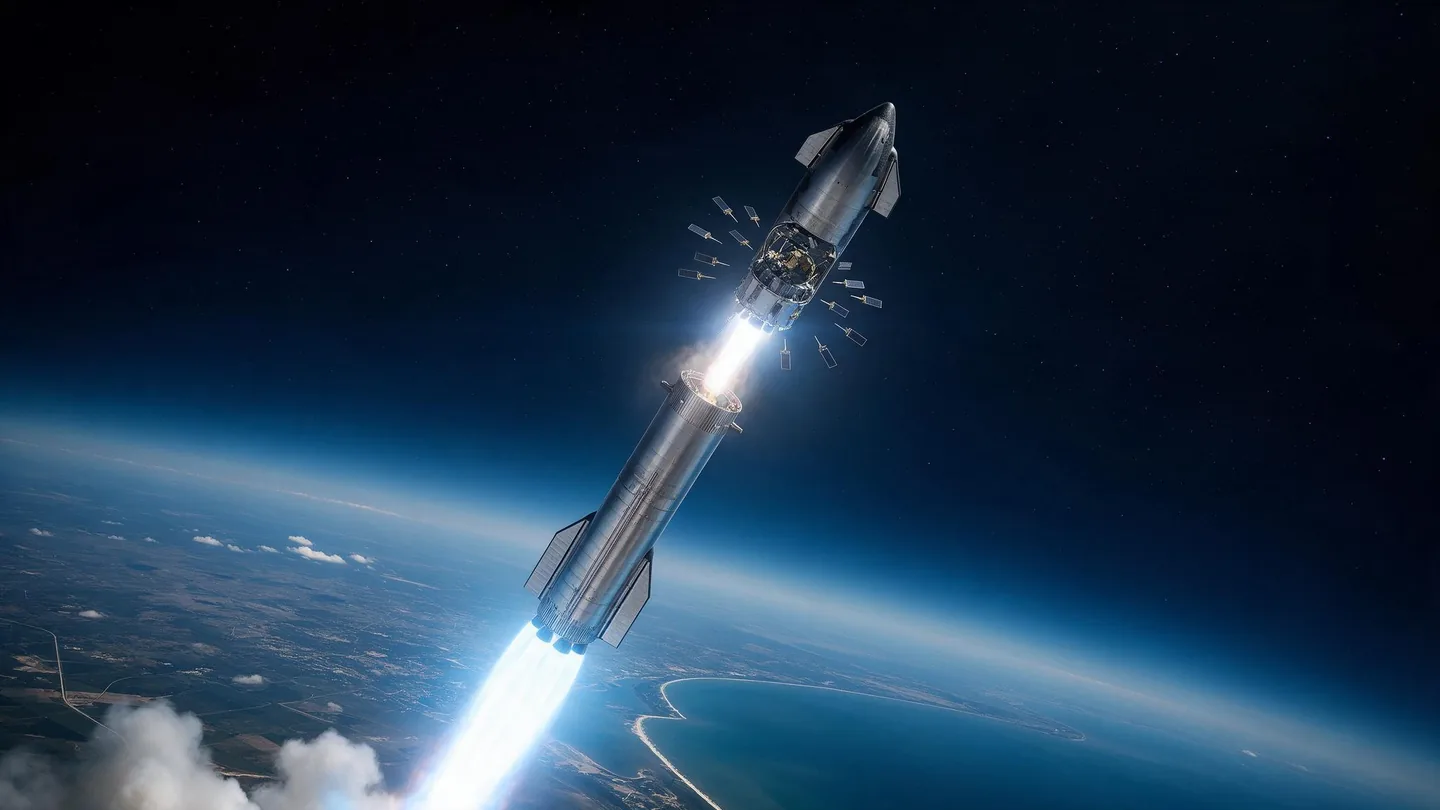
Historic Breakthrough: Starship Enters Earth Orbit for the First Time
On September 28, SpaceX's Starship launched from Starbase, Texas, on its 14th test flight. For the first time since the rocket's inaugural flight in 2023, Starship reached Earth orbit — all 13 previous flights followed suborbital trajectories.
The 407-foot-tall (124-meter) rocket lifted off at 8:49 AM EDT, powered by 33 methane-fueled Raptor engines generating up to 18 million pounds of thrust. Approximately eight minutes into the flight, the upper stage engines shut down, and Starship entered a suborbital coasting phase.
Dramatic Moments: Engine Anomaly and Critical Decision
During ascent, one of Starship's six Raptor engines shut down prematurely. The remaining five burned longer to compensate. During the live webcast, SpaceX initially indicated that mission managers might abort the orbital insertion burn and maintain a safe suborbital trajectory.
However, after the ground team confirmed that the three center Raptor engines needed for orbital insertion and de-orbit operations were functioning normally, flight controllers authorized the orbital insertion. A single Raptor engine reignited for 19 seconds, adding approximately 204 mph to Starship's velocity and placing it in a stable orbit at an altitude of about 171 miles (276 kilometers).
26 Starlink V3 Satellites Deployed in Orbit
After reaching orbit, Starship opened its payload bay doors and sequentially deployed 26 Starlink V3 satellites using a pulley-and-cable system. Each satellite weighs approximately 2 metric tons and is too large to fit inside SpaceX's Falcon 9 payload fairing — they can only be launched aboard Starship.
Each Starlink V3 satellite adds approximately 1 Tbps of capacity to the constellation, ten times more than the V2 Mini satellites launched on Falcon 9. The 26 satellites deployed in this mission collectively represent approximately 26 Tbps of capacity — roughly ten times what a single Falcon 9 launch adds. SpaceX confirmed establishing contact with all 26 satellites after deployment.
Early Return: Caution First
After completing satellite deployment, SpaceX decided to shorten the remaining flight. The original plan called for Starship to orbit Earth approximately six times over nearly 10 hours, but given the engine issue during ascent, the flight control team opted for an early return out of caution. Starship performed a de-orbit burn, re-entered the atmosphere, and splashed down in the North Pacific. The entire mission lasted approximately 3 hours and 9 minutes from launch to splashdown.
Far-Reaching Implications: Starship Reshapes Space Transportation
Starship's first orbital flight marks a new phase for SpaceX's fully and rapidly reusable launch system. Beyond batch-deploying Starlink satellites, Starship is planned for NASA's Artemis program crewed lunar missions and future Mars transportation. NASA's Artemis 3 mission in 2027 will conduct crewed tests in low-Earth orbit, with the Starship lander as a candidate test vehicle.
Starlink has become SpaceX's core revenue source. The 2026 Q2 financial report showed connection business revenue of $4.291 billion, up 66% year-over-year, with operating profit of $1.656 billion. As of June, Starlink subscribers reached 12 million, double the year-ago figure.
Hanxing Insight
Starship's first orbital flight and successful deployment of Starlink V3 satellites marks the formal entry of ultra-heavy-lift rockets into orbital operations. For small satellite operators worldwide, Starship's capacity leap means satellite designs are no longer constrained by launch volume — larger, more capable satellite platforms will accelerate constellation expansion. Hanxing — your global small satellite Chinese launch service advisor — continues to monitor the global launch capacity landscape, providing international small satellite clients with Chinese commercial rocket launch consulting and small satellite constellation networking solutions. The Starship-driven capacity revolution presents both challenges and opportunities; Chinese commercial rocket companies are accelerating reusable technology verification, and the global launch service competitive landscape is being reshaped.