
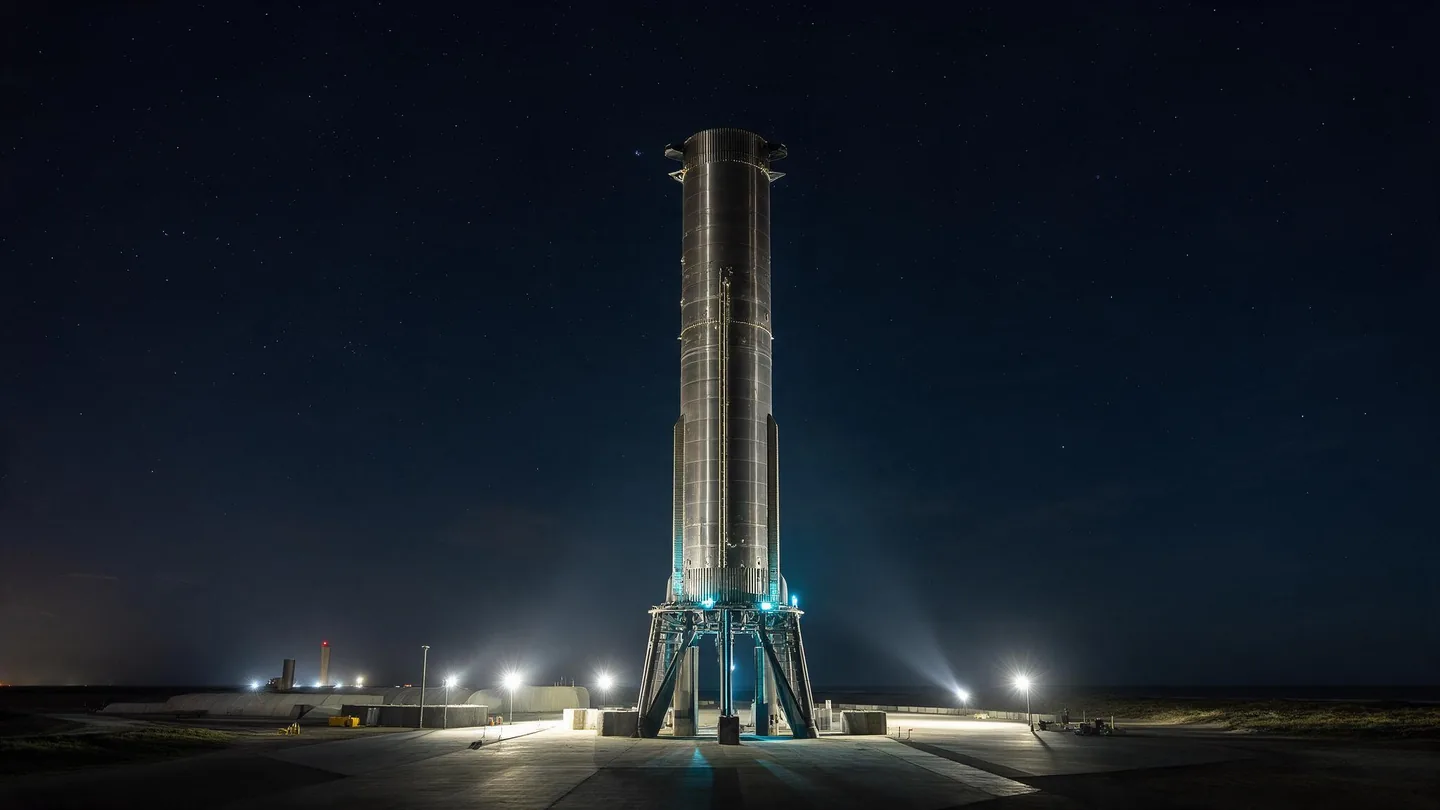
According to Spaceflight Now and other outlets, SpaceX has rolled Super Heavy booster B21 to Pad 2 at Starbase, Texas, preparing for the first orbital flight of Starship. Under the current plan, Flight 14 could launch as early as September 28, pending FAA approval of a license modification for the orbital flight profile.
A first genuine orbital mission
Unlike previous suborbital test flights, Flight 14 is designed as the program's first orbital insertion: the vehicle is to deploy 26 next-generation Starlink V3 satellites into low-Earth orbit at an altitude of about 275 km and 30-degree inclination. SpaceX says each V3 satellite adds 1 Tbps of capacity, for roughly 26 Tbps on this single mission — about ten times the capacity of a Falcon 9 launch of V2 Mini satellites.
- B21 stands about 72 meters tall with a 9-meter diameter stainless-steel hull. It departed its assembly building shortly before midnight on September 20 and was installed on the mount at Pad 2 about two hours later.
- The Starship upper stage, S41, has yet to be rolled out for integration, and no road closures had been published as of Monday morning, suggesting several days of preparation remain.
- This would be the first time the FAA grants an orbital license for an object as large as the Starship upper stage, and the agency wants to be sure the vehicle is truly ready.
From test flight to delivery
On Flight 13 in July, Starship deployed 20 V3 satellites along a suborbital trajectory; the satellites unfurled solar arrays, linked with the constellation via laser, and then reentered as planned. Flight 14 upgrades that capability to genuine on-orbit delivery: if the orbital burn holds, the V3 satellites will remain in a working orbit and eventually enter service. SpaceX has said it will not attempt to recover the booster or ship on this mission, focusing instead on orbital insertion and payload deployment.
Starship's maturation is critical to scaling the Starlink V3 fleet. With V2 Mini satellites being phased out from Florida launches, SpaceX needs Starship to put the larger, more capable V3 satellites into orbit in volume and extend the capacity lead of its low-Earth-orbit broadband network.
Hanxing's take
As the "Hanxing — global small-satellite launch service advisor in China," Hanxing closely follows launch-vehicle evolution worldwide. If Starship completes its first orbital deployment, scheduled airline-like launches with hundred-ton-class capacity and dozens of satellites per flight will become reality, reshaping the global launch market once again. Meanwhile, China's commercial rockets are accelerating at a cadence of six launches a week, and the two routes will jointly reset the cost structure of low-Earth-orbit constellation deployment. For global small-satellite customers, more diverse and higher-capacity Chinese launch solutions are becoming a practical option for balancing cost and schedule. Hanxing will keep tracking launch progress at home and abroad to deliver better launch consulting and vehicle-matching services.