
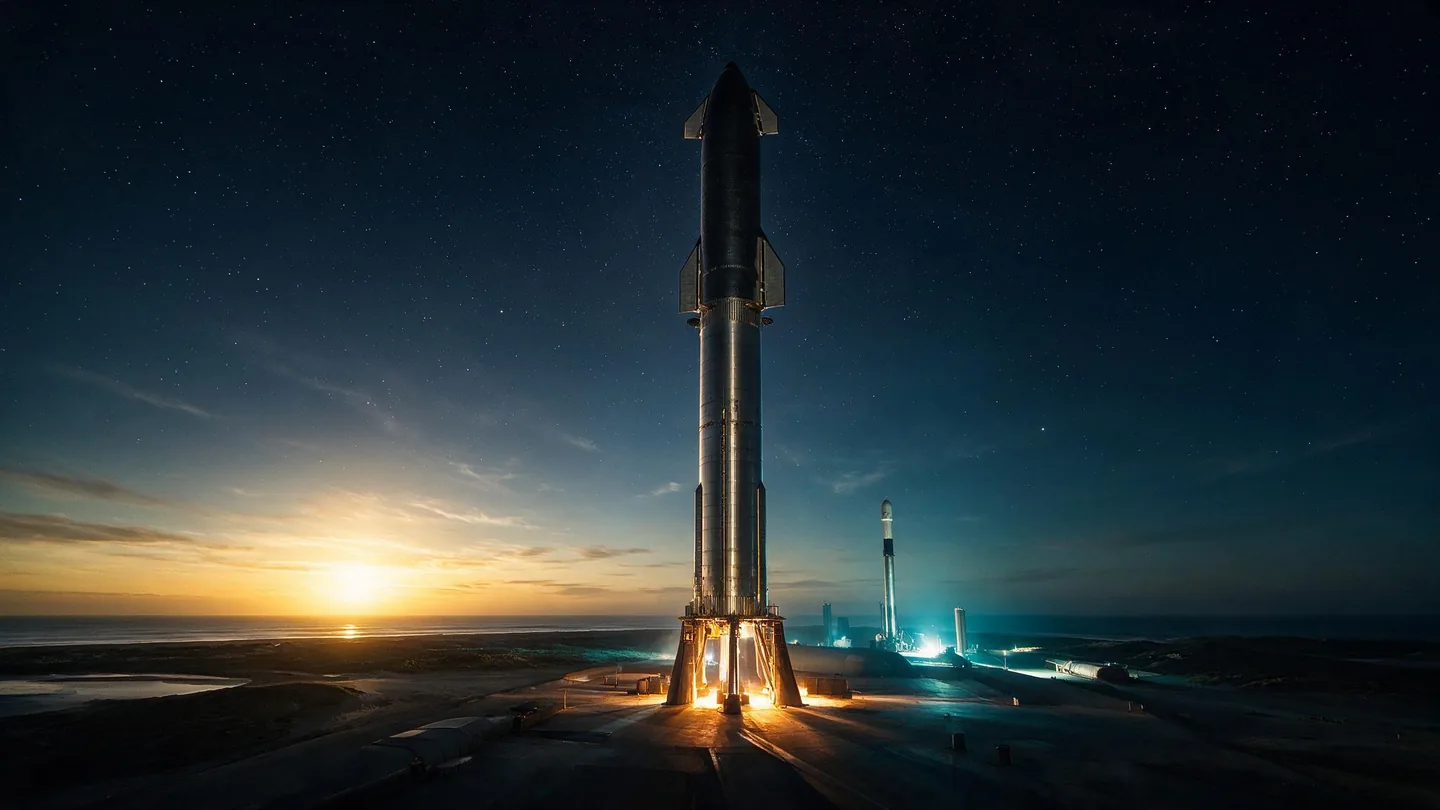
On August 22, SpaceX founder Elon Musk posted on X the clearest timeline yet for the Falcon family's retirement: "Once Starship is flying reliably several times per week, it makes sense to shift super scarce SpaceX engineering and production resources to Starship to get launch rate to several times per day, which means winding down Falcon." This was not a sudden announcement. SpaceX President Gwynne Shotwell had already stated that Falcon flights would "tail off" as Starship comes online, and Bloomberg reported that SpaceX has stopped booking new Falcon 9 commercial launches beyond 2028.
Falcon 9's Legacy and Starship's Ambition
Falcon 9 is one of the most successful orbital rockets in history. Since its debut in 2010, it has flown nearly 700 missions and became the first rocket to achieve orbital-class first-stage booster landing and reuse. In 2025 alone, Falcon 9 launched 165 times, with 122 missions dedicated to deploying Starlink satellites. However, its upper stage is expendable, capping the ultimate cost reduction.
Starship, by contrast, is designed from the ground up for full reusability — both the Super Heavy booster and the upper stage are designed to return to Earth for recovery and reflight. The Block 3 Starship stands 124.4 meters tall with a LEO payload capacity exceeding 100 tons, four times that of Falcon 9 (~25 tons). Musk's ultimate goal is even more aggressive: over 30 Starship launches per day by 2030, roughly 10,000 flights per year.
According to Ars Technica, SpaceX has informed NASA that it plans to end commercial Falcon 9 launches in 2028. However, Falcon 9 missions for International Space Station crew and cargo rotations will continue through at least 2030 — Starship is not yet certified for ISS docking, and the Crew Dragon remains the only American crewed spaceflight option. The next-generation Starlink satellites are larger and designed to fit inside Starship's payload bay rather than atop Falcon 9, which will drive exponential growth in Starship launch demand.
China: Two Breakthroughs in Two Months
In the same period that Falcon's retirement plan emerged, China achieved consecutive milestones in reusable rocket technology:
- July 10: The Long March 10B launch vehicle completed its maiden flight from the Hainan Commercial Space Launch Site, with its first stage successfully recovered via a net-capture system on the "Navigator" sea platform. This marked China's first successful controllable rocket recovery. The Long March 10B is a 5-meter-class high-thrust reusable rocket designed for high-cadence, low-cost commercial launches.
- August 19: LandSpace's Zhuque-3 (Flight 2) launched from the Dongfeng Commercial Aerospace Innovation Zone, with its first stage successfully recovered via land-based landing legs — making it China's first rocket to achieve both orbital insertion and land recovery. Zhuque-3 uses liquid oxygen-methane propulsion, a stainless-steel airframe, 4.5-meter diameter, and nine Tianque-12A engines in parallel on the first stage.
The China National Space Administration (CNSA) stated in an official announcement that these missions mark major breakthroughs in China's reusable rocket technology, with the next step being to advance engineering applications and enhance heavy-lift, low-cost, high-cadence space access capabilities.
The Gap: Full vs. Partial Reusability
Despite China's impressive progress, the gap with SpaceX spans multiple dimensions:
| Dimension | SpaceX Starship | China's Latest | |-----------|----------------|----------------| | Reusability | Fully reusable (booster + upper stage) | Partially reusable (first stage only) | | LEO Capacity | 100+ tons (fully reusable) | Zhuque-3 ~20-25 tons; Long March 10B TBD | | Launch Cadence | Falcon 9: 165 flights in 2025; Starship target: dozens/day | China total ~60-70 launches in 2025 (including expendable) | | Recovery Track Record | Falcon 9 first stage reused 300+ times | Each achieved 1 successful recovery | | Full Reuse Validation | Starship upper stage soft-splashed (Indian Ocean), no orbital recovery yet | No upper-stage recovery program announced |
The most critical gap: Falcon 9's first-stage reuse has been in commercial operation for over a decade, while China's recovery verification has just begun. The path from a single successful recovery to high-frequency, high-reliability engineering-grade reuse requires extensive flight validation.
Hanxing Perspective
The global launch capacity market is undergoing a profound reshaping. SpaceX, with the fully reusable Starship as its endgame, is voluntarily retiring the Falcon 9 that has dominated the market for over a decade — this "self-disruptive" iteration speed is a wake-up call. For China, the breakthroughs of Long March 10B and Zhuque-3 are commendable, but it must be recognized clearly: from partial to full reusability, from single validation to high-cadence operations, many engineering challenges remain. As Starship enters operational service between 2026 and 2028, the global benchmark for reusable rocket technology will leap again. Chinese commercial aerospace companies must accelerate the transition from "successful validation" to "operational deployment" to narrow the gap in the next round of global launch market competition.