
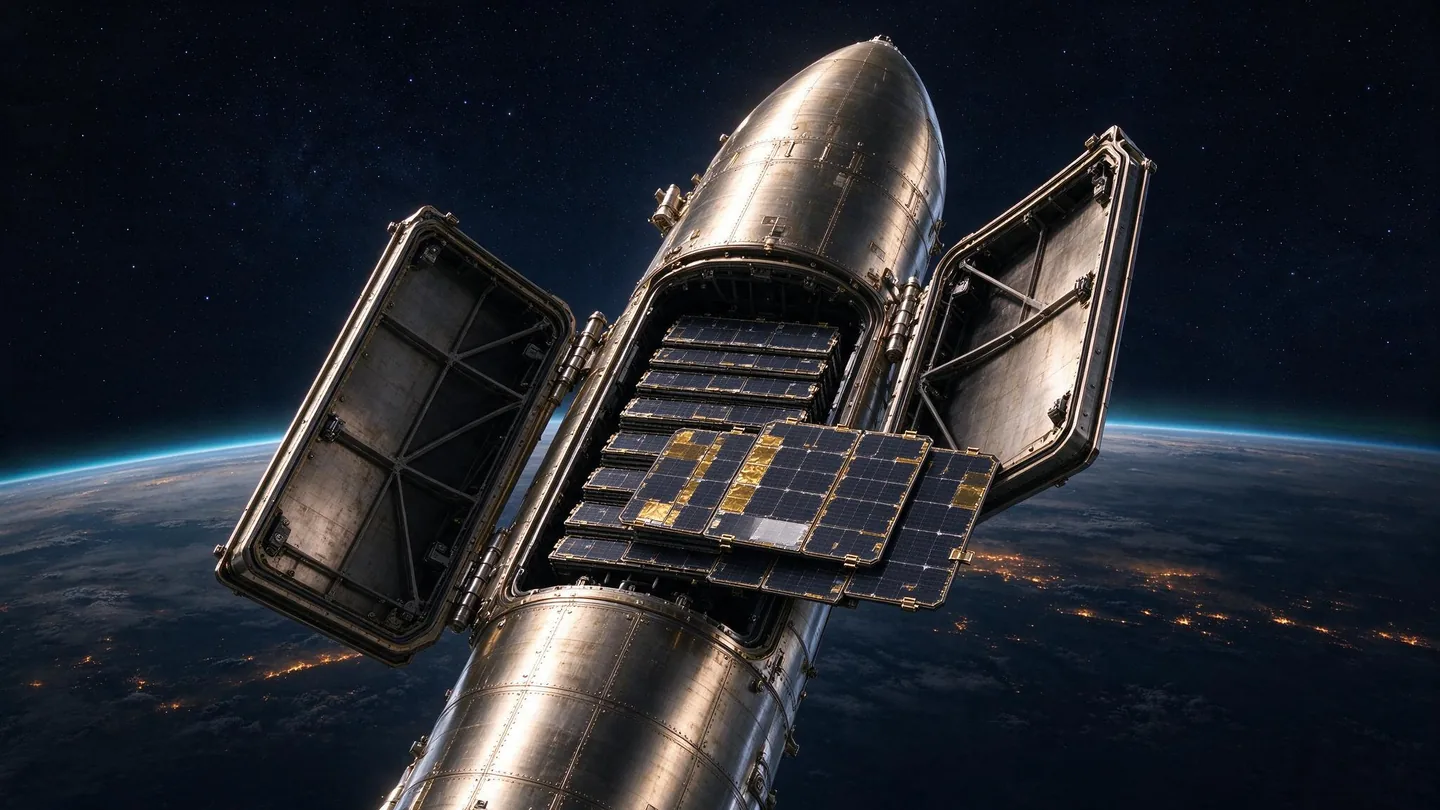
Discussion of Starship has long centred on lift and reuse: 100-plus tonnes to low Earth orbit, two-stage recovery, airline-like cadence. But a detail that surfaced in late October 2026 may matter more to third-party customers than any of those numbers — what kind of door the cargo bay actually has.
The door problem: a narrow, Starlink-shaped hatch
SpaceX's Starship users guide does describe a 9-metre clamshell fairing, theoretically the largest usable payload volume of any launcher in service or development, able to accommodate payloads up to 22 metres tall. That is the guide, though.
Ars Technica reported in late October that there is no evidence SpaceX is putting effort into developing a conventional payload-fairing door for traditional satellites and spacecraft. The company appears set to keep flying with its Starlink-optimized narrow door, ejecting satellites sideways like a PEZ dispenser.
In the same period, Quilty Space's new report on the global launch shortfall stated that SpaceX "has also stopped affirming Starship as a commercial launcher." Put the two observations together and they point at one thing: whether Starship can carry third-party payloads depends less on the performance table than on the deployment interface.
What customers are hearing
On an early-November earnings call, Telesat chief executive Dan Goldberg was asked which rocket the company's future satellites might fly on. His answer was direct.
Starship will first serve SpaceX's own constellation and requirements; second, or alongside that, the US government and perhaps other governments. As for Telesat, "so long as our next-gen satellites are configured in a way that can go into their dispenser, the same dispenser that they'll be using to deploy their own satellites, we've got some expectation that Starship would be available to Telesat."
The message for smallsat operators is plain: to fly on Starship, reshape the spacecraft to its deployment form factor first.
Flat-panel is an interface question, not aesthetics
A cohort of satellite platforms is now designed around that door. Publicly, Muon Space's Condor-Ultra and Apex's high-power buses are built to be flat, stackable and ejected one by one from a side hatch; Lockheed Martin-owned Terran Orbital has offered an Enterprise platform for the same deployment style. Such flat satellites also fit inside medium-lift fairings — they are not Starship-only — but on the Starship line they are close to the only shape that works.
The traditional "boxy satellite, large fairing, top-mounted separation" interface has not been confirmed inside Starship's bay. A satellite architecture that has been standard for a decade, with an extremely mature supply chain, cannot simply be moved onto Starship.
Why this is tangled up with the launch shortfall
Quilty Space estimates that between now and 2030 the world outside China will be short roughly 150 launches relative to demand from satellite operators and civil agencies, with the crunch most acute in 2028. Add US military demand, and if SpaceX does not extend Falcon 9 and Falcon Heavy, the shortfall could double. Meanwhile Falcon 9 has stopped taking new commercial bookings — rideshare included — for missions after 2028.
Mature capacity is contracting while the heavy-lift vehicle expected to replace it is friendly only to certain payload shapes. The gap is not "one fewer big rocket"; it is "one fewer interface that fits ordinary satellites."
For smallsat customers abroad, that adds a variable to vehicle selection. It used to be lift, price and schedule; now it also includes whether the spacecraft's configuration matches the target rocket's deployment interface. A ship that can only flick flat panels out of a side door may not be usable capacity for a one-metre remote-sensing cubesat that needs its own separation sequence.
Hanxing view
Starship's door is ultimately a compatibility problem: it turns launch capacity from "sold by the kilogram" into "sold by the shape." For smallsat customers worldwide that is both a warning and an opening — as Western heavy-lift interfaces narrow and mature medium-lift capacity contracts, providers that offer standardised launch-vehicle interfaces, proven multi-payload separation and dependable windows get repriced.
That is precisely the work of Hanxing — your China launch service advisor for small satellites worldwide: mapping a customer's spacecraft configuration, separation sequence and orbital requirements against China's operational small and medium launch vehicles, rideshare windows and dedicated-vehicle block bookings, and returning executable launch consulting and constellation dispatching plans. In the tightest years of capacity, China launch solutions offer not only price, but interface certainty.