
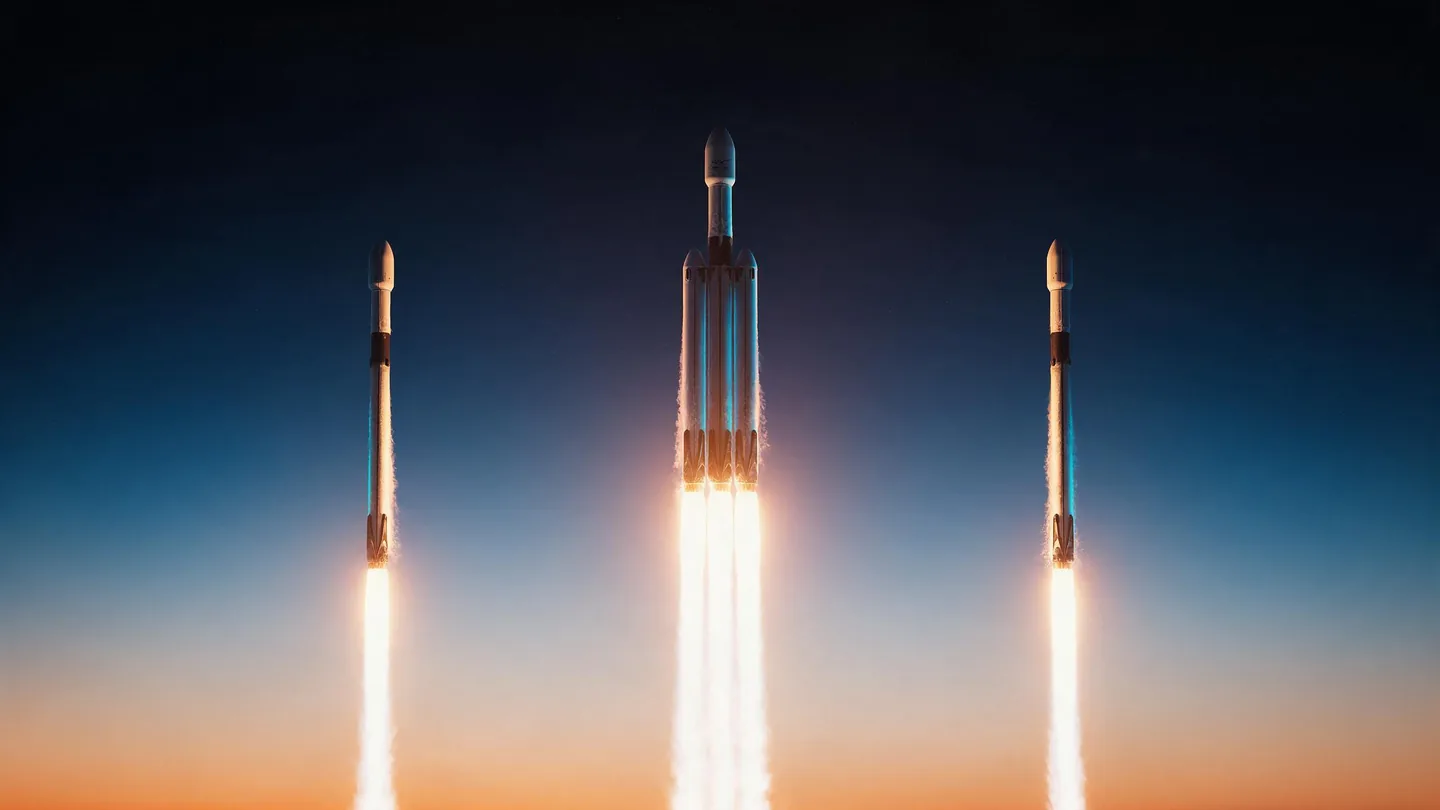
Three Launches in 12.5 Hours: SpaceX Sets New Cadence Record
On October 1, 2026, SpaceX successfully completed three orbital launches in just 12.5 hours, once again rewriting the record for the fastest launch cadence in commercial space history. The three missions lifted off from three different launch sites — Vandenberg Space Force Base in California, and both Cape Canaveral Space Force Station and Kennedy Space Center in Florida — demonstrating SpaceX's impressive multi-pad parallel launch capability.
The three missions were:
- Transporter-18 rideshare mission (SLC-4E, Vandenberg, California): A Falcon 9 delivered dozens of small satellites to sun-synchronous orbit, marking SpaceX's 18th dedicated rideshare mission
- Starlink mission (Cape Canaveral, Florida): A Falcon 9 deployed a new batch of next-generation Starlink satellites into low Earth orbit
- NROL-97 classified reconnaissance mission (LC-39A, Kennedy Space Center, Florida): A Falcon Heavy rocket launched a classified spy satellite for the U.S. National Reconnaissance Office
Falcon Heavy Returns: Highlights of the NROL-97 Mission
As the grand finale of the tripleheader, the Falcon Heavy's NROL-97 mission drew significant attention. It was the third Falcon Heavy launch of 2026 and another national security payload mission for the heavy-lift vehicle.
Falcon Heavy, configured with three Falcon 9 first-stage boosters strapped together, can lift 63.8 tons to low Earth orbit and remains one of the most powerful operational commercial rockets. During the NROL-97 mission, both side boosters successfully returned to landing zones at Cape Canaveral, once again validating the Falcon Heavy's reusability.
Notably, NROL-97 represents another milestone in the growing partnership between the NRO and SpaceX, reflecting the U.S. military's increasing reliance on commercial space launch capabilities.
Airline-Style Launches: From Vision to Reality
The true significance of SpaceX's tripleheader lies not just in the numerical record, but in what it represents: airline-style space launch operations are moving from vision to reality.
- Multi-pad operations: Simultaneous use of three launch pads on both coasts demonstrates extraordinary launch site scheduling capability
- Rapid turnaround: Refurbishment intervals between flights continue to shrink, with Falcon 9 boosters now flying again in fewer than four days
- Mission diversity: Three completely different mission types — rideshare, Starlink deployment, and national security — all flown on the same day
- High reliability: All three launches succeeded, and the Falcon 9 family has now surpassed 700 total launches with a success rate exceeding 99.5%
This "airline-like" launch cadence is transformative for the small satellite industry. As launch windows shift from "once every few months" to "multiple times per week," small satellite operators will see a qualitative leap in constellation deployment speed and operational flexibility.
Profound Impact on the Global Launch Market
SpaceX's ever-increasing launch cadence is fundamentally reshaping the global commercial launch market:
On the supply side: Reusable rocket technology continues to drive down launch costs while dramatically increasing launch capacity, transforming the once supply-constrained market.
On the demand side: Lower costs and more flexible launch windows are stimulating the emergence of new applications — from large constellations to in-orbit services and space tourism — creating a positive cycle of supply generating demand.
On the competitive side: Faced with SpaceX's rapid iteration, other global launch providers are accelerating their own reusable rocket programs. In China, companies like LandSpace, i-Space, and CAS Space are all actively developing reusable rocket technologies.
Hanxing Insight
SpaceX's single-day tripleheader once again proves to the world that commercial space has entered the "airline era." For global small satellite operators, this is both an opportunity and a challenge — rapidly growing launch capacity lowers the barriers to constellation deployment, but it also narrows the window for first-mover advantage.
At Hanxing — China Launch Service Advisor for Global Small Satellites, we closely monitor every significant development in the global launch market. China's commercial launch capabilities are also advancing rapidly: the Long March rocket family has surpassed 70 launches annually, and Chinese commercial rocket companies are accelerating reusable technology development. For overseas customers seeking diversified launch solutions, the Chinese launch market is becoming an increasingly important option. Hanxing provides professional launch consulting, small satellite constellation deployment, and China launch solutions, helping global customers navigate the rapidly changing space landscape and find optimal launch pathways.