
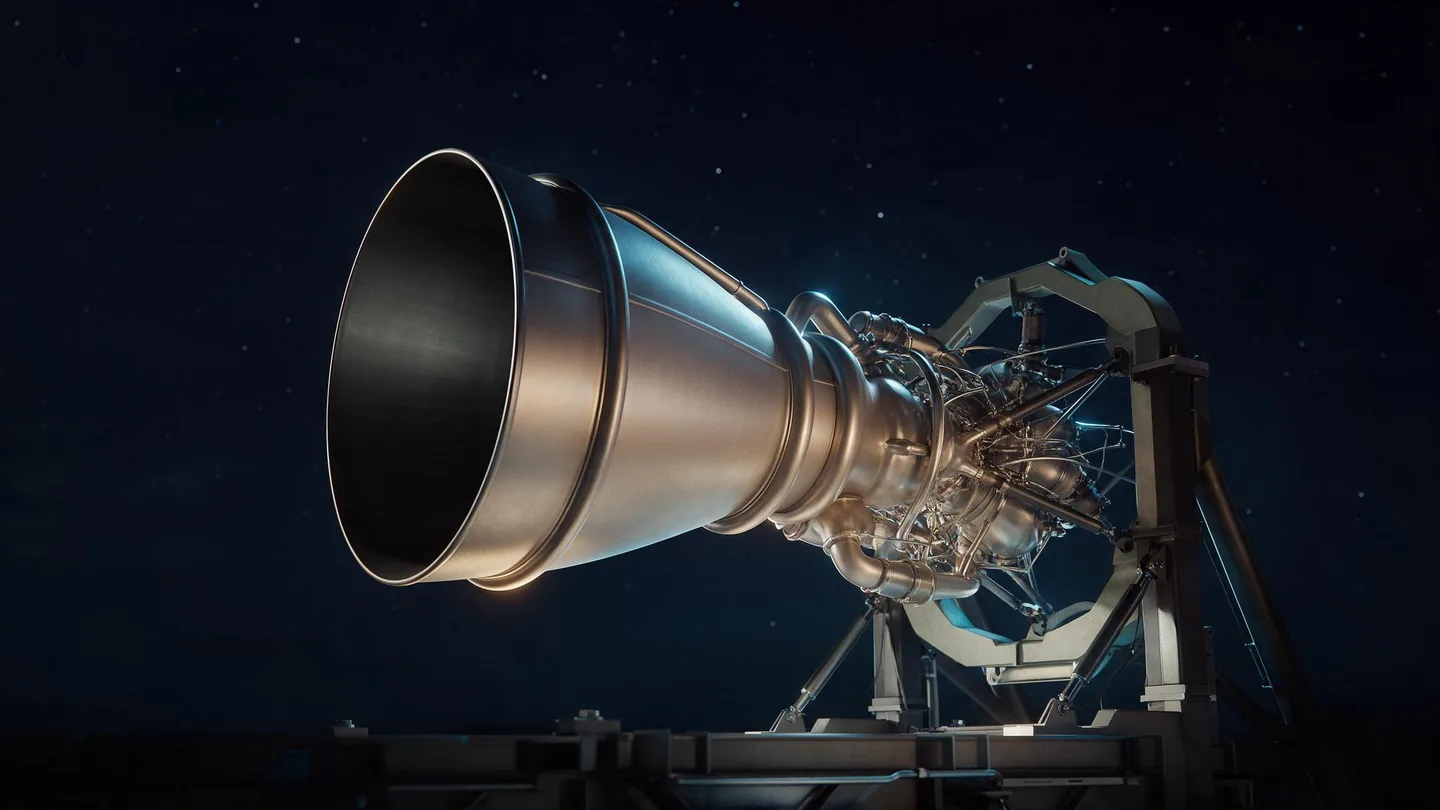
This week Chinese launch startup Space Pioneer unveiled the latest design of its next-generation Tianhuo-21 (TH-21) methane-liquid-oxygen engine, and images quickly circulated across social media. From its stripped-down exterior to its headline numbers, the engine closely mirrors SpaceX's Raptor 3, drawing immediate industry attention.
Numbers that match Raptor 3
Public specifications show the Tianhuo-21 runs on liquid oxygen and liquid methane in a full-flow staged-combustion (FFSC) cycle, targeting about 2,450 kN (roughly 250 tonnes) of sea-level thrust, a specific impulse of 332 seconds, and throttle range of 50 to 110 percent. That places it squarely in the class of the Raptor 3 and points clearly toward a heavy-lift, reusable launch vehicle.
Full-flow staged combustion is often called the 'Everest' of liquid rocket engines: the oxidizer and fuel each pass through their own preburner to drive the turbopumps before both streams recombine in the main combustion chamber. It delivers higher efficiency and longer life than a conventional closed cycle, but it demands exquisitely synchronized control of the preburners, main chamber, turbopumps and valves — any perturbation in one leg can destabilize the whole system.
Musk's engineering warning
Responding to the Tianhuo-21 design on X, SpaceX founder Elon Musk cautioned that copying Raptor 3 is not as simple as it looks, and that he would not advise a young company to attempt it. Raptor 3, he explained, survives extreme temperatures without a heat shield; its exterior is simple but its interior is extraordinarily complex, achievable only through heavily modified metal 3D printing. Many observers read the remark less as discouragement than as an engineering caveat — a full-flow engine is not just two preburners bolted together.
China's commercial engine race
Space Pioneer is not alone in pursuing Raptor-class power. LandSpace's 'Lanyan' (BF-20), a 220-tonne methalox full-flow staged-combustion engine, completed full-system long-duration testing this March with more than 100 cumulative hot fires, while the YF-215 full-flow engine for the Long March 9 continues to advance. The Tianhuo-21 debut shows China's commercial sector building a multi-front, world-class reusable heavy-lift propulsion base.
Space Pioneer has raised nearly $1 billion in total. Its flagship Tianlong-3 rocket, benchmarked against the Falcon 9, is working through its post-anomaly return-to-flight review ahead of a targeted launch later this year. The new engine sketches a clear upgrade path toward larger, reusable heavy rockets.
Hanxing view
High-thrust, reusable engines are the underlying driver for lowering per-kilogram launch costs and expanding constellation capacity. As full-flow engines move from the test stand toward flight hardware, small-satellite customers at home and abroad stand to gain more abundant and more affordable access to orbit. Hanxing — your global small-satellite launch consultant in China — will keep tracking the evolution of domestic engines and launch capacity to match each customer's small-satellite constellation with the right Chinese launch solution.