
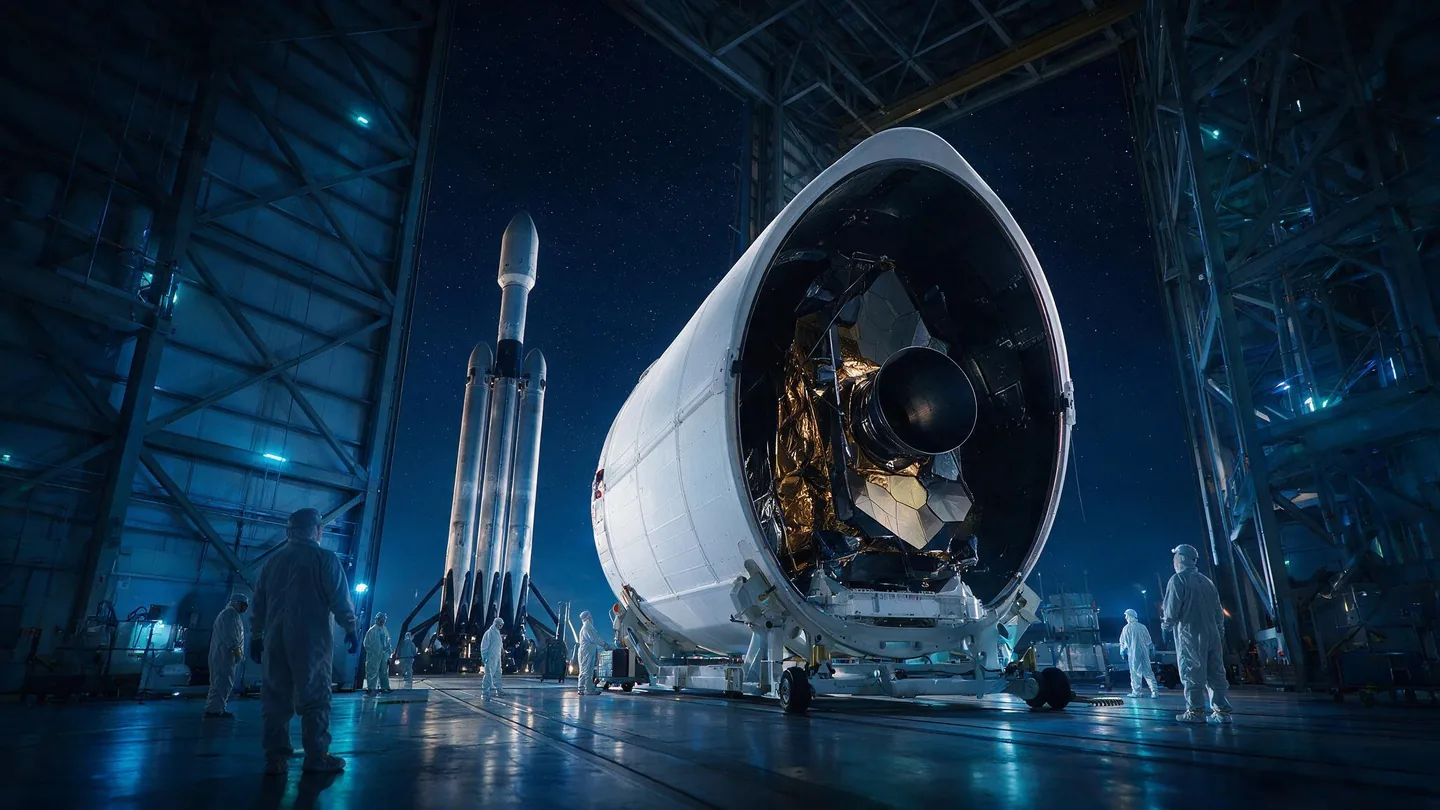
On August 25, NASA's Nancy Grace Roman Space Telescope, encapsulated in its payload fairing, was transported from the Payload Hazardous Servicing Facility to the SpaceX hangar at Launch Complex 39A at NASA's Kennedy Space Center, ahead of mating with a SpaceX Falcon Heavy rocket. This milestone marks the final stretch before the highly anticipated telescope reaches its launch window.
Mission Overview
The Roman Space Telescope is scheduled to lift off on August 30 aboard a SpaceX Falcon Heavy from Kennedy Space Center in Florida. This launch represents one of NASA's most significant science missions of the year. NASA completed its Flight Readiness Review on August 21, confirming that the mission team, launch vehicle, and spacecraft all meet launch requirements.
The telescope was enclosed in its payload fairing during transport to protect it from environmental conditions during transit and launch. Upon arrival at the SpaceX hangar, engineers will perform final mating operations to connect the telescope to the Falcon Heavy's upper stage.
Scientific Goals
The Roman Space Telescope is named after Nancy Grace Roman (1925–2018), NASA's first Chief of Astronomy and the driving force behind the Hubble Space Telescope's creation in the 1960s.
The telescope's core scientific objectives include:
- Wide-Field Survey: Equipped with the Wide Field Instrument (WFI), offering a field of view 100 times larger than Hubble's, enabling coverage of far greater sky area per exposure and potentially discovering tens of thousands of new exoplanets
- Dark Energy and Dark Matter Research: Studying the physics of the universe's accelerating expansion through supernova observations and gravitational lensing
- Exoplanet Census: Using microlensing techniques to search for Earth-like planets in the galactic bulge
Launch Services Partnership
This marks the second time SpaceX's Falcon Heavy has been selected for a high-priority NASA science mission. The Falcon Heavy, composed of three boosters, is one of the most powerful operational rockets. NASA's selection of a commercial launch provider for such missions reflects the growing role of commercial spaceflight in deep-space science.
After launch, the Roman telescope will be placed into an orbit near the Sun-Earth Lagrange Point 2 (L2), sharing the same orbital neighborhood as the James Webb Space Telescope. At L2, the telescope can face away from the Sun and Earth, obtaining a stable thermal environment for observations.
Hanxing Perspective
The Roman telescope launch is a key milestone on the 2026 global space launch calendar. The Falcon Heavy, currently the only operational commercial launch vehicle delivering large spacecraft to L2, will have its reliability validated once again. For the small-satellite industry, major science missions offer valuable lessons — commercial launch services are increasingly covering the full spectrum from low-Earth orbit to deep space. Hanxing continues to track global launch market diversification, matching Chinese small-satellite clients with launch solutions spanning from LEO constellation deployment to deep-space exploration.