
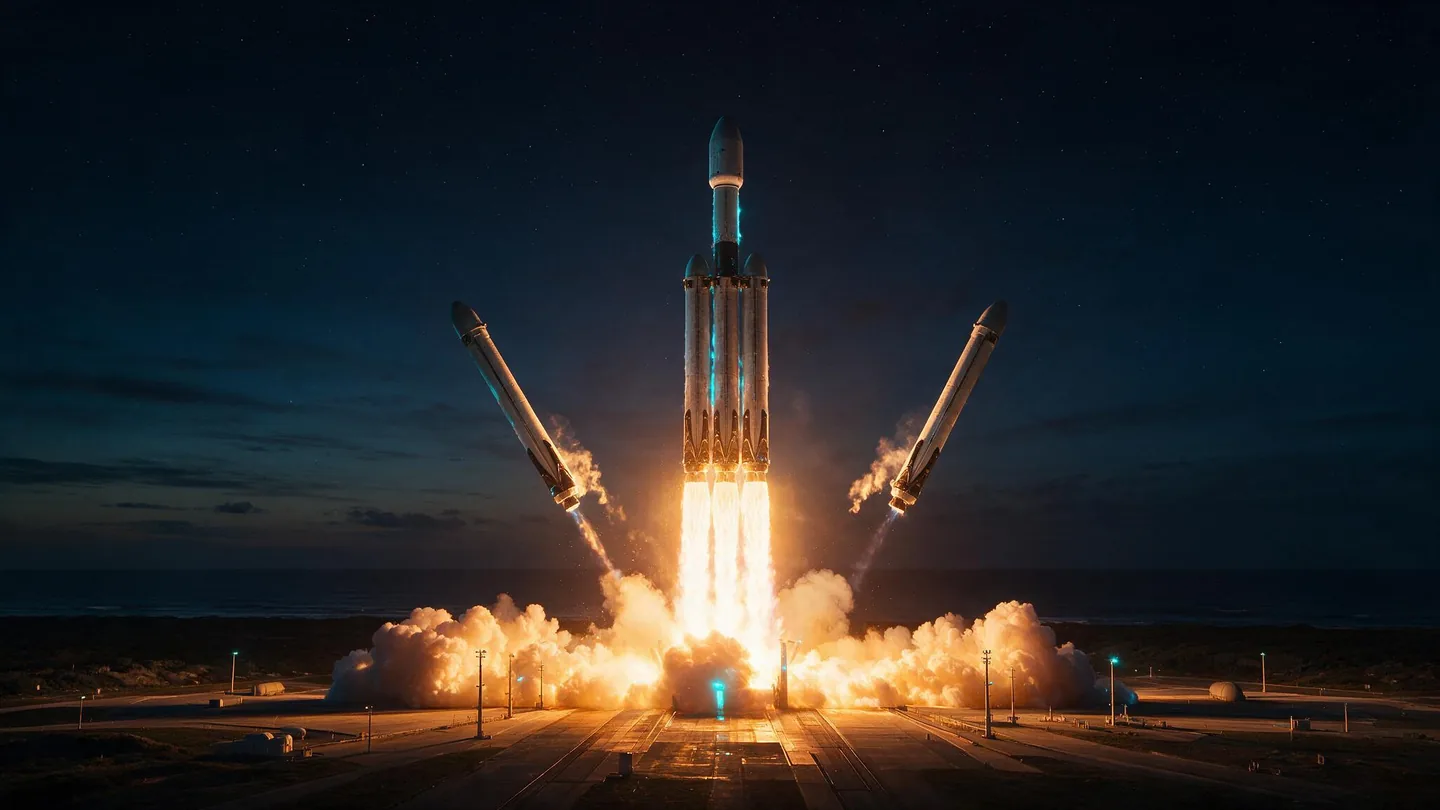
On the morning of August 30, NASA's Nancy Grace Roman Space Telescope lifted off from Launch Complex 39A at Kennedy Space Center in Florida. The launch vehicle was a SpaceX Falcon Heavy, which ignited its 27 Merlin engines at 7:26 a.m. EDT and carried the approximately $4.3 billion flagship observatory toward Sun-Earth Lagrange Point 2 (L2). This marks NASA's second astrophysics flagship mission launched this century, following the James Webb Space Telescope in 2021.
Launch Mission Details
The Falcon Heavy generated roughly 5 million pounds of thrust at liftoff. About two and a half minutes after launch, its two reusable side boosters separated and returned to landing zones at Cape Canaveral for recovery. The second stage deployed the Roman telescope approximately 31 minutes into the flight. The observatory will now spend roughly three months traveling to the L2 Lagrange point, about 1.5 million kilometers from Earth.
NASA launch director Denton Gibson noted that Roman is a large spacecraft requiring the full thrust of the Falcon Heavy, which performed flawlessly. SpaceX confirmed the two side boosters had previously flown the GOES-U and Viasat-3 F3 missions, marking their first and third flights respectively.
Ground controllers acquired telemetry within seven minutes of liftoff. The solar panels and lower instrument sun shade deployed successfully about 83 minutes after launch, and the spacecraft transitioned from near-Earth tracking networks to NASA's Deep Space Network approximately 70 minutes into the mission.
Telescope Technical Highlights
Named after NASA's first chief astronomer, Nancy Grace Roman — widely regarded as the "mother of Hubble" — the telescope carries a 2.4-meter primary mirror identical in size to Hubble's. Notably, this mirror was originally manufactured by the U.S. National Reconnaissance Office (NRO) for a spy satellite program and was transferred to NASA in 2012, then reconfigured for deep-space astronomy.
The telescope's primary payload is the Wide Field Instrument, a 300-megapixel near-infrared camera capable of capturing a single image covering a swath of sky larger than the full Moon. NASA Science Mission Directorate head Nicky Fox called Roman the "Swiss Army knife of telescopes," noting its field of view is 100 times wider than Hubble's and its survey speed roughly 1,000 times faster — what Hubble accomplishes in a month, Roman can do in under an hour.
A second instrument, the coronagraph, blocks starlight to directly image exoplanets. Its self-flexing mirrors can adjust their optical prescription in flight, making it 100 to 1,000 times more sensitive than coronagraphs on Webb or Hubble.
Science Objectives
Roman's primary science goals include:
- Dark energy and dark matter: By observing thousands of supernovae and the distribution of billions of galaxies, Roman will precisely measure the Universe's expansion rate and test whether the current Standard Model of cosmology holds
- Exoplanet census: Expected to discover tens of thousands of new planets, including direct imaging studies of giant planet atmospheres
- Cosmic survey: Roman's main survey will cover about 12 percent of the sky, producing the largest astronomical image ever — NASA estimates it would take over half a million 4K TVs to display a single frame
- Data output: Approximately 1.4 terabytes of data per day during operations, the highest data rate of any NASA astrophysics mission
Industry Context
Roman's launch is not only a scientific milestone but also another significant commercial mission for SpaceX's Falcon Heavy, currently one of the most powerful operational launch vehicles in the Western world. NASA Administrator Jared Isaacman stated post-launch that Roman was "delivered ahead of schedule and on budget," representing the kind of success story NASA wants to see across the agency.
Notably, the observatory transitioned to NASA's Deep Space Network about 70 minutes after liftoff. The DSN had just inaugurated its brand-new DSS-23 antenna at the Goldstone complex in California on August 25, providing enhanced communications support for deep-space missions like Roman.
Hanxing Observation
As a global full-chain service provider for small satellite launches from China, Hanxing closely follows every major development in international spaceflight. Roman's successful launch once again demonstrates the irreplaceable role of heavy-lift launch vehicles in cutting-edge science missions — from deep-space exploration to astronomical observation, high-capacity rockets are the key that unlocks the cosmos. Hanxing will continue monitoring global launch capacity supply and demand, matching clients with optimal launch solutions, and helping more spacecraft explore the vast universe.