
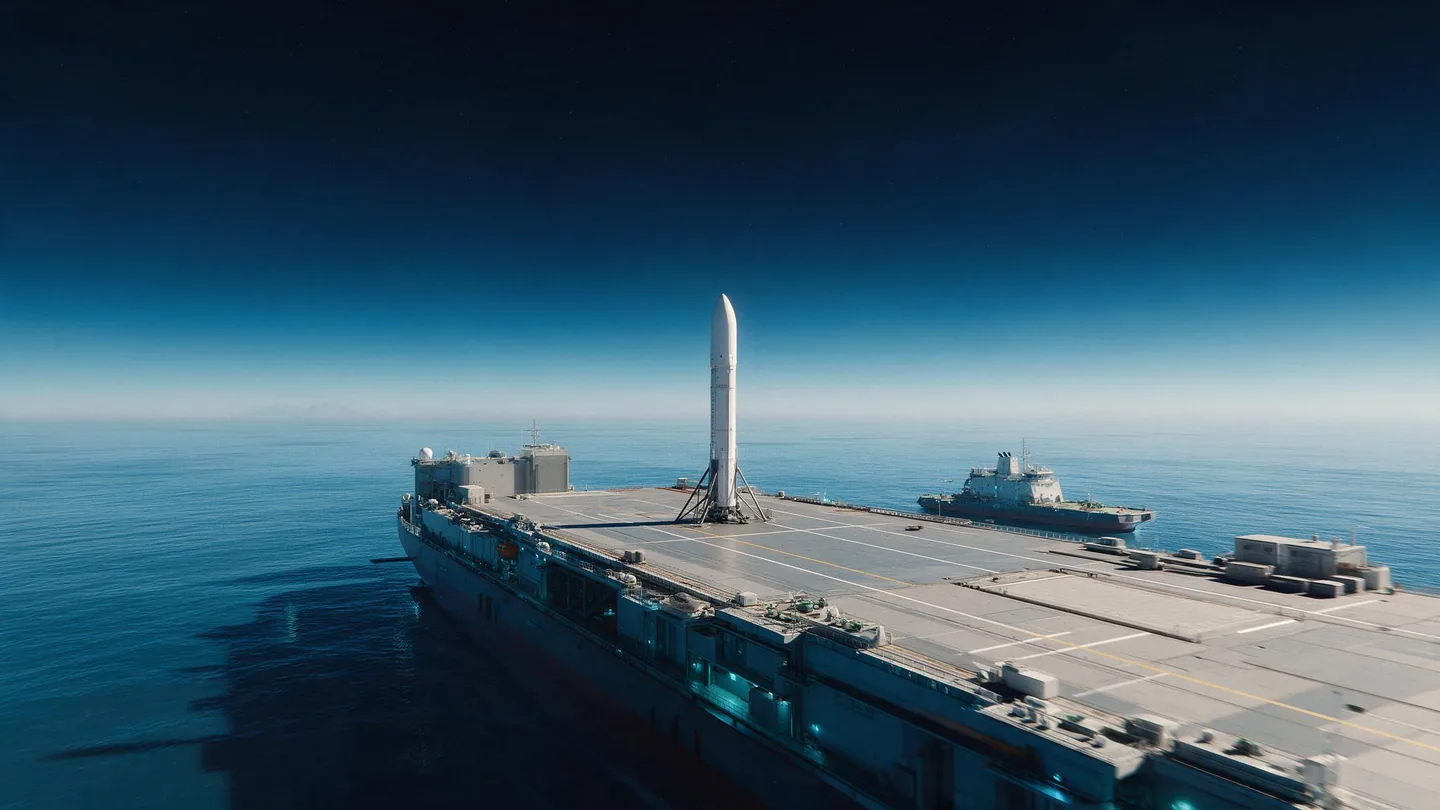
The Ceres-1 sea-launch variant (Y8) is scheduled to lift off around 11:30 local time on Oct. 21 from the launch ship Dongfang Aerospace Port, operating in waters off Rizhao in Shandong province. The mission carries a single payload, the Xiguang-4 01 remote sensing satellite built by Xi'an Zhongke Xiguang Technology, which serves global users with high spatial, temporal and spectral resolution Earth observation data.
If it goes on schedule, this will be Rizhao's eighth offshore launch support mission and the seventh sea flight of the Ceres-1 sea variant since its debut on Sept. 5, 2023.
A number worth noting: 50
To date, the Ceres-1 and Smart Dragon-3 vehicles have flown seven offshore missions from Rizhao, placing 50 satellites into their intended orbits. The figure is not dramatic in itself, but behind it sits a complete offshore launch chain: factory integration, land-sea transfer, at-sea erection, dynamic-base alignment, launch execution and drop-zone support.
At the first sea launch in September 2023, that chain still felt experimental — the ship, the platform and the crew were assembled for a single mission. By the eighth, it has begun to resemble a scheduled service: rockets roll out of the Haiyang assembly base, board the ship and head for a sea area whose launch point, drop zones and tracking resources can be planned in advance.
A command brain onshore
This mission is the first to use a "land-based command, sea-based launch" model, with the command hub at the Shandong Sea Commercial Launch Rizhao Command and Control Center — the city's first land-based rocket launch command facility — which is about to enter service.
Equipped for scheduling, display, satellite communications and wide-area links, the centre relays real-time data from the launch platform and rocket to shore. It handles pre-launch checks, the countdown sequence, the ignition command and monitoring of the ascent phase from liftoff to orbit insertion.
Previously, offshore command relied mainly on the sea platform or remote tracking assets. Moving that function to a local shore facility yields two direct gains: more efficient launch organization and better emergency response, because the decision chain no longer has to cross a stretch of ocean.
For satellite customers neither point is abstract. Whether a window opens on time and whether an anomaly can be handled quickly bear directly on how credible a mission schedule is.
Single-payload and multi-payload are two different businesses
This mission carries one satellite. That is less spectacular than "18 satellites on one rocket," but the two serve entirely different customer needs.
Multi-payload launches address batch insertion cost — the right fit for constellation operators in dense deployment, focused on cost per satellite and time to complete the constellation.
Single-payload launches address dedicated orbit and controllable timing — the right fit for a single high-value remote sensing spacecraft, a technology demonstrator, or a mission with tight requirements on inclination and local time of descending node. These customers are not pooling to save money; they need the whole vehicle at their disposal: their orbit, their window, their separation sequence.
The real complexity of the smallsat market is exactly here: customers are not one group but two or three overlapping ones. Only a provider that can supply both rideshare and dedicated service can cover the long tail.
Where the long-term value of sea launch lies
The core advantage of sea launch was never cheapness. It is flexibility.
First, launch point flexibility. A ship can reposition to match different inclinations without being constrained by the azimuth limits of a fixed pad. Second, drop-zone flexibility. Splashdown areas sit over water, far from populated regions, sharply reducing safety coordination costs and making schedules easier to secure. Third, low infrastructure thresholds. Extending capacity needs a ship and a platform, not a new land-based complex.
Combined, these change one fundamental thing: launch shifts from a scarce resource to a purchasable service. Once windows can be planned ahead and bought on demand, satellite companies can accelerate verification and iteration.
Hanxing view
Rizhao's eighth offshore mission matters less as one more sea launch than as evidence that the operating model has reached the point of supporting an eighth run. Repeatable means predictable, and predictable is what customers can write into their build and delivery plans. For smallsat customers at home and abroad, the questions that actually matter when choosing a launch are whether a site has flown often enough, whether the process has been validated and whether a window can be locked — not the single number on a payload capacity chart. Hanxing — your China launch advisory for small satellites worldwide — tracks the support capabilities of Chinese launch sites and vehicles, and provides end-to-end China launch solutions covering launch consulting, orbit and site matching and mission execution, so smallsat constellations find a more dependable footing in both time and space.