
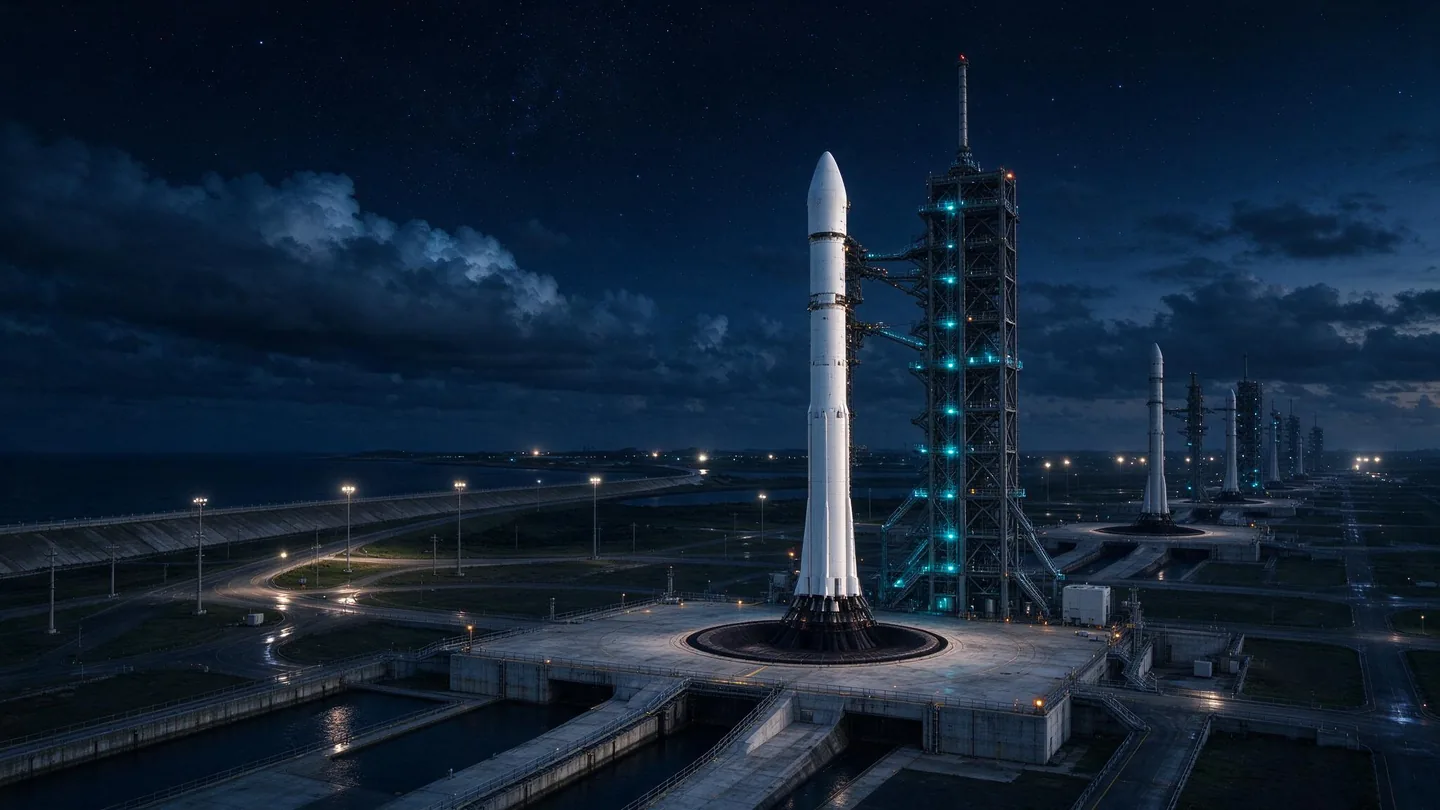
"Launch is tight" has been an industry refrain for years. This time there are numbers. A new report from analytics firm Quilty Space estimates a shortfall of roughly 150 medium- and heavy-lift launches outside China between now and 2030, well below what satellite operators and civil space agencies want to fly. Add the U.S. military's expanded demand, and — if SpaceX does not extend Falcon 9 and Falcon Heavy service — the gap could roughly double.
Caleb Henry, Quilty's director of research, is blunt: the crisis is worse than expected, will not disappear this decade, and may not ease until the late 2030s. His advice to customers is a single sentence: "If you haven't booked your launch already, and you need one, you're late."
How the gap formed
The report stacks several simultaneous shifts. Russian rockets have effectively left the Western commercial market since the war in Ukraine. Amazon Leo's thousand-satellite constellation is locking up heavy-lift slots. A generation of new rockets — New Glenn, Vulcan, Neutron, Terran R, Nova — has slipped well behind planned cadence. And most consequentially, Falcon 9 is being retired as a commercial launch product, with SpaceX redirecting the most prolific rocket in history toward its own constellation and government missions.
Supply is contracting while demand soars, from megaconstellations at one end to a wave of funded small satellite startups at the other. Quilty's model puts the crunch at its worst in 2028, with slow improvement afterward.
Can Starship close it? Check the fairing
In theory Starship's capacity and reusability could flip the picture. But the report flags a structural problem: SpaceX has stopped affirming Starship as a commercial launcher, and there is no evidence it is developing a conventional payload fairing door for traditional satellites.
The vehicle currently uses a narrow, Starlink-optimized door that ejects satellites like a PEZ dispenser. For a conventional spacecraft, that means either designing the satellite to fit the dispenser or not flying at all.
Telesat president and CEO Dan Goldberg offered a telling answer on an earnings call when asked which rocket the company's future satellites might use: SpaceX will prioritize its own constellation first, then the U.S. government, and only if Telesat's next-generation satellites are configured to fit that dispenser does it expect Starship to be available.
New Glenn and the military wild cards
A second mitigating factor is Blue Origin's New Glenn cadence. Quilty adopted a conservative forecast — eight launches in 2028, 12 in 2029, 16 in 2030 — with Henry admitting he would be happy to be proven wrong. Blue Origin is building capacity for up to 150 upper stages annually; at high rate, the math changes entirely.
The final wild card is the U.S. military. National security launch currently runs two lanes: Lane 1 for higher-risk missions open to any rocket that has reached orbit at least once, including Falcon, New Glenn and ULA's Vulcan; Lane 2 reserved for SpaceX and ULA. This year the Space Force sharply raised forecast demand — Lane 1 from an estimated 30 to 60 launches to about 170, and Lane 2 from 54 to 79, ordered between 2025 and 2029.
Quilty excluded that surge from its shortfall math, on the belief that the U.S. government will compel SpaceX to fly missions it deems national priorities — SpaceX is already building a non-trivial share of those satellites, including a space-based moving-target-indicator constellation.
Industry impact
The report's value is converting launch anxiety into a comparable supply-and-demand ledger. For operators, the lessons are earlier bookings, longer contracts and more credible backups. For launch providers, the implication is that reliable capacity is itself a scarce asset.
Hanxing view
Note the qualifier: the shortfall is measured outside China. While Western capacity is squeezed toward a 2028 trough by constellation and military demand, China's Long March family and a new cohort of private liquid rockets keep adding supply to the market — including the 5,150 kilograms of Long March piggyback margin opening this month and multiple private vehicles reaching first flight and serial production. Hanxing — your China launch services advisor for small satellites worldwide — connects overseas customers to that path: orbit and envelope matching, rideshare versus dedicated-payload trade-offs, interface coordination and launch consulting, so that small satellite operators facing a tight market can find a more predictable China launch solution. For constellation builders, one more available market is one more chance to get to orbit on schedule.