
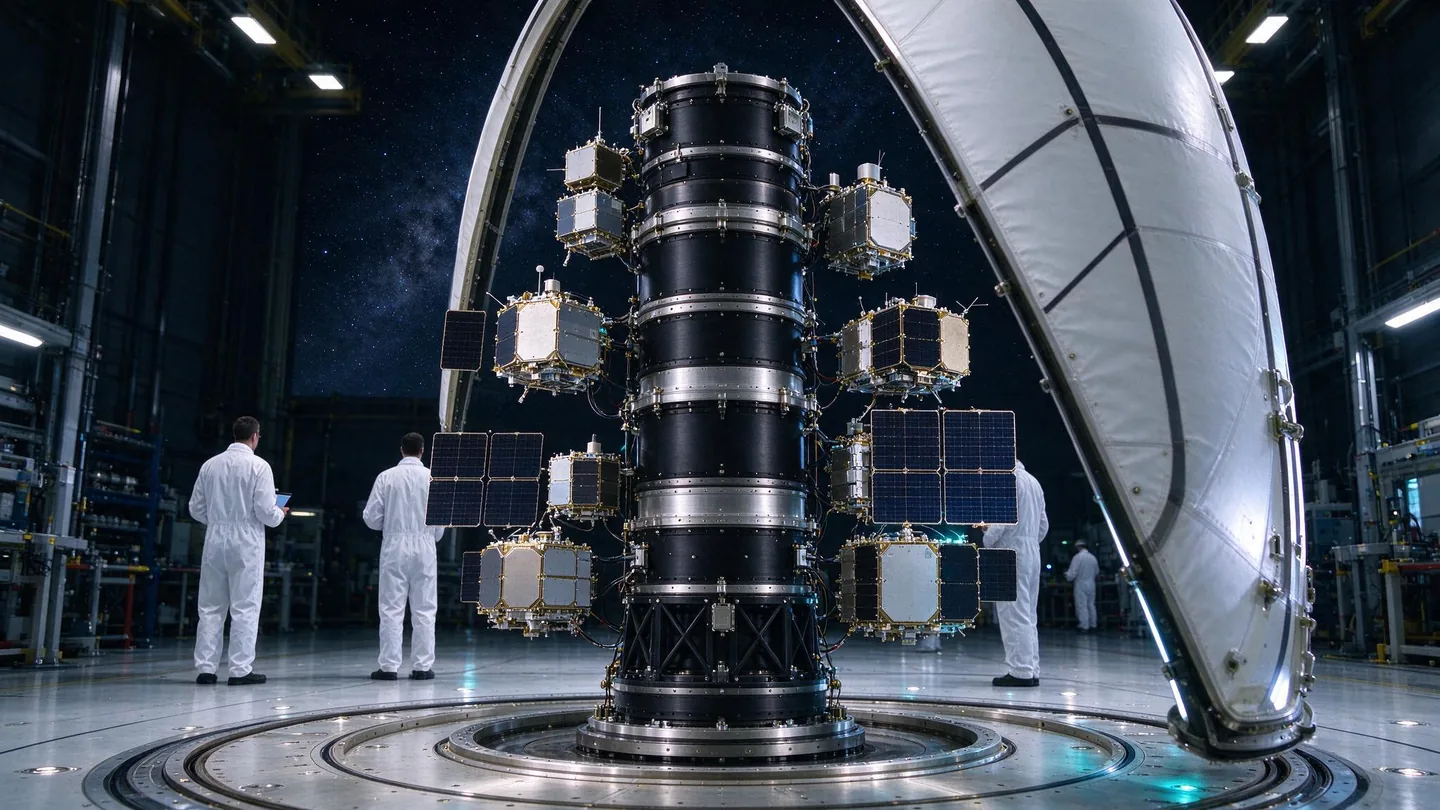
For Chinese commercial launch providers, flying overseas payloads is no longer a promise on paper. At 12:03 on 10 December 2025, CAS Space's Kinetica-1 Y11 carried nine satellites from the Dongfeng commercial space zone, three of them for customers in the UAE, Egypt and Nepal — all flying rideshare. The same vehicle family had by then delivered 84 satellites to orbit with more than 11 tonnes of payload mass.
For an overseas operator with one or two smallsats, a limited budget and no familiarity with Chinese licensing, the hard question is not whether it can fly — it is which contract gets it there. Here is the comparison.
Rideshare: cheapest, but you accept someone else's schedule
Rideshare is the usual entry point. Several customers' satellites share one fairing, with costs split by payload mass or slot, coordinated by the primary customer or the launch provider.
What has actually happened: on that Kinetica-1 mission, three international customer satellites flew alongside six domestic ones for urban planning, disaster reduction and hydrometeorology. The provider's own framing — launch capacity, standardised vehicle-payload interfaces and operational flexibility — translates to interfaces good enough that differently shaped customers can share a fairing.
Three things you accept:
- The window belongs to the primary mission, not to you. Your satellite must clear design, testing and paperwork by someone else's date;
- Separation order is constrained. In multi-customer missions, mounting position, separation sequence and flight programme are designed together to avoid interference; the later you separate, the more orbital dispersion you absorb;
- Delay consequences can be transferred but not removed. SpaceX has published one approach on its rideshare product: if a customer's payload slips, paid funds can be rebooked onto a later mission with a rebooking fee. No comparable public clause exists on the Chinese side yet, so it has to be negotiated line by line.
Best for: one or two satellites in the tens-to-hundreds of kilograms, with schedule float of three months or more, where first flight heritage matters more than precise orbit placement.
Dedicated: you are buying certainty
A dedicated contract reserves a whole vehicle's capacity, or a full fairing section, with orbit, inclination, window and separation sequence defined by the customer. It costs far more, and what you buy is the right to decide when that rocket flies.
Why overseas customers choose it: first batches of a constellation, Sun-synchronous orbits requiring a specific right ascension of the ascending node, and replenishment missions that must hold a phase relationship with existing planes. Rideshare makes those subordinate to others; dedicated does not.
The cost: reserving a medium-lift vehicle runs tens of times a rideshare slot. On Chinese public figures the quoted range varies widely — one industry outlet cites roughly USD 5,000–8,000 per kilogram, while an engineer interviewed by Yicai put some commercial vehicles' launch cost at RMB 50,000–60,000 per kilogram (about USD 7,000–8,500). For comparison, SpaceX's Falcon 9 rideshare has fallen to roughly USD 1,500–3,000 per kilogram.
That gap carries an important point: Chinese vehicles currently compete on window flexibility, dedicated customisation and supply that is not entangled in US export controls — not on headline unit price. A selection decision built only on a price table will reach the wrong conclusion.
Best for: constellation batch deployment, hard requirements on orbital plane accuracy, budgets that can absorb dedicated capacity, and customers who need a launch date written into their own programme milestones.
In-orbit delivery: buy the satellite, the launch and the ground segment together
The third model is known in China as whole-satellite export plus in-orbit delivery. The customer is not buying a launch; it is buying a chain — satellite development, launch, TT&C and in-orbit acceptance — with title transferring in orbit.
This model has a long record. NigeriaSat-1 was the first commercial in-orbit delivery project won by China Great Wall Industry Corporation through international open tender in 2004, and the first export of the DFH-4 platform; it launched on a Long March 3B from Xichang on 14 May 2007 and was delivered in orbit on 6 July. Venezuela's Venesat-1 followed in October 2008, China's first whole-satellite export and in-orbit delivery to Latin America. Laos, Bolivia, Belarus, Indonesia and Pakistan have taken similar paths.
The key difference: liability extends to the satellite working in orbit, not merely to payload separation. The contractor carries the spacecraft risk; for the buyer this means the lowest technical barrier and the narrowest choice — bus, model and schedule are all led by the contractor.
Best for: states or institutions without satellite development capability that want an operating system delivered in one purchase, rather than operators that already own their spacecraft.
Licensing: two lists, filed nine months before the launch month
Whichever model you choose, Chinese civil launches pass through a licensing gate. Under the Interim Measures for the Administration of Licences for Civil Space Launch Projects (Order No. 12 of the Commission of Science, Technology and Industry for National Defence, 2002, still in force), civil launch projects are subject to licence administration; the project's prime contractor is the licence applicant, and the application must be filed nine months before the intended launch month.
Two items in the filing list matter especially for overseas customers:
- Foreign-related projects must additionally submit policy assessment and confidentiality/security assessment material;
- Projects executed at a launch site outside China must submit legally valid copies of the vehicle and satellite orbital parameters, plus copies of frequency authorisation.
In practice the customer faces two lists: the launch licence, held by the prime contractor, and the satellite export / dual-use item authorisation, determined by the customer's own jurisdiction and China's export-control rules. The second is usually slower — long dual-use approval cycles in aerospace are a widely acknowledged industry pain point.
A further hard constraint comes from the other direction: the United States has long restricted satellites containing US technology from launching on Chinese vehicles and caps the share of US-origin components in Chinese satellites (a commonly cited figure is 25 percent). A satellite's supply chain decides, before any pricing discussion, whether it can fly on a Chinese rocket. Ask this at the enquiry stage, not after signing.
Insurance and liability: three contracts, three risk landing points
| Model | Who carries launch-failure risk | Delivery point | Typical dispute | |---|---|---|---| | Rideshare | Usually each customer's own launch insurance; provider liability limited by contract | Payload separation | Whose fault when orbit accuracy falls short after separation | | Dedicated | Negotiable per mission; often provider liability to orbit insertion | Orbit insertion | Liquidated damages and re-manifesting when the window slips | | In-orbit delivery | Contractor, through in-orbit acceptance | In-orbit delivery (ITO) | Splitting spacecraft faults from launch faults |
There is no industry-wide standard for risk allocation. Third-party liability and launch-failure premiums and deductibles are priced mission by mission. The only reliable advice: do not reuse another customer's contract template — rewrite the liability clauses around your satellite's value and your programme milestones.
A workable selection sequence
Compressed into decision order:
- Check supply-chain compliance first. Does the satellite contain US-controlled components, and is the proportion over the limit? If not compliant, nothing else matters.
- Then define orbital accuracy needs. Precise RAAN and phase relationships → dedicated; dispersion acceptable → rideshare.
- Then check schedule float. Three months or more of slack → rideshare; milestones fixed in contract → dedicated, with liquidated damages negotiated in.
- Then reconcile the licensing timeline. Is there more than nine months from today to launch? If not, riding an existing mission's licence rhythm via rideshare is the realistic route.
- Price last. Compare marginal cost per kilogram between rideshare and dedicated — do not benchmark Chinese vehicles against a published Falcon 9 price that excludes your integration, TT&C and compliance costs.
Hanxing view
None of these three routes is better; they only match or fail to match. Rideshare gives a startup its first flight heritage, dedicated gives a constellation a controllable orbital plane, in-orbit delivery gives a buyer without spacecraft capability an operating system. The professional work is explaining those differences before the customer has decided what it actually needs.
Hanxing — the global smallsat China launch service advisor — does exactly that selection step: verify supply-chain compliance and the licensing timeline first, then compare rideshare windows, dedicated schedules and delivery liability line by line, and only then quote a price and a milestone plan. For an overseas smallsat operator, a China launch solution is not a number — it is a path designed to survive contract drafting. Launch consulting, constellation planning and China launch solutions all start from this comparison table.