
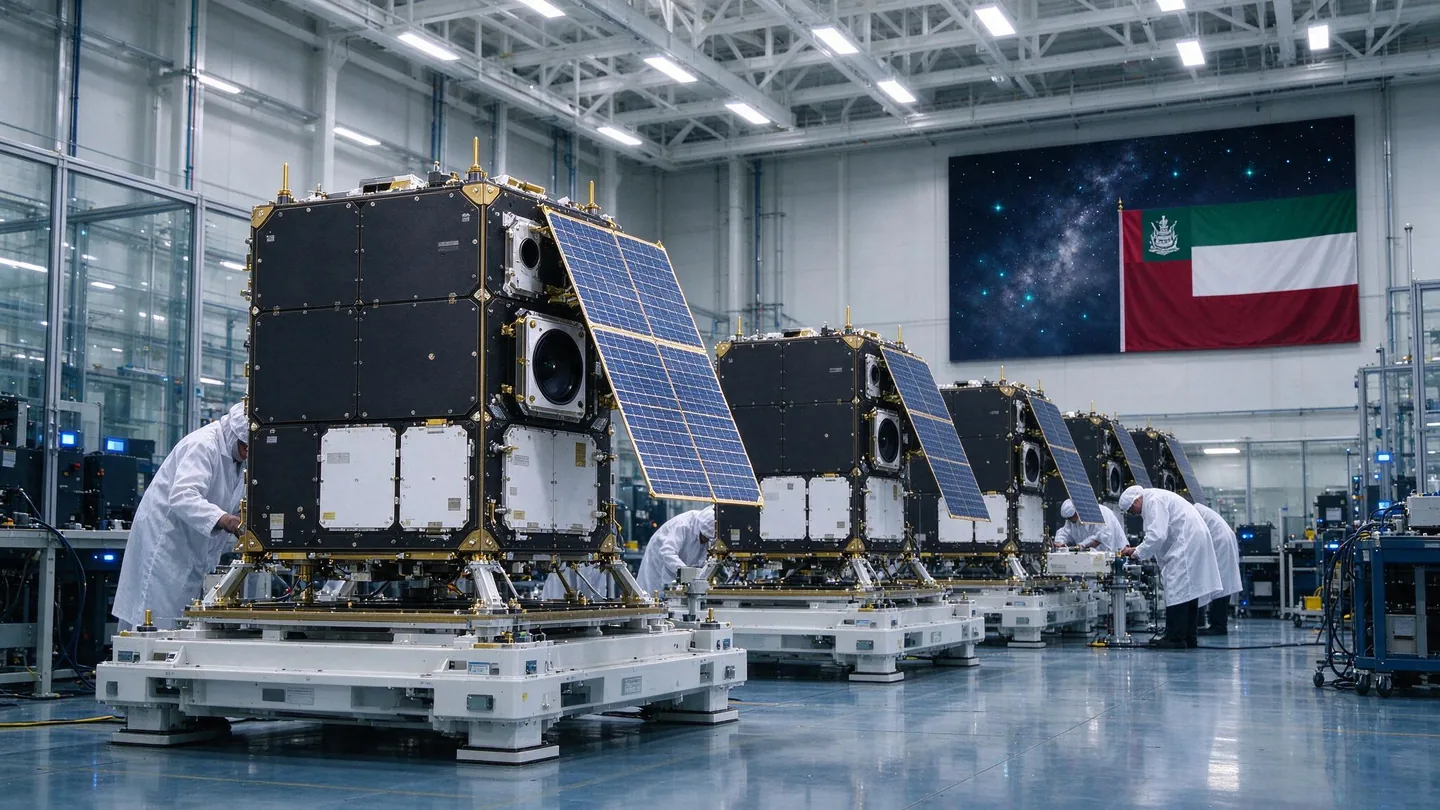
On Nov. 2, in a signing ceremony in Beijing witnessed by Sultan Haitham bin Tariq Al Said of Oman, STAR.VISION Aerospace signed a space-AI agreement with Oman Lens. The subject of the deal is not a single satellite but an entire capability chain: the two companies will jointly build, launch and operate the first 20 spacecraft of the Oman Lens constellation, while developing a satellite assembly, integration and testing (AIT) center in Oman, training 1,000 Omani professionals and establishing the Middle East's first joint space-AI laboratory.
STAR.VISION describes it as the first full-constellation export agreement signed by a Chinese commercial space company, and Chinese media have called it the largest single commercial satellite export project to date. The contract value has not been disclosed, and the "largest ever" framing remains a company and media characterization.
The unit of delivery has changed
Placed on the timeline of Chinese satellite exports, the shift is structural. For nearly two decades, Chinese whole-satellite exports meant one large geostationary communications spacecraft delivered in orbit under a project contract — beginning with NigComSat-1, launched from Xichang in 2007, and followed by orders from Venezuela, Bolivia, Algeria and Ethiopia.
This deal is different. The buyer receives 20 low-orbit AI imaging satellites, a domestic AIT center, a training program covering 1,000 people and a joint laboratory, with operating rights and data ownership held by Oman while STAR.VISION supplies support across manufacturing, launch and operations.
For the buyer, the purchase is no longer a product but a continuously supplied service capability. For the seller, revenue shifts from a one-off delivery to layered streams: spacecraft manufacturing, facility construction, multi-year training and follow-on data services.
Trust built from OL-1 to the "Oman Twins"
The order did not appear from nowhere. In November 2024, a STAR.VISION-built satellite designated OL-1 reached orbit as Oman's first AI satellite, establishing the working relationship. In October 2026, the two companies jointly unveiled the "Oman Twins" at the 77th International Astronautical Congress; those two spacecraft are the first of the batch covered by the new agreement.
According to the company, the twins are built around a "model-as-payload" concept: a scientific foundation model supports autonomous spacecraft control, coordinated observation and on-orbit data fusion, while long-horizon reasoning on board allows the satellite to adapt to its environment and re-plan its own tasks. Chinese reports say the first two Oman Lens satellites are planned for launch by the end of this year, carrying high-resolution panchromatic and multispectral payloads developed jointly by companies from both countries.
Who will launch the 20 satellites
The agreement does not lock in a launch provider. English-language space outlet china-in-space reported that the 20 satellites will be produced in China and launched on a "to-be-confirmed" launch vehicle. That open slot is precisely where launch-services opportunity sits.
Deploying 20 small remote-sensing satellites is not a single-launch problem. The phasing of orbital planes determines revisit time, the cadence of batch launches determines when the constellation becomes usable, and launch windows must line up with ground stations in Oman, tracking arcs and spectrum coordination. For the customer, the hard part moves from buying a rocket to scheduling a four-to-five-year insertion plan.
That is where Chinese commercial launch has become strong. The Lijian-2 has already flown 18 satellites on a single mission for the Qianfan constellation; Long March 8A and Long March 12 rotate frequently through the Hainan commercial spaceport; and from November, Long March vehicles are releasing piggyback capacity in the thousands-of-kilograms range. Dedicated medium-lift missions, small-batch rideshares and constellation "train" launches now come with concrete price and schedule options.
What is still unresolved
Three cautions are worth keeping. First, a local AIT center is heavy engineering, typically measured in years from construction to a trained workforce. Second, cross-border satellite trade runs into export controls and orbital-slot coordination, variables no company controls. Third, operating a constellation implies multi-year tracking, ground-segment and data-distribution services, with longer payment cycles than single-satellite delivery — the opening project of Chinese whole-satellite export, NigComSat-1, has itself seen a dispute over unpaid service fees in recent years.
Hanxing view
For customers who can build satellites but cannot get them to orbit, the direct consequence of deals like this is that launch demand now arrives in constellation-sized blocks and multi-year schedules. Hanxing — the global small-satellite China launch services advisor — connects overseas smallsat customers with Chinese commercial launch capacity, providing launch advisory spanning orbital-plane design, batch-launch scheduling and combinations of dedicated and rideshare options. As more sovereign customers buy entire constellations in one package, the binding constraint for smallsat constellations shifts from technology to scheduling — and a mature China launch solution is exactly what shortens that most uncertain stretch.