
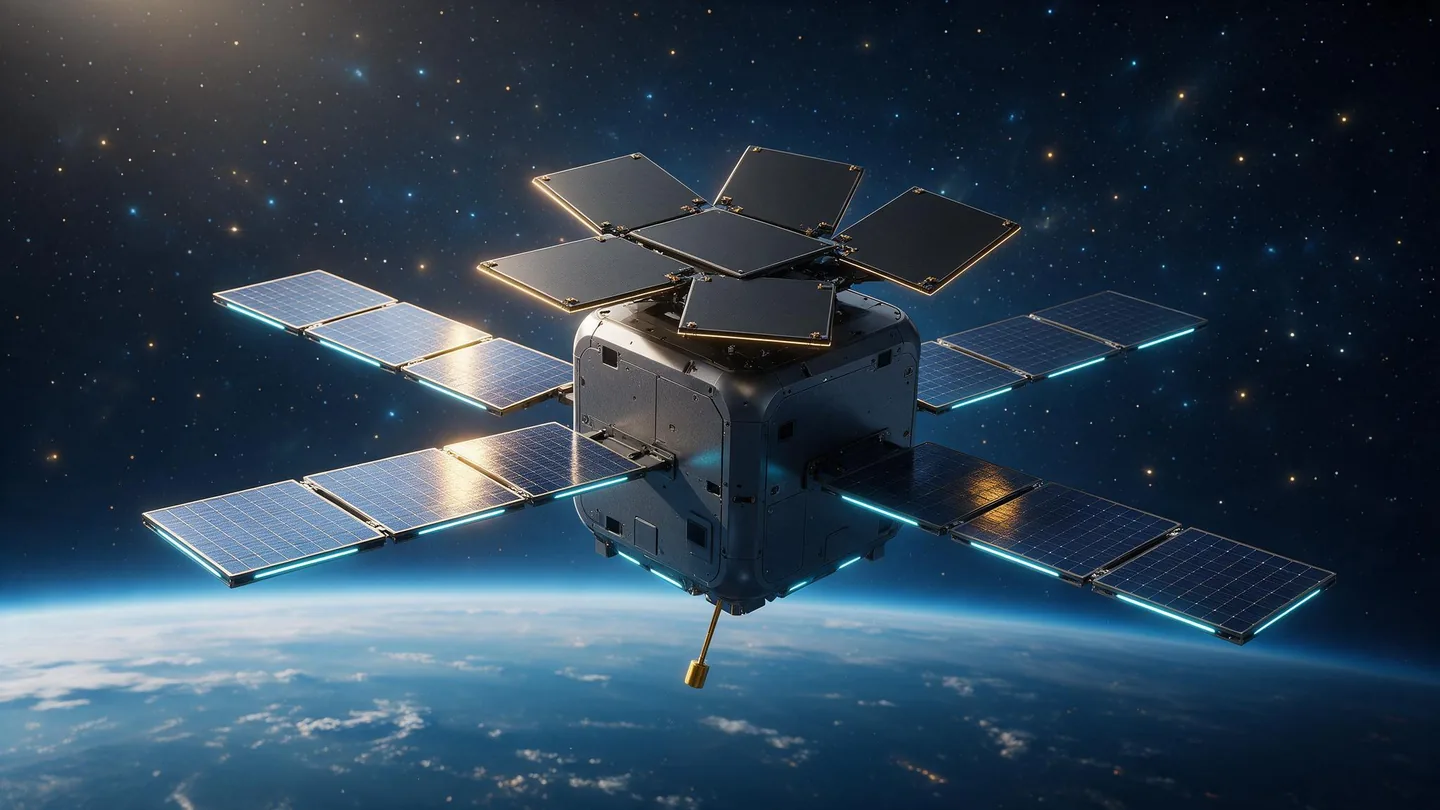
On September 17, NASA announced it had selected SpaceX to provide launch services for StarBurst, a small satellite that will ride to low Earth orbit on a Bandwagon rideshare mission. The Falcon 9 is set to lift off from Space Launch Complex 40 at Cape Canaveral Space Force Station in Florida no earlier than 2028.
A washing-machine-sized observatory
StarBurst weighs around 300 kilograms, but its science goal is heavyweight: catching short gamma-ray bursts produced when neutron stars merge, among the most violent releases of energy in the universe. Twelve caesium iodide scintillation detectors cover the 30 to 1,000 keV range, giving the spacecraft an effective area about five times larger than the Fermi Gamma-ray Burst Monitor and an unobstructed view of most of the sky from low Earth orbit. The team expects it to catch roughly ten neutron star mergers a year - events thought to forge most of the gold and platinum in the cosmos.
The mission is led by principal investigator Daniel Kocevski at NASA's Marshall Space Flight Center and sits within NASA's Astrophysics Pioneers Program, which backs lower-cost science on small platforms. The detector instrument was built by the U.S. Naval Research Laboratory. Its launch had originally been targeted for 2027; moving to no earlier than 2028 is a reminder that slips of a year or so are routine in small-satellite scheduling.
The contract matters as much as the spacecraft
Two details stand out for the wider industry. First, the award is a firm-fixed-price task order under NASA's VADR contract - Venture-Class Acquisition of Dedicated and Rideshare - an indefinite-delivery, indefinite-quantity vehicle with a 10-year ordering period and a total value of up to $1 billion, designed to let the agency buy launch services for small missions quickly. Second, StarBurst is not buying a dedicated rocket: it is buying a seat on a rideshare. For a 300-kilogram satellite without extreme orbit requirements, sharing a launch saves money and schedule - the most common arithmetic in the smallsat market today.
Hanxing's View
From NASA's VADR vehicle to the rideshare catalogues of commercial providers, buying a "seat to orbit" is becoming the default for small satellites. But rideshare is not plug-and-play: inclination, separation altitude, deployment sequence and liability all shape whether a spacecraft reaches its working orbit intact. What customers need is someone to close the gap between one satellite and one launch.
For international small-satellite operators seeking predictable cost, Chinese commercial rockets offer a practical alternative, with both multi-payload rideshare opportunities and dedicated missions. Hanxing - your China launch service advisor for small satellites worldwide - helps customers compare and select launch options, from rideshare compatibility assessment and orbit and schedule matching to full constellation deployment solutions and launch consulting, turning available capacity into a plan they can act on.