
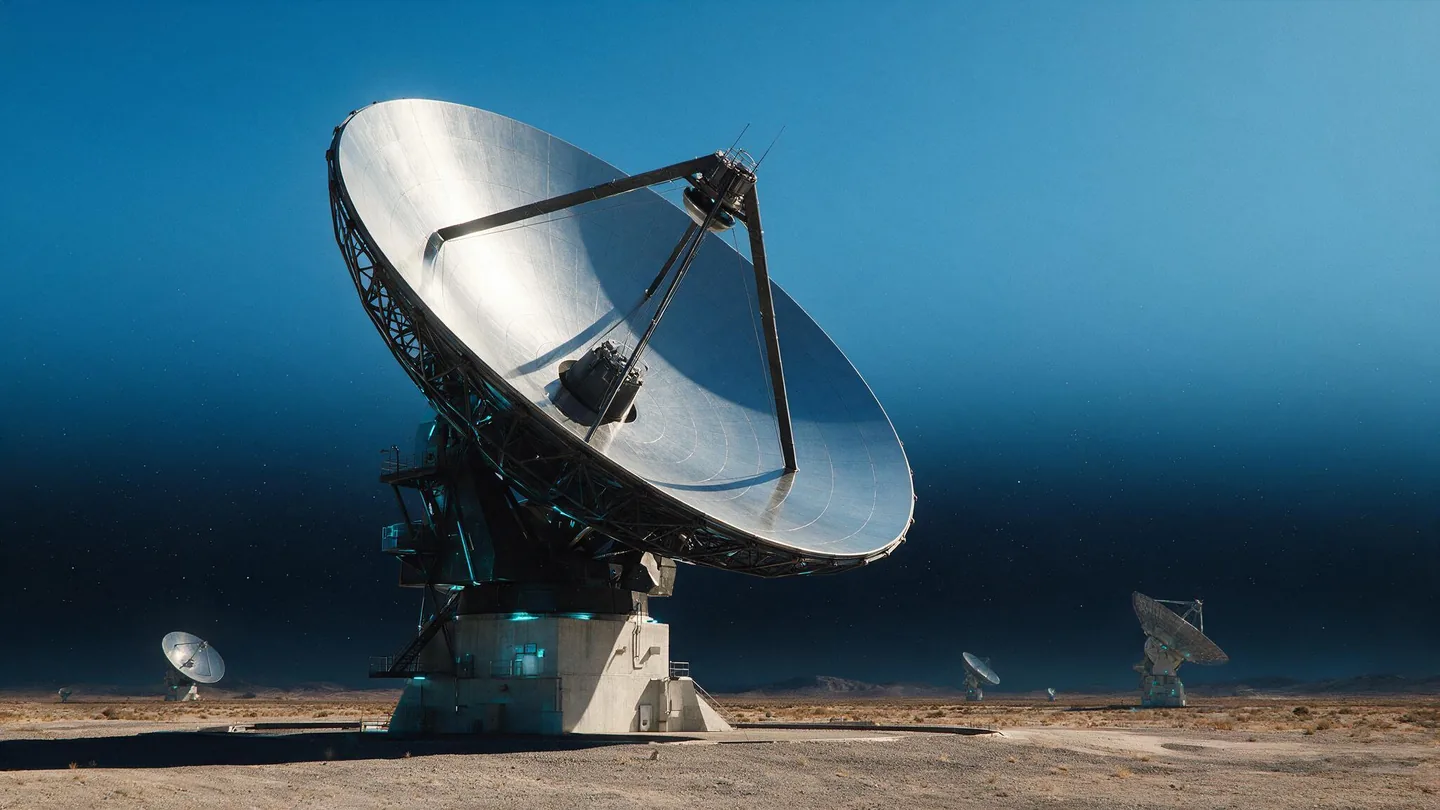
On August 25, NASA held a ribbon-cutting ceremony for the new Deep Space Station 23 (DSS-23) antenna at the Goldstone Deep Space Communications Complex in California's Mojave Desert. The 34-meter (114-foot) multifrequency beam-waveguide antenna is the latest addition to NASA's Deep Space Network (DSN) Aperture Enhancement Project, having entered formal operations on August 3 with its first tracking of NASA's Chandra X-ray Observatory.
New Antenna Technical Features
DSS-23 is located at the Goldstone complex near Barstow, California, managed by NASA's Jet Propulsion Laboratory (JPL). As a beam-waveguide antenna, it uses a precision mirror system to direct received radio frequency signals into an underground control room for amplification and processing — significantly reducing signal loss and simplifying maintenance compared to traditional antenna designs.
The antenna is multifrequency-capable, supporting S-band, X-band, and Ka-band communications simultaneously, allowing it to serve diverse deep-space missions operating across different frequency bands. James Kenyon, associate administrator of NASA's Research and Technology Mission Directorate, said at the inauguration: "By expanding the Deep Space Network, we are strengthening the communications foundation NASA needs for the bold missions ahead — from exploring more of the Moon than ever before to peering deeper into the solar system."
Global DSN Layout
NASA's Deep Space Network comprises three facilities spaced roughly 120 degrees apart in longitude around the globe:
- Goldstone, California, USA: The Northern Hemisphere hub in the Mojave Desert
- Canberra, Australia: Providing Southern Hemisphere coverage
- Madrid, Spain: Covering European and African regions
This arrangement ensures that at least one antenna always has line-of-sight to deep-space probes as Earth rotates. The DSN currently supports more than 40 spacecraft exploring the solar system and interstellar space.
DSS-23 is the latest product of the DSN Aperture Enhancement Project, initiated in 2009 to build six new 34-meter multifrequency beam-waveguide antennas. Since entering service, DSS-23 has already communicated with NASA's Mars Reconnaissance Orbiter (MRO), Psyche, Juno, and the Voyager 1 spacecraft — now beyond the solar system's boundary.
Growing Deep-Space Communication Demand
As deep-space mission numbers and data volumes surge, NASA's Deep Space Network has long faced oversubscription pressures. The addition of new antennas directly alleviates capacity bottlenecks. Notably, NASA's Roman Space Telescope, launched on August 30, transitioned to the Deep Space Network approximately 70 minutes after liftoff — underscoring the DSN's critical role across the full lifecycle from near-Earth to deep-space operations.
Industry Impact
Upgrades to deep-space communication infrastructure have far-reaching implications for the entire space industry. For satellite operators and mission planners, ground station availability and bandwidth directly determine the timeliness and integrity of mission data. DSN expansion not only serves government flagship missions but also provides more communication window options for international collaborative missions and commercial deep-space ventures.
Hanxing Observation
As a global full-chain service provider for small satellite launches from China, Hanxing understands the critical role communication infrastructure plays across the space industry value chain. From launch range instrumentation to in-orbit operations, ground networks are the lifeline between satellites and Earth. NASA's continuous DSN upgrades set a benchmark for the global space community, reminding us that small-satellite TT&C and data reception capabilities must develop in parallel. Hanxing will continue monitoring the evolution of global ground station networks to provide end-to-end launch-to-operation support for our clients' satellite missions.