
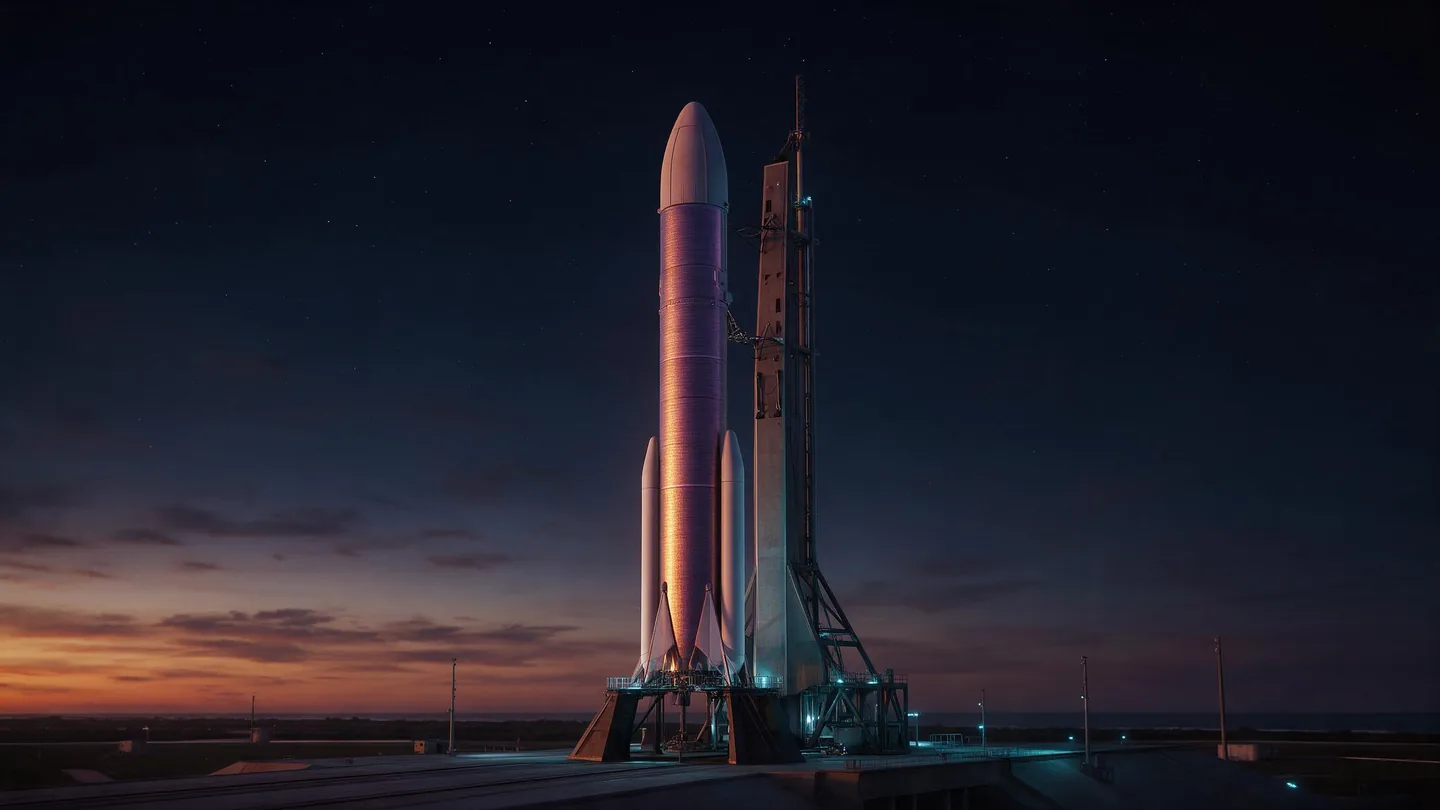
On September 9, 2026, NASA announced that it has added Relativity Space Terran R launch vehicle to its NASA Launch Services (NLS) II contract, making the 3D-printed reusable rocket eligible to compete for future NASA science mission launches.
Contract Details
The NLS II contracts are multiple-award, indefinite-delivery/indefinite-quantity (IDIQ) contracts with an ordering period through June 2030 and an overall period of performance through December 2032. The contracts include an annual on-ramp provision that allows new launch service providers to compete and lets existing contractors introduce new vehicles not previously on their contracts. Terran R was added through this on-ramp mechanism.
Notably, inclusion in the NLS II contract does not guarantee Relativity Space will receive launch orders — it simply establishes eligibility to bid. Even so, for a company that has yet to conduct Terran R first orbital flight, NASA contract qualification is a significant validation of its technical approach and engineering capability.
Terran R Specifications
Terran R is a two-stage, partially reusable medium-lift launch vehicle standing approximately 66 meters (216 ft) tall with a 5-meter (16 ft) diameter. Key performance metrics:
- LEO capacity (reusable mode): 23,500 kg
- LEO capacity (expendable mode): 33,500 kg
- GTO capacity (reusable mode): 5,500 kg
The first stage is powered by 13 Aeon R 3D-printed engines, each generating approximately 302,000 lbf of thrust; the upper stage uses a single Aeon V vacuum engine. Terran R is planned to launch from Launch Complex 16 at Cape Canaveral Space Force Station, Florida, with a maiden flight targeted for late 2026.
Commercial Progress and Infrastructure
Relativity Space has accelerated its commercial momentum. In November 2025, SES expanded its multi-launch agreement with Relativity, pushing Terran R commercial backlog to $2.9 billion. In June 2026, NASA established a public-private partnership with Relativity Space for a privately funded Mars science mission. The company has also secured up to $134 million in financing through Florida Spaceport Improvement Program to expand test and launch infrastructure at Kennedy Space Center and Cape Canaveral.
Impact on the Small-Satellite Launch Market
Terran R addition further enriches the medium-lift launch options available to NASA and commercial customers. With 23.5 tons to LEO, Terran R payload class approaches that of SpaceX Falcon 9 (approximately 22.8 tons), while its 3D-printing manufacturing process could significantly shorten production timelines and reduce costs. For customers needing batch deployment of small-satellite constellations, an additional reusable medium-lift rocket option means more competitive pricing going forward.
Hanxing Perspective
NASA inclusion of Terran R in the NLS II contract is the latest sign of the evolving global commercial launch market. With emerging reusable-rocket companies like Relativity Space and Stoke Space growing rapidly, and China Long March series and private rockets advancing in parallel, international small-satellite customers face an unprecedented range of launch options. As a global small-satellite China-launch service advisor, Hanxing closely tracks global launch-capacity developments. When evaluating launch solutions for clients, we assess international emerging rockets technical features and timelines while highlighting the unique advantages of Chinese commercial rockets in cost, reliability and launch-window availability — helping clients find the optimal small-satellite launch solution.