
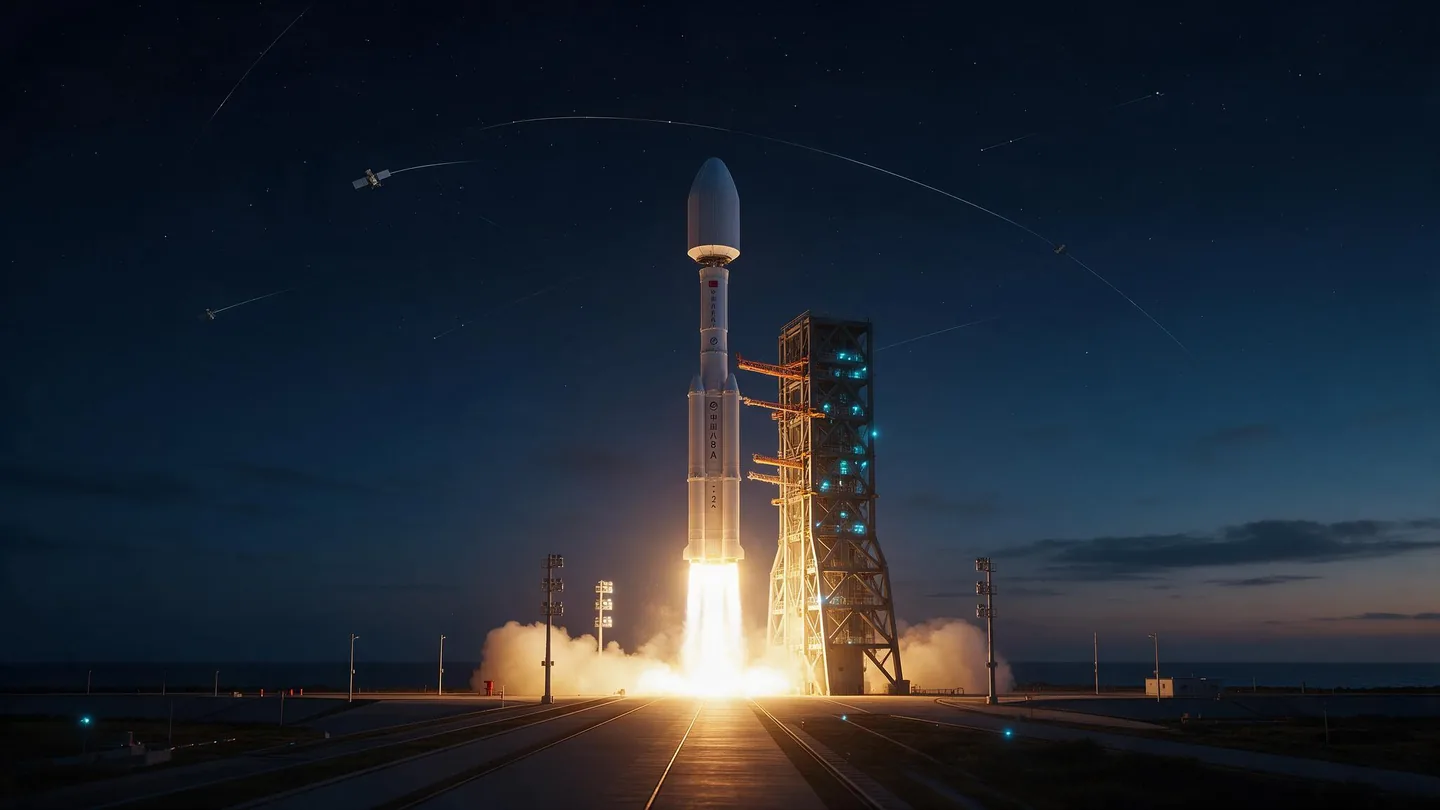
On February 11, 2025, the Long March 8A rocket made its maiden flight from the Wenchang launch site, delivering the Satellite Internet LEO-02 group into orbit. By August 2026, the vehicle had completed 10 launches with a 100% success rate, quietly becoming the core launch workhorse for China's low-Earth-orbit satellite internet constellation — and behind it, a fierce race for orbital and spectrum resources is accelerating.
Long March 8A: Built for Constellation Mega-Deployment
Developed by the China Academy of Launch Vehicle Technology, the Long March 8A upgrades the Long March 8's upper stage to a 3.35-meter common hydrogen-oxygen stage, with optional 4.2-meter or 5.2-meter fairings — the latter being the largest diameter fairing in the Long March family, providing greater payload volume.
The 700-kilometer sun-synchronous orbit capacity reaches 7 tonnes, a two-tonne leap over the base Long March 8. The larger fairing volume matters because flat-panel LEO broadband satellites are volume-limited: how many fit under the fairing determines deployment efficiency. On July 5, 2026, the rocket's ninth flight launched 20 Qianfan polar-orbit satellites in a single mission, validating batch deployment capability and theoretically cutting per-satellite launch cost by roughly 75% (actual savings are lower due to supporting overhead).
Launch cadence is equally critical. Hainan Commercial Space Launch Site's Pad 1 employs an improved "three-vertical" test-and-launch mode with "7-day launch, 7-day recovery" turnaround, enabling high-density launch operations. Modular design and batch production ensure sustained high-frequency deployment.
The Space Race: Orbital and Spectrum Deadlines
Near-Earth orbital slots and communication frequencies are finite resources. The International Telecommunication Union (ITU) applies "first file, first coordinate, first use" principles, with strict milestone deadlines: launch the first satellite within 7 years and operate it for 90 days, complete full deployment within 14 years, or face spectrum reduction or loss of protection.
Competition is intense. Foreign constellations already have over 10,000 satellites in orbit, occupying prime orbital slots and frequency bands. China's national SatNet and Qianfan constellations each plan tens of thousands of satellites, with over 200,000 satellite filings submitted to the ITU. Paper filings must convert to actual in-orbit assets, or the rights expire. Moreover, LEO satellites last only 5 to 7 years, requiring continuous replacement launches — a permanent demand on launch capacity and frequency.
The Commercial Loop: Beyond Home Broadband
Terrestrial 5G and fiber networks are mature, making consumer home broadband a difficult profit path for LEO satellite internet. The real growth lies in areas ground networks cannot reach.
Maritime and aviation: Ocean-going vessels, transoceanic flights and offshore platforms are core customers. Traditional geostationary satellites impose hundreds of milliseconds of latency at high cost; LEO satellites achieve roughly 50ms latency, ideal for enterprise dedicated lines and data services.
Emergency and disaster response: When earthquakes or floods destroy ground infrastructure, LEO satellites maintain emergency communications and image backhaul. During 2025 flood season, China Telecom's satellite service served 180,000 users across key flood regions, averaging 32,000 calls per day.
Emerging infrastructure: Low-altitude economy drone and eVTOL traffic management, agricultural and forest fire monitoring, remote mining and pipeline IoT inspection — all demand ubiquitous coverage that LEO satellites provide.
Future consumer potential: Direct-to-smartphone satellite technology is maturing, allowing ordinary phones to connect without specialized terminals. China's MIIT has set a target of over 10 million satellite communication users by 2030. Mass terminal adoption could amortize upfront investment and open a path to long-term profitability.
Realistic Constraints
Lower launch cost is necessary but not sufficient. A complete commercial loop depends on satellite manufacturing costs, terminal adoption, operating revenue, in-orbit replacement costs, international frequency coordination, and financing. Rocket capacity solves "getting there"; "using it" and "earning from it" require the entire value chain. This is why nations invest heavily in constellation building — securing non-renewable orbital and spectrum resources first, then iterating toward viable business models.
Hanxing Observation
The Long March 8A's maturation and high-frequency launch capability are converting China's ITU spectrum filings from paper rights into in-orbit assets. For global small-satellite customers, this means high-capacity, high-cadence, low-cost launch services are becoming reality. Hanxing — China's launch service advisor for global small satellites — tracks Long March rockets and Hainan launch site developments, offering launch consultancy, constellation planning and Chinese launch solutions to help constellation projects deploy efficiently within the orbital-spectrum window.