
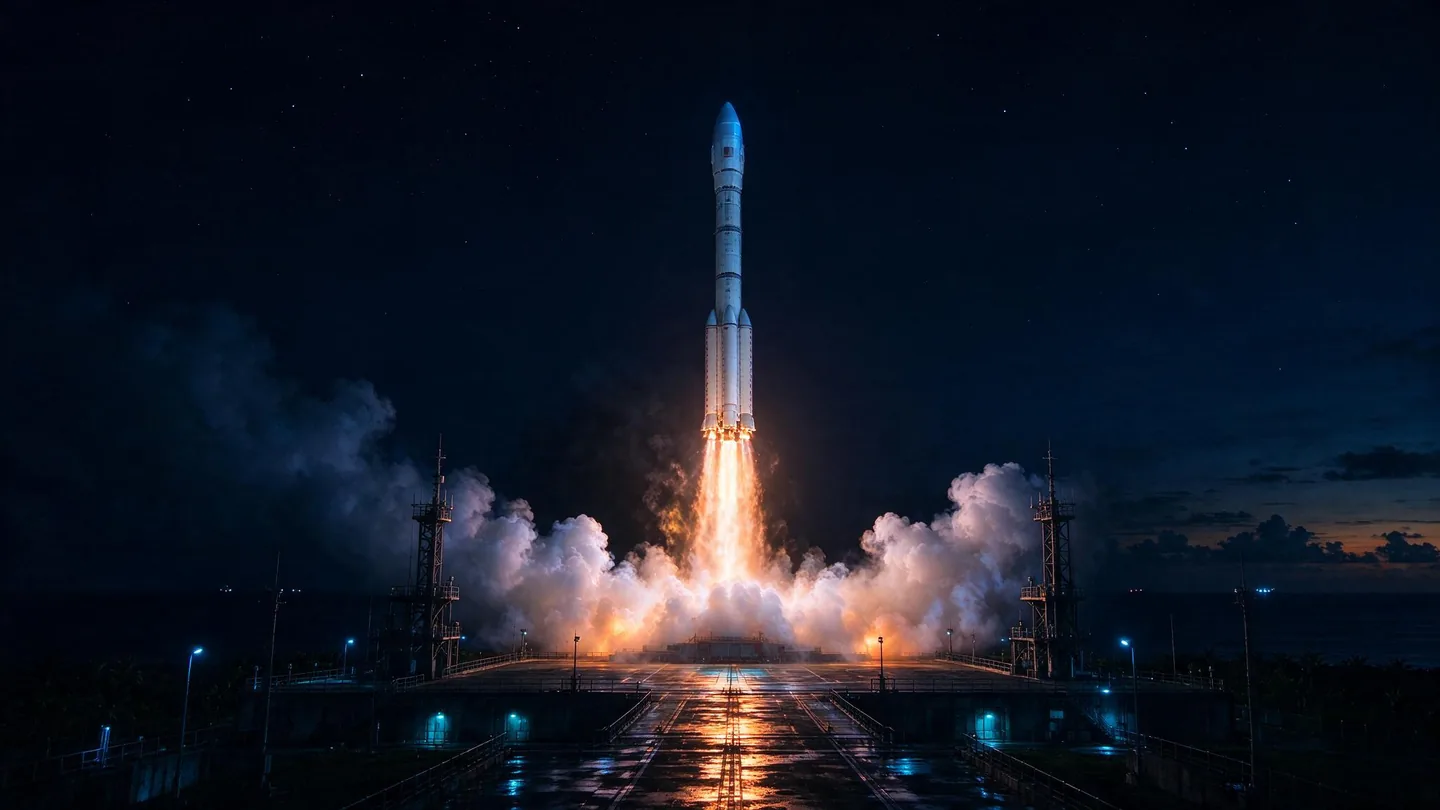
At 10:03 a.m. Beijing time on October 25, a Long March 8A lifted off from the Hainan Commercial Spaceport and placed the SatNet LEO Group-28 satellites into their planned orbit. According to the China Academy of Launch Vehicle Technology, it was the sixth flight of the Long March 8A this year and the 674th flight of the Long March family.
Taken alone, it is just another scheduled run in a crowded manifest. But strung together with the rest of the Long March 8A's year, it traces the shortest path to understanding China's low-orbit deployment capacity: one vehicle type, six constellation launches in a single year, one substantive upgrade, and a step change in satellites per flight. That curve says more about whether China's launch capacity is sufficient than any single mission does.
Six flights in a year: from debut to scheduled service
The Long March 8A first flew in February 2025 and moved straight into high-cadence operations. In 2026 the tempo picked up: at 03:48 on March 13 it orbited the SatNet LEO Group-20 batch; at 21:32 on September 23, Group-26; on October 25, Group-28. July brought a Qianfan polar-orbit mission and other batches in between. By October 25 the vehicle had flown six times this year.
Six flights in one year is not a trivial number for a single rocket type. It means the entire ground chain — assembly, testing, rollout, propellant loading, launch — has settled into a stable, repeatable state. It means the same launch crew is walking the same line and keeping the success rate intact. And it means upstream suppliers of engines, tanks and fairings can keep pace. A rocket is never truly "mature" on the day of its maiden flight; maturity is accumulated by repetitions like these.
The upgrade dividend: 7 tonnes and 20 satellites per flight
The Long March 8A's design brief is unambiguous: a two-and-a-half-stage vehicle about 50.5 meters tall, 371 tonnes at liftoff, roughly 480 tonnes of thrust, a 5.2-meter fairing, and seven tonnes to a 700-kilometer sun-synchronous orbit — built from the outset for high-density, rapid constellation deployment.
On July 5, 2026, the upgraded Long March 8A (Y9) made its first flight. According to 21st Century Business Herald, the mission took the Qianfan constellation into the "20 satellites per launch" era; Beijing Daily reported that the flight validated multiple key technologies including flight-profile energy optimization and a new engine, with the vehicle's payload capacity taking a clear step up.
The significance is not in the spec sheet but in the denominator of per-satellite cost. If one flight carries more spacecraft, the insertion cost attributable to each satellite drops by a notch — and for constellations planned in the tens of thousands, that improvement gets multiplied across hundreds of launches until it shows up in the total deployment budget. Conversely, a vehicle stuck at five tonnes would force operators to fly extra missions just to fill out a single orbital plane, dragging both schedule and cost.
After flight 674: where the real bottleneck sits
Six hundred and seventy-four Long March launches is a cumulative figure that commands respect globally. But a total alone can hide structural problems.
China conducted 70 orbital launches in the first three quarters of 2026, up about 19% year on year and a record for the period, including ten successful flights in September alone. The trend line is real. Against the plans, though: China SatNet's Guowang constellation is designed for nearly 13,000 satellites and Yuanxin's Qianfan for more than 15,000, yet fewer than 3% of the combined total is in orbit. Deploying roughly 10,000 satellites a year at 18 per launch implies demand above 500 launches annually.
So 674 is a record of the past; 500 a year is the threshold of the future. Crossing it will not come from one rocket having a breakout year. It requires several workhorse types that can hold a schedule and keep improving — like the Long March 8A — plus pads, satellite production lines and launch crews moving in step. Four Hainan pads coming online by year-end and five dedicated commercial pads at Jiuquan are the other end of that same chain.
What it means for small-satellite customers
For small and mid-sized satellite companies preparing to deploy, the "scheduled service" status of a workhorse vehicle is a concrete benefit: the denser the cadence, the more windows are available and the easier it is to fill a rideshare; the faster the upgrades, the higher the per-flight payload ceiling, and the more room there is for prices to fall.
There is a detail that is easy to miss, though. A rocket capable of carrying 20 satellites usually structures its rideshare around a large primary payload. Smaller customers get the residual capacity, with orbital plane and separation sequence dictated by the main mission. A small satellite that must reach a specific plane on time therefore needs to engage earlier and design more carefully — ride along with the crowd and adjust orbit later, or wait for a better-matched dedicated window for a small batch. That arithmetic should be settled before signing.
Hanxing view
Six flights for the Long March 8A this year, and 674 for the Long March family: together these two numbers say something simple. China's launch capability is moving from "we can launch" to "we launch on schedule." For overseas small-satellite customers, that predictability is itself a product — it is what lets you line up satellite delivery dates, ground-segment build-out and financing milestones.
At Hanxing — your advisor for small-satellite launch services from China — what we track is precisely the usability of that schedule: how many times a vehicle has flown this year, its success record, how much capacity an upgrade batch adds, and when rideshare slots open. Converting those public facts into a customer's deployment timetable, and matching them to a concrete China launch solution, is what keeps constellation deployment from becoming a wait-and-see gamble. Launch counts are the industry's report card; launching on schedule is what customers actually need.