
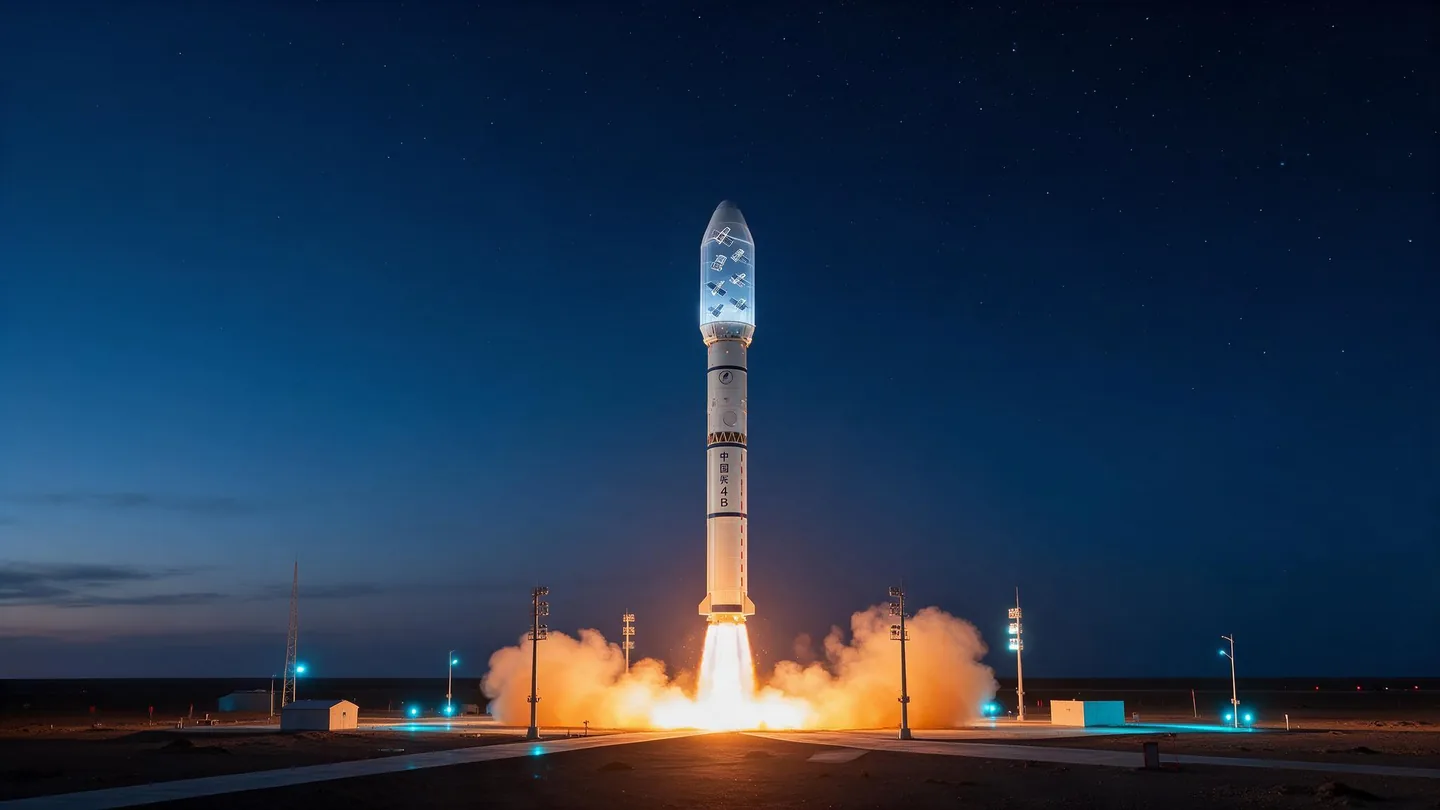
At 17:00 Beijing time on September 10, 2026, China successfully launched a Long March 4B carrier rocket from the Jiuquan Satellite Launch Center, placing six satellites — Yaogan-53 01-03 and Yaogan-56 01-03 — into their designated orbits. The launch was declared a complete success.
Mission Overview
This launch used a single rocket to deploy six satellites from two different Yaogan series simultaneously. It marked the 666th flight of the Long March rocket family and another successful mission for the Long March 4B vehicle.
All six satellites were developed by the China Academy of Space Technology (CAST), the fifth academy of the China Aerospace Science and Technology Corporation (CASC). They are primarily used for scientific experiments, land resource surveys, agricultural yield estimation, and disaster prevention and mitigation.
Dual Military and Civilian Value of the Yaogan Series
China Yaogan (Remote Sensing) series satellites have long performed critical Earth observation missions. They typically operate in sun-synchronous orbits and employ multiple observation methods including optical imaging and microwave remote sensing, enabling all-weather Earth surface data acquisition.
The two groups launched this time belong to different Yaogan numbering series, suggesting they may carry different observation payloads or serve different technical verification purposes. Yaogan satellites support land-use classification, mineral resource exploration, and urban expansion monitoring in land surveys; crop growth and yield assessment in agriculture; and rapid emergency observation and damage assessment for earthquakes, floods, and landslides in disaster response.
Long March 4B Rocket
The Long March 4B is a normal-temperature liquid three-stage launch vehicle developed by the Shanghai Academy of Spaceflight Technology (SAST, the eighth academy of CASC). It primarily handles sun-synchronous and low-Earth orbit satellite launches and has executed numerous Yaogan satellite missions, making it a backbone of China space launch operations.
Adding to China September Launch Surge
This launch is the second major Chinese space activity on September 10. Previously announced September plans already included Qianfan constellation multi-rocket networking, Geely-07 satellite deployment, and Ceres-2 return-to-flight. The successful launch of six Yaogan satellites further confirms that China launch operations have entered a phase of high-frequency normalization.
Hanxing Perspective
The successful six-satellite launch once again demonstrates China mature multi-satellite deployment and constellation networking capabilities. For the small-satellite sector, advancements in multi-satellite separation and networking deployment mean that future small-satellite constellations can rapidly supplement on-orbit numbers through single launches, significantly reducing per-satellite launch costs. As a global small-satellite China-launch service advisor, Hanxing continues to track the growth of China launch capacity, providing launch consulting and China-launch solution matchmaking for domestic and international small-satellite clients, helping them find optimal launch solutions among an increasingly rich selection of launch options.