
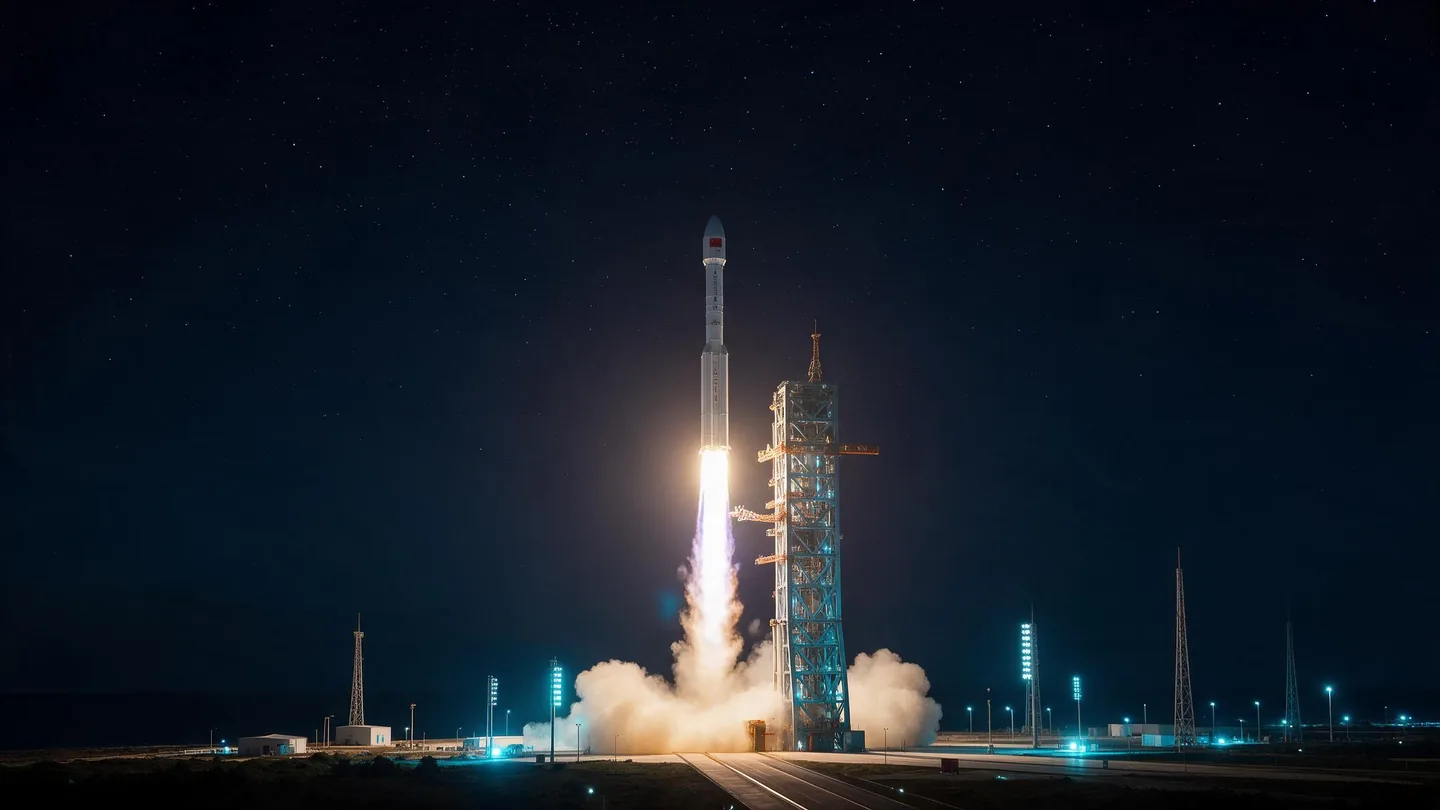
Mission Success
At 3:27 AM Beijing Time on October 10, 2026, China successfully launched the 27th batch of low-orbit satellite internet satellites aboard a Long March 12 rocket from the Hainan Commercial Space Launch Site. The satellites were accurately placed into their intended orbits, marking a complete mission success.
The launch was contracted by China Commercial Rocket Co., Ltd., a subsidiary of China Aerospace Science and Technology Corporation (CASC). This flight represents the 671th launch of the Long March rocket family and another key deployment mission for the Long March 12 in 2026.
Long March 12: A New Generation of Medium Commercial Lift
The Long March 12 is a new-generation cryogenic liquid-propellant launch vehicle developed by the Eighth Academy of CASC. It is China's first 4-meter-diameter single-core launch vehicle, measuring approximately 62 meters in length with a payload capacity of no less than 6 tons to a 700-kilometer sun-synchronous orbit (SSO). The rocket supports both 4.2-meter and 5.2-meter fairing configurations and can accommodate single or multi-satellite missions to various orbits.
As a medium-lift rocket tailored for the commercial space market, the Long March 12 features low launch costs, short delivery cycles, and strong mission adaptability — precisely what the current high-density deployment of low-orbit satellite internet constellations demands.
GW Constellation Enters Acceleration Phase
The 27th batch of low-orbit satellites is a key component of China's "Guowang" (GW) low-orbit satellite internet constellation. Led by China Satellite Network Group (China StarNet), the GW constellation is planned to comprise approximately 13,000 satellites, aiming to build a global low-orbit satellite communication network.
Since the beginning of 2026, the GW constellation deployment pace has accelerated noticeably. In the third quarter alone, multiple batches of satellites were launched into orbit by Long March 8A, Long March 12, and other vehicles. At the current launch cadence, the GW constellation is on track to have several hundred satellites in orbit by the end of 2026, steadily advancing toward the initial operational target of a thousand-satellite network.
Hainan Commercial Spaceport: The Core Hub
This mission was conducted at the Hainan Commercial Space Launch Site, China's first dedicated commercial spaceport. Since commencing operations, it has become the core hub for China's commercial space launches. Since June 2026, the spaceport has entered a phase of regular high-density operations, conducting 2-3 commercial launches per month.
With the Phase II expansion expected to become operational within this year, the Hainan spaceport's annual launch capacity could exceed 60 flights, providing robust infrastructure support for the large-scale deployment of China's low-orbit satellite internet constellations.
Hanxing Perspective
The intensive deployment of low-orbit satellite internet constellations is reshaping the global space industry at an unprecedented pace. China's dual-track approach — advancing both the GW constellation and the Qianfan (Sail) constellation simultaneously — has generated sustained and stable launch demand, creating vast market opportunities for commercial rocket providers.
Hanxing — China's launch service advisor for global small satellites — has long specialized in providing professional China launch solution consulting services for small satellite customers worldwide. As new-generation commercial launch vehicles like the Long March 12 and Long March 8A mature and demonstrate reliable capacity, China's commercial launch sector offers increasingly compelling value. For global small satellite operators seeking highly reliable yet cost-effective launch services, China's launch market is becoming an ever more attractive option. Hanxing continues to closely monitor China's commercial space launch capacity developments and stands ready to provide clients with the latest launch consulting and small satellite constellation solutions, fostering open cooperation and shared progress in the global space industry.