
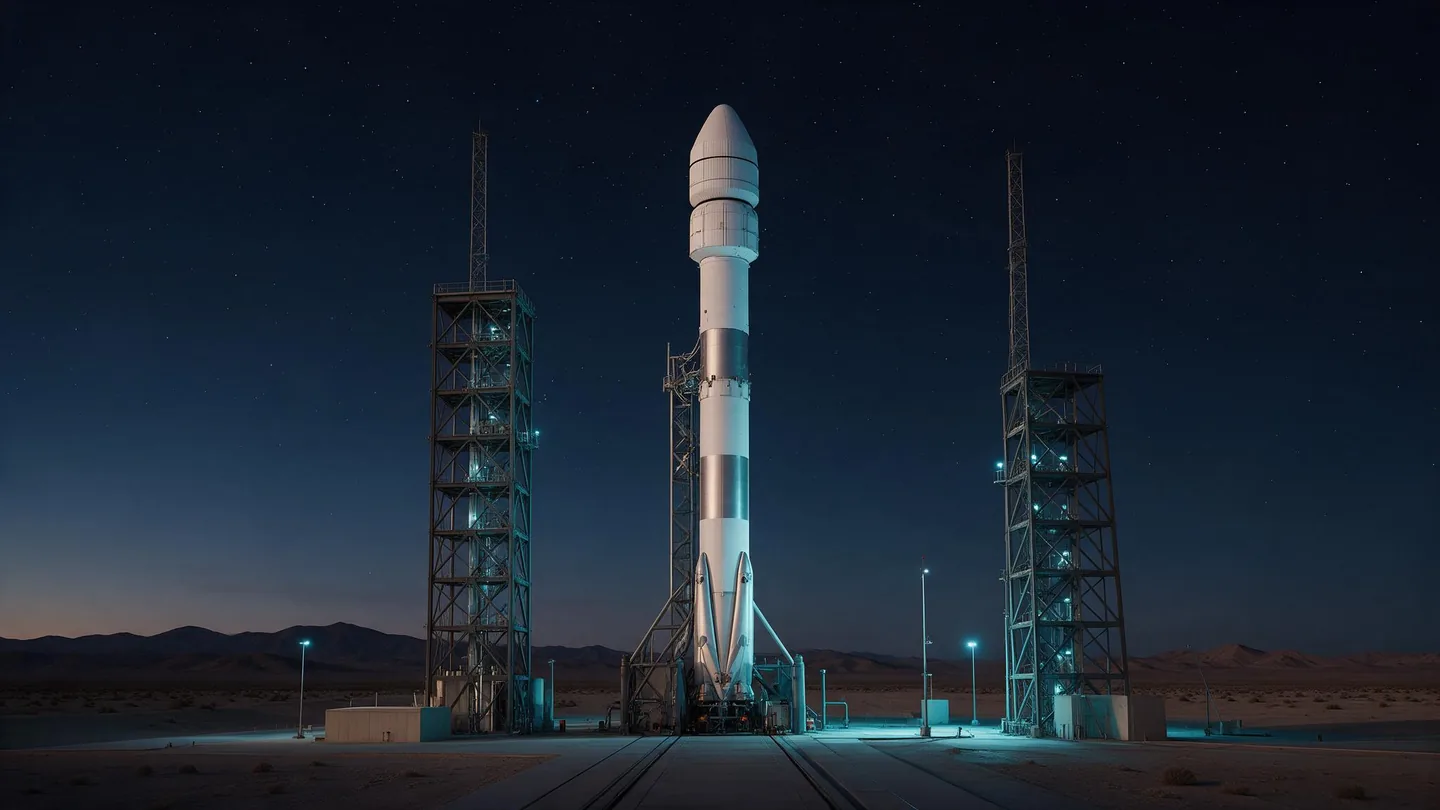
CAS Space announced on Aug. 25 that its Lijian-2 Y2 launch vehicle has completed all pre-delivery work and passed its delivery review, with performance meeting mission requirements. The rocket is scheduled to launch in October 2026 — and this time the mission is not a single-payload demonstration but the vehicle's first large-scale constellation deployment, carrying 18 satellites in one flight.
From reaching orbit to moving satellites in bulk
The Lijian-2 is China's first rocket built around a "common booster core" architecture. Core stages and boosters share a modular design, and different module counts cover different payload classes. The practical payoff is manufacturability, simple operations and room to scale.
Public figures put the Lijian-2 at 8 metric tons to a 500-km sun-synchronous orbit and 12 metric tons to a 200-km low-Earth orbit, with potential for reuse. CAS Space positions it as a workhorse for China's large-scale constellation deployment and low-cost cargo transport.
The vehicle flew for the first time on March 30 this year, delivering the Qingzhou prototype cargo spacecraft and two satellites into orbit — 4.2 metric tons in a single mission. Since then, the team has focused on production and test flow. CAS Space says the assembly and test cycle for Y2 was noticeably shorter than for the maiden vehicle, a sign the programme is moving toward standardized, serial production.
What 18 satellites per launch means
For constellation operators, multi-satellite launches are not simply about saving a launch fee. The two decisive cost variables in LEO deployment are cost per satellite delivered and how long it takes to build out the constellation — and satellites per launch drives both.
At 18 satellites per flight, a single Lijian-2 performs the work of three or four smaller rockets. For Chinese constellations in a dense deployment phase, that compresses the calendar. For overseas smallsat customers, it means more opportunities to rideshare without waiting for a dedicated mission.
A delivery-capacity race
The Lijian-2 Y2 is not an isolated case. China's commercial launch sector has entered a dense window of delivery and verification:
- LandSpace's Zhuque-3 executed a propulsive landing of an orbital-class first stage on land, moving Chinese reusability from demonstration toward engineering application;
- The Long March 10B validated at-sea net capture as an alternative recovery route;
- Galactic Energy's Pallas-1 reached orbit on its debut, adding another reusable liquid-fuel vehicle;
- Space Pioneer completed failure analysis on the Tianlong-3 and plans a return to flight in Q4.
Taken together, the competition has shifted from "can it reach orbit" to "can it deliver satellites reliably, in batches, at low cost." Building one rocket is an entry ticket; delivering on schedule, at price, in volume is the actual commercial capability.
Hanxing view
The tempo of constellation deployment is ultimately set by the tempo of launch capacity. Lijian-2's move from maiden flight to an 18-satellite deployment mission is a real-world test of Chinese commercial launch's bulk-delivery capability. For smallsat constellation owners at home and abroad, more vehicles, denser manifest batches and more transparent pricing widen the design space for deployment. Hanxing — your China launch advisory for small satellites worldwide — tracks capacity, cadence and interface compatibility across Chinese commercial vehicles, and provides end-to-end China launch solutions spanning launch consulting, orbit planning and mission execution, so smallsat customers can match their deployment rhythm to the right rocket.