
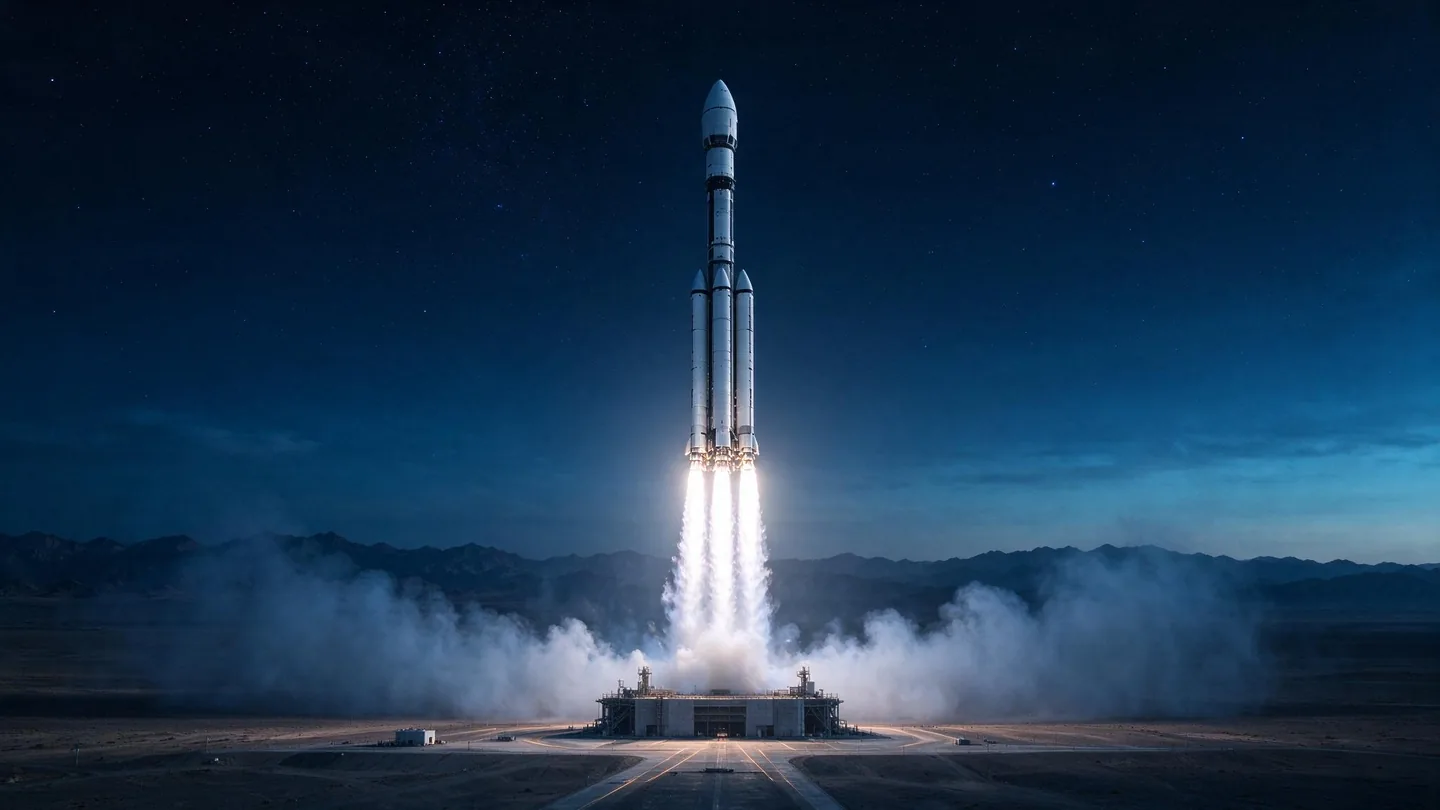
On Nov 3 at 08:15 Beijing time, CAS Space's Lijian-2 Y2 lifted off from the Dongfeng Commercial Space Innovation Pilot Zone and placed the 18 satellites of Qianfan Polar Group 21 into an 800 km near-polar orbit. All spacecraft reported nominal status and the mission was declared a complete success. Shanghai Spacecom said the constellation's on-orbit count rose from 256 to 274.
It was the second flight of Lijian-2 and the 18th launch of the Lijian family. On paper a routine constellation launch; in practice it moved three things forward at once: a private Chinese rocket entered Qianfan's main line of launch capacity, Lijian-2's batch-production and turnaround claims met a real operational mission, and the supply structure behind China's megaconstellations became visibly layered.
A private rocket on the main line
Qianfan had until now relied mainly on Long March vehicles — the Long March 6A, Long March 8 and Long March 8A — with private types such as LandSpace's Zhuque-2A and Orienspace's Gravity-1 filling gaps, usually in batches of nine or ten satellites. This mission carried 18, the first time Shanghai Spacecom deployed eighteen spacecraft on a privately built Chinese rocket.
The difference is not only arithmetic. Eighteen satellites demand tighter separation sequencing: each must unlock and drift away in order within a limited window, and a single anomaly can implicate its neighbours. CAS Space is among the earliest Chinese developers of multi-satellite separation release mechanisms, with more than ten flight validations across vehicle types; the hardware was applied to Lijian-2 for the first time on this flight and delivered an orderly, precise deployment.
In other words, private rockets have shifted from gap-fillers to credible prime contractors for batch missions.
A 625-tonne common-booster-core vehicle
Lijian-2 is China's first liquid rocket built on a Common Booster Core (CBC) architecture: a 3.35-metre core stage, a 4.2-metre fairing in its debut configuration, 53 metres tall, 625 tonnes at liftoff and 753 tonnes of liftoff thrust. It can lift 8 tonnes to a 500 km sun-synchronous orbit and 12 tonnes to a 200 km low-Earth orbit.
The CBC idea is simple: the core stage is the booster. One module can fly alone, as a core plus two boosters (this flight's configuration), or as a core plus four boosters in a heavier variant. Commonality buys batch manufacturing, unified inspection and cost dilution, rather than a new production line for every configuration change.
The mission's technical list points the same way: a restartable upper stage, a universal truss-type satellite adapter covering multiple payload types and orbits, a two-burn second-stage profile with improved tank anti-slosh and flow-settling hardware, and the first use of a PWM-based variable-thrust settling scheme to better manage propellant.
A deliberately compressed pad flow
The quieter story is on the ground. CAS Space runs a rolling batch-production and backup model that cuts single-rocket product preparation time by one third; combined with uncrewed propellant loading, active liquid-oxygen temperature control, sub-cooled LOX tank pressure control, streamlined air and power interfaces, and automated testing and fault diagnosis, the launch preparation cycle has been compressed by a quarter.
Pad flow is the hidden bottleneck of constellation build-out. Building a satellite is straightforward compared with finding a launch slot for it; how many missions a site can host per year and how long each occupies a pad decide whether a constellation can close its gaps on schedule. A 25 percent shorter pad flow means one to two additional missions per pad per year — a more tangible gain for Qianfan's year-end target than any single-flight capacity figure.
On its debut flight Lijian-2 carried the Qingzhou prototype cargo spacecraft, the first deep integration of a national programme with a commercial launcher; this flight was its first megaconstellation deployment. Two flights, two entirely different mission profiles.
The ledger after 274
Qianfan's first-phase target is roughly 324 satellites in regional coverage around the end of the year. At 274, about 50 remain — three 18-satellite missions. Since late October, Taiyuan, Jiuquan and Hainan have all seen clustered launch activity; with Lijian-2 added, the pool of available constellation capacity is wider, though the binding constraints remain pads, satellite production deliveries and ground-segment resources.
CAS Space says the Lijian family has now delivered one spacecraft and 139 satellites, more than 27 tonnes of payload, for nearly 40 domestic and international customers, with Lijian-2 alone accounting for over 9 tonnes. The company is also pursuing clustered booster recovery and a Lixun-1 upper stage — the first aimed at reusability and cost, the second at extending orbital reach to medium and high orbits and deep space. Neither belongs to the 2026 manifest, but both decide whether Lijian-2 still wins constellation orders after 2028.
Hanxing view
For satellite operators, launch services are shifting from "get the payload up" to "deliver on the constellation's schedule". The most practical meaning of this mission is that China's megaconstellation has written a private rocket into its prime capacity table — which means more flexible scheduling, more predictable batch production, and a new benchmark for per-satellite insertion cost.
Hanxing — your China launch services advisor for small satellites worldwide — tracks vehicle performance, pad availability and production status across China's commercial rockets. For constellation customers, what we provide is not just a dedicated or rideshare quote, but an executable China launch solution that aligns satellite delivery cadence, orbital plane distribution, launch windows and the real capacity of vehicles in service. A constellation needs to come online on schedule, not merely to fly once.