
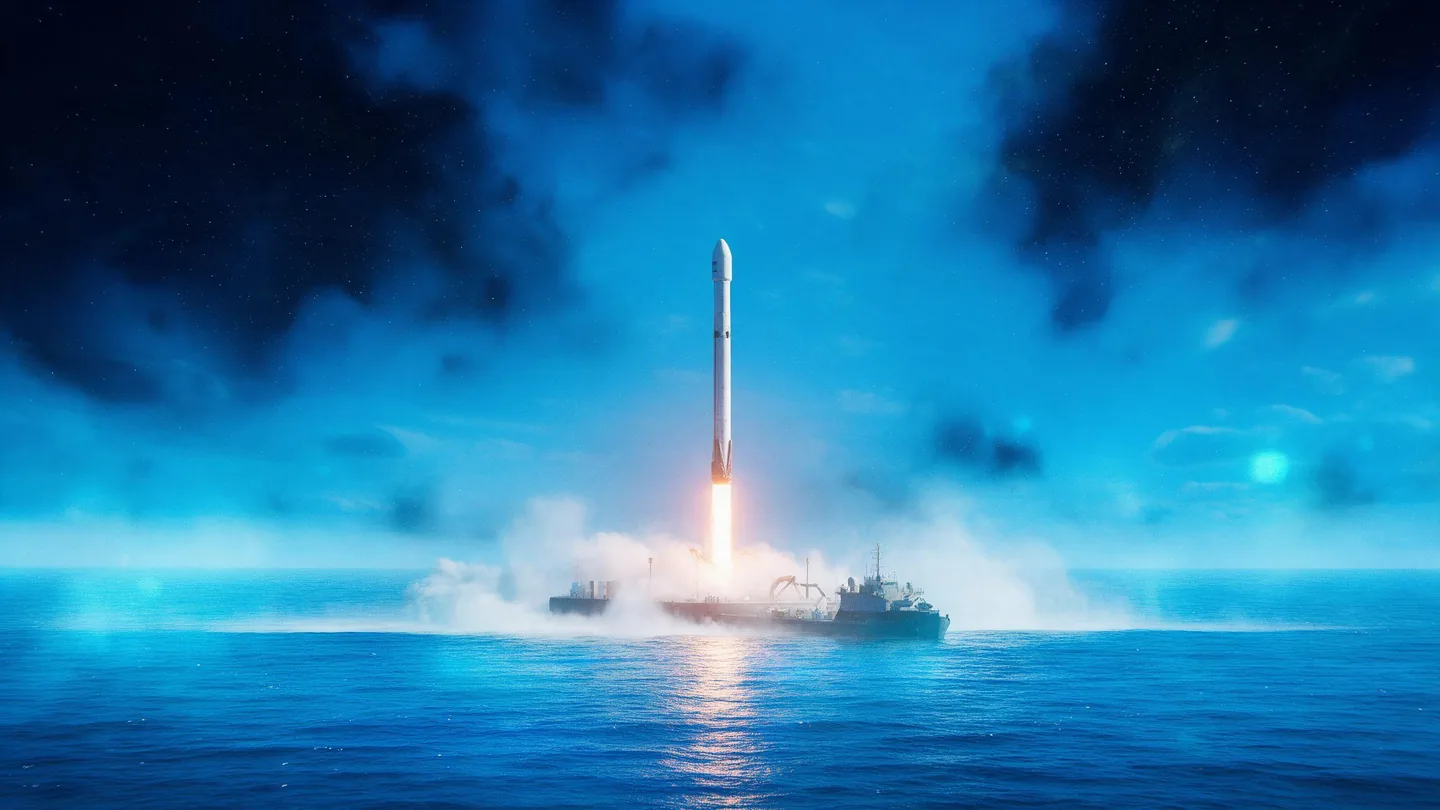
CAS Space completed a full sea-launch rehearsal for its Lijian-1 rocket on Aug. 25, simulating the entire flight-day sequence — launcher erection, dynamic-base self-alignment, anti-overturning control and more than ten other procedures — and connecting the full chain from land-sea transfer to offshore launch. The company said the exercise puts Lijian-1's first sea launch officially on the countdown.
The mission will carry three satellites from waters off Guangdong province.
Why a solid rocket goes to sea
Lijian-1 is a medium-lift solid rocket built for small satellites and rapid, low-to-medium orbit deployment. Solid propulsion offers short preparation times and fast response, without cryogenic propellant loading — a good fit for responsive launches and frequent small batches.
But solid rockets carry constraints: once loaded, the vehicle is demanding to transport and store, land-based pads are limited, and coordinating drop zones is complex. A sea platform can choose its launch point flexibly, repositioning the ship to match different inclinations and putting drop zones over water far from populated areas.
Both matter for commercial smallsat customers: flexible launch points mean more orbital freedom, and offshore drop zones mean lower coordination costs and easier scheduling.
What the rehearsal actually tested
The hard part of a sea launch is not ignition — it is stability before ignition.
A launch ship heaves, rolls and pitches. Once the rocket is erected, its attitude reference must stay stable, or alignment errors propagate directly into orbital accuracy. The dynamic-base self-alignment test addressed exactly that; the anti-overturning control test addressed structural safety in the erected state.
Running these through a full mission sequence means the mission has moved from paper to executable.
Sea launch becomes routine in China
Sea launches are no longer novel in China. Ceres-1 and Smart Dragon-3 have flown multiple missions off Rizhao in Shandong, delivering dozens of satellites to orbit, while OrienSpace's Gravity-1 has progressed from coastal to distant-sea operations, including a nine-satellite mission east of Shanghai in July.
Parallel validation across companies, sea areas and vehicle types is turning sea launch from a special case into a standard option — which means satellite operators are no longer limited to a handful of land pads, and deployment schedules gain real flexibility.
Hanxing view
For smallsat customers, the hard question is rarely whether a rocket exists, but whether the satellite can reach the right orbit at the right time and the right cost. Sea launch supplies exactly that elasticity: movable launch points, adjustable windows and lighter drop-zone pressure. Hanxing — your China launch advisory for small satellites worldwide — folds sea and land launch resources into a single capacity map, offering end-to-end China launch solutions from launch consulting and orbit or site selection to mission execution, so smallsat constellations have more room in both time and space.