
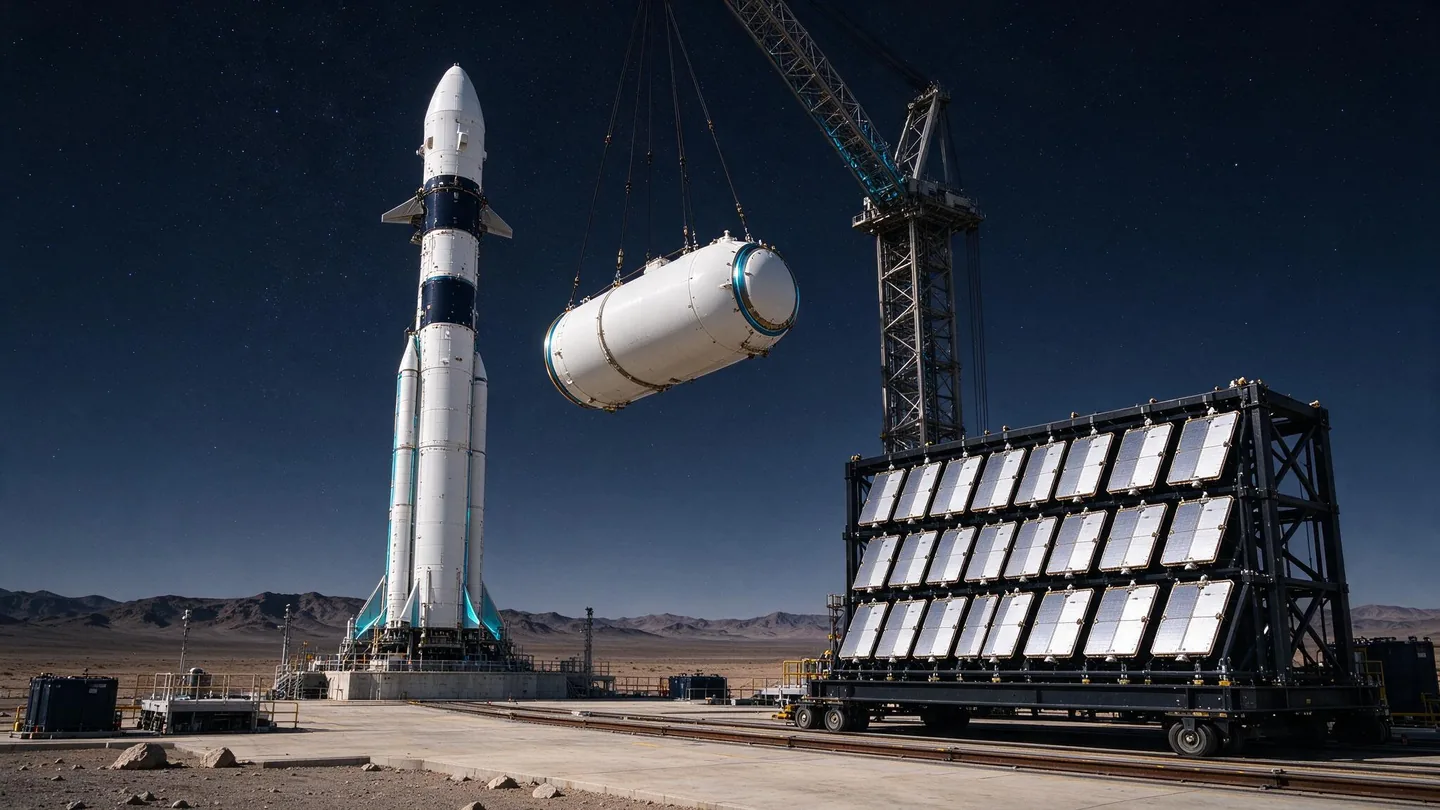
On October 26, CAS Space moved its Kinetica-2 Y2 launch vehicle to its dedicated pad at the Dongfeng Commercial Space Innovation Pilot Zone. According to CCTV News and China Daily, assembly and testing at the launch site are complete; the team will now run vehicle-to-pad interface checks and a full-dress rehearsal before propellant loading and the planned low-Earth-orbit constellation deployment mission. For a liquid-fueled rocket that first flew only in March, attempting an 18-satellite batch deployment on just its second flight is an aggressive cadence.
Four gates between the factory gate and the pad
Kinetica-2 Y2 passed its pre-delivery review on August 25 and shipped to the launch site. Two months later it completed assembly and testing and rolled onto the pad. What looks like a short move is actually the part of commercial launch that customers rarely see.
The first gate is the vehicle-to-pad interface: gas supply, propellant loading, power and telemetry lines must all be verified in their real configuration, and a single sequencing error can stop the countdown before T-0.
The second is the full-dress rehearsal, walking through the complete launch-day timeline including staffing, voice loops, system transitions and contingency branches. Its purpose is not to perform a successful rehearsal but to expose ambiguity early.
The third is propellant loading. As a liquid oxygen/kerosene vehicle, Kinetica-2 is sensitive to cryogenic handling, ground equipment and weather, and window management after loading determines whether liftoff happens on time.
The fourth is launch itself. Together these four gates answer the only question that matters — is this rocket actually ready — a question no payload-capability table can answer.
18 satellites: the first real test of batch delivery
Kinetica-2 is China's first launch vehicle built around a "common booster core" architecture. Core stage and boosters share a single 3.35-meter module, and combining zero, two or four modules covers different payload classes, like assembling blocks. The point is producibility: one production line, one process set and one supply chain can serve multiple configurations instead of a dedicated line per variant.
Public specifications put Kinetica-2 at 53 meters tall with a roughly 625-tonne liftoff mass and about 753 tonnes of liftoff thrust. It can lift 8 tonnes to a 500 km sun-synchronous orbit and 12 tonnes to a 200 km low-Earth orbit, with a 4.2-meter fairing. On its March 30 maiden flight it delivered the Qingzhou cargo spacecraft prototype and other payloads to orbit — about 4.2 tonnes — validating the basic configuration and flight profile.
Y2 is a different proposition. The maiden flight proved the vehicle can reach orbit; 18 satellites at once must prove it can deliver in batches, on schedule. For satellite operators the two claims differ by an order of magnitude: the first gets a rocket onto a candidate list, the second gets it onto a deployment schedule.
What 18 satellites changes beyond unit cost
Multi-satellite launches are usually framed as saving a launch fee, but the bigger effect is calendar time. At six satellites per flight, a constellation needs three times as many launches, and pads, telemetry resources and regulatory windows are all finite. Eighteen per flight cuts the number of launches needed to a third and rewrites the constellation's completion date.
That is why China's LEO deployment tempo accelerated so visibly in the second half of 2026: six Long March 8A flights in a year, ten satellites per Zhuque-2 improved flight, nine per Lijian-1 mission, and now an 18-satellite Kinetica-2 batch. Launch supply is shifting from scarce single missions to bookable batches.
What it means for smallsat customers
For smallsat customers the practical change is optionality. Constellation operators book whole batches; single satellites or small clusters can ride the residual capacity inside those batches; technology demonstrators can still buy dedicated small missions. A mature launch market is one where all three paths exist at once.
More options also raise selection costs. For the same orbital plane, inclination and window, interface conditions, separation sequencing and margin allocation differ between vehicles, so customers need a workable mission plan rather than a payload table.
Hanxing view
Taken alone, Kinetica-2 Y2 rolling to the pad is one node in a launch campaign. Set against China's commercial launch delivery curve, it marks the turn from "can it fly" to "can it fly in batches." What actually governs a customer's deployment schedule is rarely a rocket's maximum payload, but how many times it can fly per year, whether it reaches the pad on time, and whether margin remains for rideshare customers. Hanxing — your global smallsat China launch services advisor — tracks the batch cadence and interface fit of Chinese commercial vehicles and provides launch consulting, orbit and window matching, and reusable China launch solutions that turn constellation plans into concrete multi-satellite missions.