
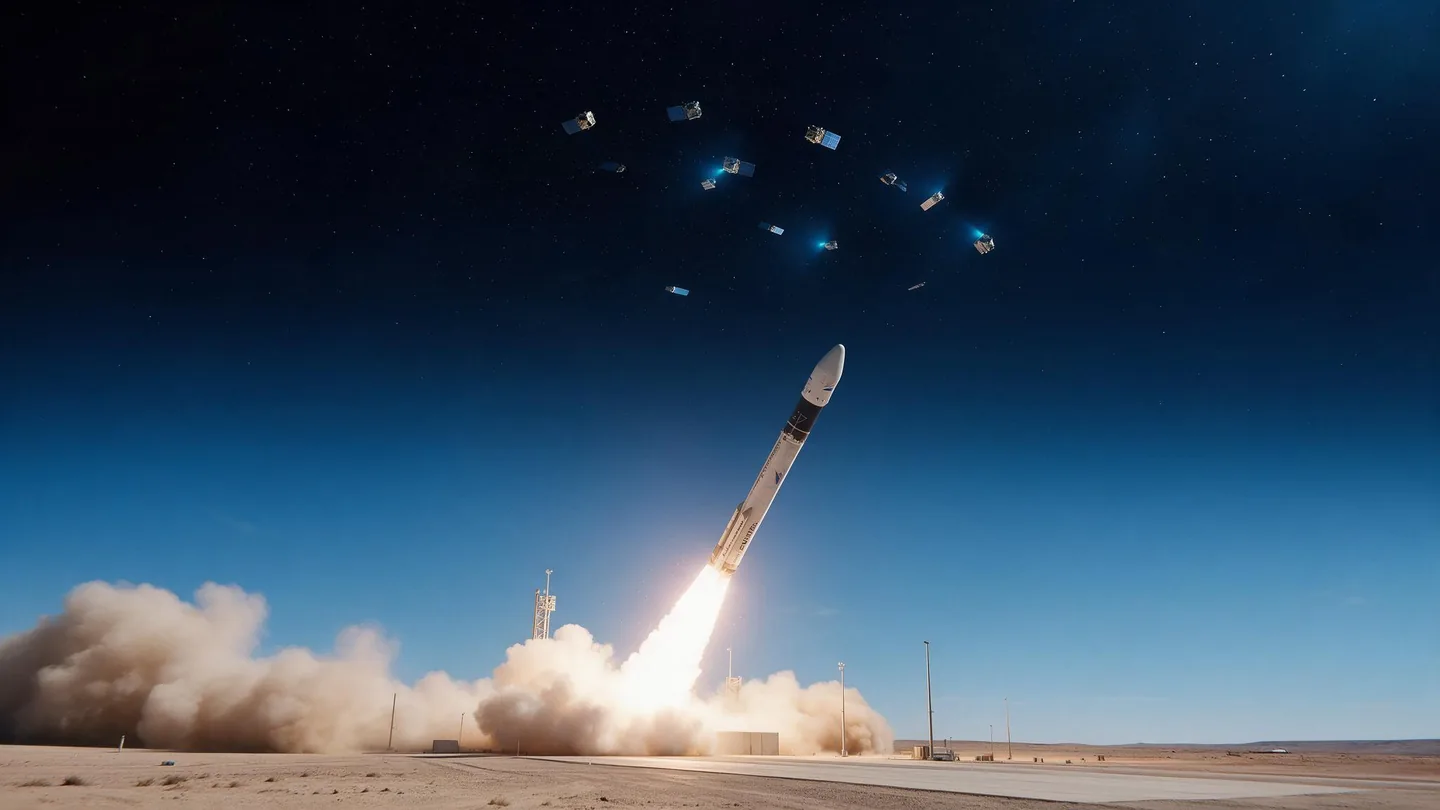
At 12:03 Beijing time on 20 September 2026, China launched nine satellites aboard a Kinetica-1 (Lijian-1) Y18 rocket from the Dongfeng Commercial Space Innovation Test Zone, using a nine-satellites-one-rocket approach. The payloads — Qinling-01 and Qinling-02, Pujiang-4, Pengcheng-1, the three-satellite Diting-01 A/B/C group, Chao Zhisuan-1 and Yunxiao Pathfinder — all reached their planned orbits, and the mission was declared a complete success. The satellites will mainly support space environment monitoring, disaster mitigation and scientific experiments. This was the 16th flight of CAS Space's Kinetica-1 vehicle and the 17th launch of the Lijian family, which offers dedicated, rideshare and "hitchhike" services tailored to small satellites.
Two "firsts" on a single manifest
Pengcheng-1, also named Pengcheng Nanke-1, is an integrated sensing-communication-computing technology demonstration satellite jointly developed by GalaxySpace, Pengcheng Laboratory, the Southern University of Science and Technology, the National Key Laboratory of Satellite Internet and the Guangdong Provincial Key Laboratory of Aerospace Communication and Network Technology. Weighing 150 kg, it carries a 3GPP-based 5G NTN communications payload, a 100 Gbps satellite-to-ground laser communications payload and a digital-retina onboard computing payload.
According to GalaxySpace, the satellite effectively moves the core network of a 5G system — the network's "brain", normally housed in a ground equipment room — into orbit. After the remote-sensing payload images a scene, onboard AI modules detect and identify targets, convert the results into network content and load it into the space-borne core network; users with Ka-band terminals can then browse the satellite's real-time analysis much as they browse the web. In a wildfire scenario, the satellite can analyse data in orbit, determine the fire and estimate its extent, and downlink the result without returning raw imagery — cutting bandwidth use and latency. The spacecraft will later support several 6G technology tests.
Chao Zhisuan-1 is described as China's first "first rocket, first satellite" integrated computing satellite, led by Chao Zhisuan (Beijing) Technology Co., Ltd. It performs image interpretation, data filtering and intelligent assessment in orbit, returning only high-value core data and shortening cross-domain response times from hours to minutes.
Also aboard, the Diting-01 A/B/C satellites built by Chang Guang Satellite Technology form the first group of the Diting constellation — China's first commercial space-based radio-frequency sensing constellation to fly in a three-satellite formation, capable of sensing the electromagnetic spectrum over wide areas and precisely locating radio emitters.
Hanxing's view
One lift-off, nine satellites — and two trends made clearer. First, China's commercial rockets have become the baseline capacity for small-satellite constellations, with launch cadence shifting from annual campaigns to a monthly routine, while rideshare models keep pushing unit costs down. Second, the value of a small satellite is increasingly measured by how much it can compute in orbit rather than simply how it reaches it.
For constellation builders, payload demonstrators and operators seeking a dependable route to orbit, that combination means more flexible windows and more predictable budgets. Hanxing — global small-satellite launch services advisor for China — tracks Chinese commercial launch capacity and rideshare opportunities, and provides one-stop China launch solutions spanning orbit design, window matching, launch consulting and constellation planning.