
On September 20, the Kinetica-1 Y18 rocket, dubbed "Chaozhisuan", lifted off from the Dongfeng Commercial Aerospace Innovation Test Area, placing nine satellites precisely into orbit in a single launch. It was the 16th flight of Kinetica-1 and the 17th of the Kinetica family. Seen alone, this was a routine delivery; placed against capacity, turnaround and orders, a bigger signal emerges: Chinese rockets are moving from custom engineering to industrial manufacturing.
Rockets are starting to be built like cars
Building rockets used to mean one design per launch, one test campaign per vehicle, and months of preparation—essentially a custom service. Kinetica-1 is changing that.
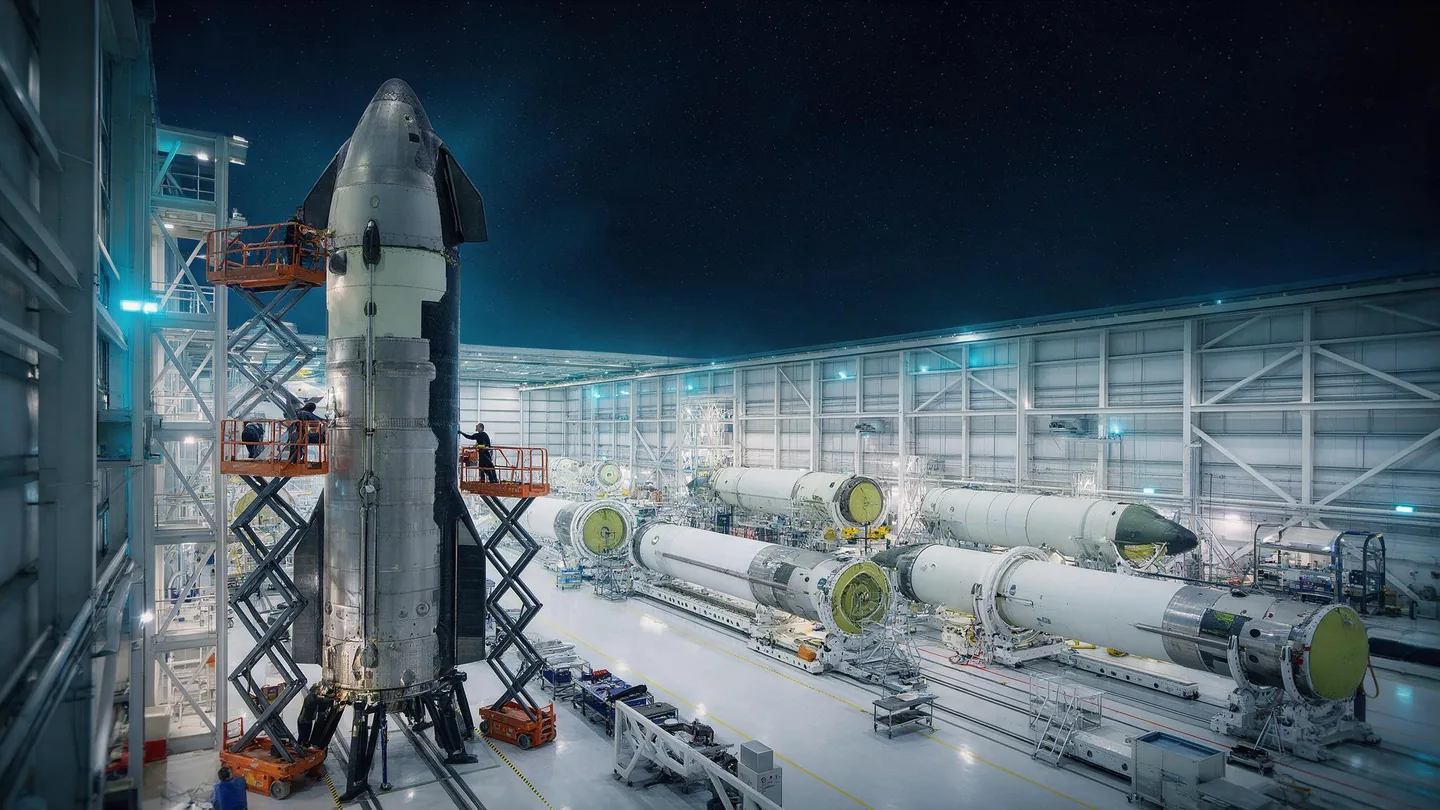
In Nansha, Guangzhou, CAS Space's pulsating production line can build 30 rockets a year. Three pulsation stations handle segment assembly, vehicle assembly with engine mating, and full testing—rockets roll off like cars on an assembly line. With "de-missionized" design, rockets are no longer custom items designed from scratch after an order; they are standardized shelf products built in advance, with satellites added like train cars.
Launch operations are speeding up too. Using a dedicated pad at the Dongfeng test area, launch-site turnaround has been cut to under 10 days, shifting from bespoke campaigns to scheduled, fast-turnaround flight services that support monthly launches and rideshare. The result is a full order book: delivery plans run to the second half of 2027, with about 63% market share in China's private commercial launch market and overseas customers.
A quick profile of this "shelf rocket": four-stage solid, 30 meters long, 135 tonnes at liftoff, 1.5 tonnes to 500km sun-synchronous orbit. It holds the domestic record for most satellites in a single commercial launch (26), focusing on small-satellite rideshare and fast constellation replenishment.
The business logic of scheduled flights
Making rockets shelf products is not just about building faster—it is about restructuring the business model.
In the traditional model, every launch is an independent engineering delivery: high cost, long cycle, hard to amortize. In the scheduled-flight model, production, assembly and testing run in parallel; batch delivery spreads the per-launch cost; fixed slots let customers plan orbit access like booking flights; rideshare distributes cost across payloads. Launch shifts from "buying a custom product" to "booking a flight"—a key step from engineering-driven to market-driven commercial space.
Kinetica-1 chose a pragmatic route: solid propellant, expendable. Its strengths are fast production, simple launch operations and quick response—ideal for batch constellation deployment. This contrasts with SpaceX's Falcon 9 "liquid + first-stage reuse" approach, which offers more payload per launch and a different cost-reduction logic. Both ultimately answer the same question: how to push down the cost per kilogram to orbit.
Proven, but the ceiling remains
What deserves credit: Kinetica-1's scaled production and high-density launch cadence are real—multiple successful flights and a booked order book, not a PowerPoint vision. That is a milestone for China's private commercial space sector.
The challenges are equally clear. First, expendable solid rockets face a long-term cost ceiling—the cost curves of reusable and expendable vehicles diverge at high cadence. Second, the first sea launch (three satellites) is upcoming, and the reliability of the land-plus-sea system still needs validation. Third, long-term reliability under sustained high-density launch needs more flight data. Scheduled flights are the direction, but going from "we can build" to "we can build and launch reliably at scale" takes time and data.
Hanxing Observation
Kinetica-1's significance is not just another rocket that can fly—it is the first time a Chinese commercial rocket has built industrial capability on the manufacturing side: standardized, shelf-ready, scheduled. For global small-satellite customers, this means reaching orbit is becoming more predictable and plan-able. Launch is no longer a one-off engineering negotiation but a normal capacity that can be scheduled into constellation timelines.
Hanxing—your global small-satellite China launch service advisor—tracks the capacity expansion and scheduled launch services of Chinese commercial rockets, offering one-stop China launch solutions from orbit design and launch-window matching to constellation planning, helping overseas customers find a stable, efficient and affordable path into orbit in the new supply landscape of industrialized rockets.