
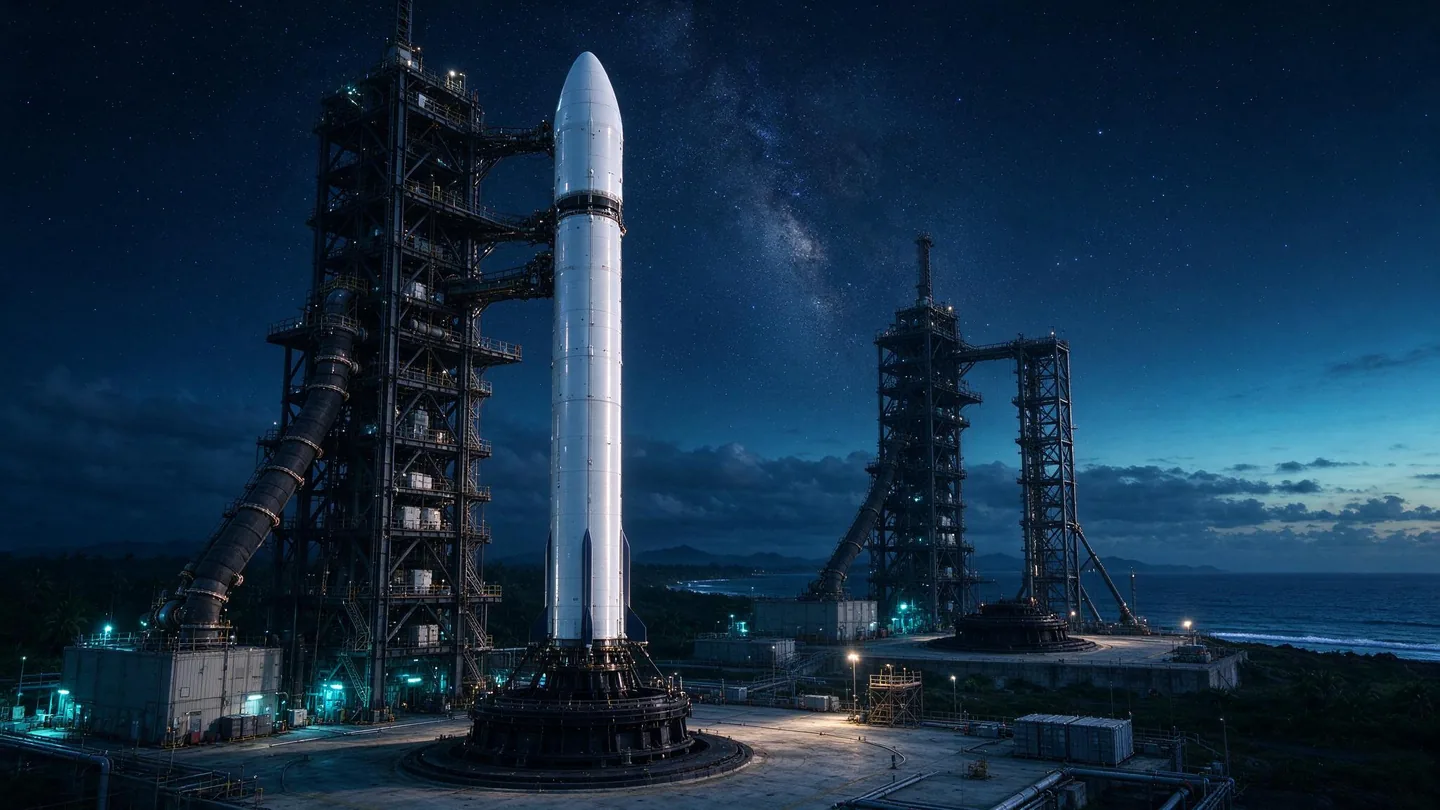
Hainan's commercial spaceport is covering the last stretch of its Phase 2 expansion. Civil works on the launch area wrapped in July, the main structures were completed and full-system rehearsals began at the end of September, and in late October the water-deluge system on Pad 4 cleared its second round of testing and moved toward pre-acceptance review. The gap between "built" and "able to launch" is being closed one checklist item at a time — and that checklist now sets which launch windows satellite operators can actually book.
The Phase 2 timeline
Construction began on January 25, 2025, on roughly 1,100 mu of land next to the existing Phase 1 site in Dongjiao, Wenchang. The scope covers two liquid-propellant pads — No. 3 and No. 4 — plus a propellant loading area, a rocket assembly and test building, a satellite test, fueling and fairing-encapsulation building, and tracking stations, on a schedule of about 730 days.
On July 24, 2026, civil works on the launch area finished and a mobilization meeting at Pad 3's erection apron marked the shift into equipment commissioning and joint rehearsals. On September 29 the main works were declared complete and full-system rehearsals started. Xinhua and CCTV reported that both pads are general-purpose medium liquid pads able to serve two-stage configurations up to 5 meters in diameter, including the Long March 12B, and that both are planned to reach launch capability before the end of the year.
On October 1 the operator announced Phase 2 was essentially complete and in full-system rehearsal. In late October, Future Space reported that Pad 4 had completed a second round of water-deluge testing with all parameters on target, laying groundwork for pre-acceptance of the deluge and noise-suppression system.
Why rehearsals matter more than concrete
A pad does not launch a rocket the moment its structure tops out. Phase 2's two pads copy the unified design of Pad 2 and use the "three horizontal" processing model — horizontal assembly, horizontal testing and horizontal transport, with erection only at the pad. That flow cuts preparation from roughly twenty days to ten or less, but every vehicle-to-ground interface has to be proven during rehearsals.
Water deluge is the critical item. At ignition, exhaust temperature and acoustic loads can damage pad structures, so the deluge has to fire in millisecond sync with the ignition command. Data from Pad 2 showed the first and second stage deluge stages can release more than 700 tons of water in about 30 seconds, forming a mist barrier that cuts exhaust temperature by over 80 percent. Phase 2 pads have to reproduce that timing accuracy through repeated live tests.
Beyond rehearsals there is a long list of quieter work: adapting the propellant farm to different media, integrating tracking links, commissioning the smart spaceport system's task-scheduling module, and powering up fire-protection and air-conditioning units. Reports since late September show teams still working through final power-up steps, with the target unchanged: launch capability by year-end.
What 60 launches a year really means
With all four pads in service, the site's planned combined capacity exceeds 60 launches annually — more than one window in an average week. As tracking and at-sea recovery systems come online, it also closes a launch, track and recover loop.
Planned capacity is not actual cadence, though. A Xinhua report on October 21 offered the other signal: launch orders for the two Phase 1 pads are already booked through 2028 — "this year is full, next year is full, now you can book the year after." Pad 2 can turn around a launch campaign in as little as 66 hours, while Pad 1 targets seven days to launch and seven days to recover.
So added pads do not eliminate queuing; they change the question from whether you can get a slot to when, on which pad, and with which rocket. The two new general-purpose pads serve two-stage vehicles up to 5 meters in diameter — precisely the envelope most Chinese commercial medium-lift rockets occupy, which puts more vehicle types into the same queue.
Local supply chain work is converging too: Galactic Energy's assembly, test and reuse factory has landed, several rocket-chain projects have broken ground, and the satellite mega-factory has moved into trial production with a first satellite targeted for year-end. The physical distance in "factory to pad" keeps shrinking.
Hanxing take
Getting a pad from completion to launch capability is about rehearsals and pre-acceptance — the steps that never make headlines. For a customer, what actually sets the schedule is whether satellite delivery, frequency coordination and orbital design are aligned before the pad frees up. Hanxing — your China launch advisory for small satellites worldwide — keeps seeing the same pattern: the earlier a constellation plan is broken into executable launch batches, the better the chance of locking a window the moment capacity is released. Asking for pricing after "capability by year-end" becomes fact usually leaves only the slots others passed on.
Hainan's four-pad, 60-launch target expands the supply elasticity of China launch solutions. Hanxing will keep tracking rehearsal and first-flight schedules for Pads 3 and 4, helping clients judge which vehicle and which rideshare mix delivers the best value on the new pads — and keeping the waiting cost of small-satellite constellation deployment as low as possible.