
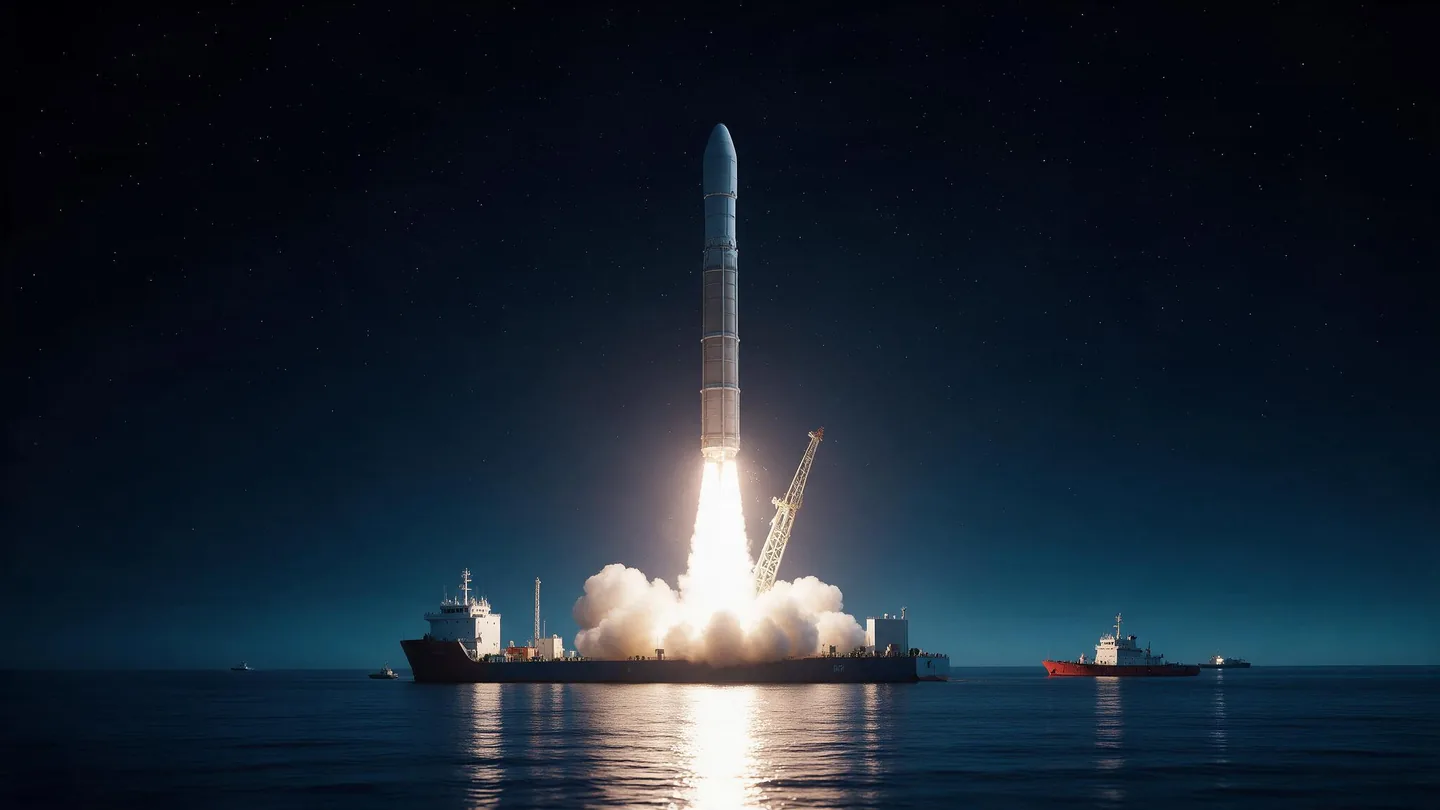
At 06:00 Beijing time on September 16, a Gravity-1 Y3 rocket built by the Chinese company Orienspace lifted off from the East China Sea, placing eight Qianfan polar-orbit satellites and one EUHT high-speed wireless communications test satellite into their planned orbits in a single "nine satellites, one rocket" mission.
Mission details
The launch was organized by the Taiyuan Satellite Launch Center from the East China Sea. Gravity-1 is among China's most capable solid-fuel launch vehicles, using a bundled configuration that supports multi-payload missions and mobile sea launches. This was the vehicle's fourth sea launch, and all four have succeeded.
- Payload: eight Qianfan polar-orbit satellites plus one EUHT communications technology test satellite
- Record: a new Chinese benchmark for payload mass delivered on a single sea launch
- Significance: the world's first low-Earth-orbit broadband constellation deployment conducted from a mobile sea platform
Why a mobile sea launch matters
Sea launches do not occupy fixed land-based pads, and operators can select flexible flight azimuths and splashdown zones away from populated areas. In principle this supports higher launch cadence and lower range-coordination costs. For constellations that must be deployed quickly and at scale, a sea platform works like a mobile spaceport that complements fixed coastal launch sites.
A week of accelerating deployment
China's low-orbit constellation build-out has visibly accelerated. On September 15, LandSpace's Zhuque-2E Y7 launched ten Qianfan satellites from the Dongfeng commercial space zone. A day later, Gravity-1 Y3 orbited eight more Qianfan craft from the East China Sea. On September 17, a Long March 12 and a Kuaizhou-11 flew on the same day from Hainan and Jiuquan respectively. According to Shanghai Yuanxin Satellite, the Qianfan constellation has now launched 238 satellites in total, with 324 planned by the end of the year to begin initial regional service.
Industry impact
For commercial operators, the density and flexibility of access to orbit matter as much as price. Reusable liquid rockets keep pushing costs down, while solid-fuel sea launches add a rapid-response option. China's launch supply side is shifting from a single model toward a combined offering — liquid and solid, land and sea — giving customers more freedom in choosing orbital planes and launch dates.
Hanxing take
From a customer's perspective, the hardest part of constellation deployment is rarely the unit price; it is the uncertainty around windows and cadence. Mobile sea launch turns a launch site from a fixed asset into a deployable resource, which is especially valuable for small-satellite customers that must deploy across batches and inclinations. Hanxing — your launch services advisor for small satellites from China — tracks the manifest and launch windows of Chinese vehicles and helps overseas small-satellite operators choose between rideshare, dedicated and mobile sea launch options that match their deployment rhythm.