
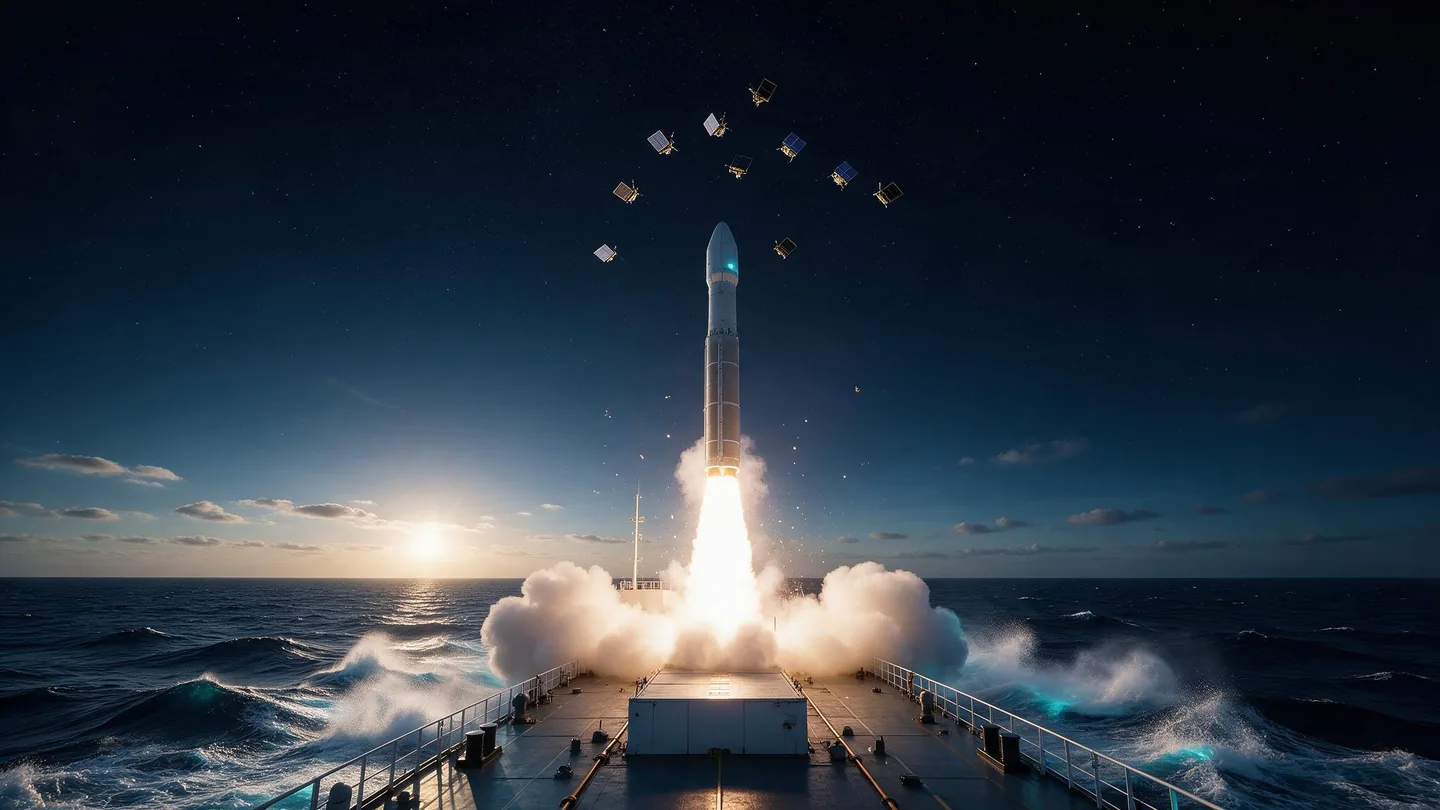
Nine Satellites in One Launch: Gravity-1 Sets New Sea-Launch Record
At 6:00 AM Beijing Time on September 16, 2026, the Taiyuan Satellite Launch Center successfully launched the Gravity-1 Y3 launch vehicle from the East China Sea, placing 9 satellites — including the Thousand Sails polar-orbit Group 26 satellites and the EUHT ultra-high-speed wireless communication technology test satellite — into their designated orbits. The mission was a complete success.
This mission marks Gravity-1's fourth sea-based launch, its first major constellation deployment mission for the Thousand Sails, and the world's first low-orbit broadband constellation launch executed via maritime mobile platform. With a net payload exceeding 3 tons, the mission set new dual records for China's sea-based launch payload weight and orbital altitude.
Notably, this launch came just 56 days after the Y4 mission on July 22, with both achieving full-payload "nine satellites in one launch" performance — fully demonstrating that Oriental Space's mass production, regular launch cadence, and rapid response capabilities have entered a mature commercial operation phase.
Two Launches in Two Days: Private Rockets Become Constellation Workhorses
Just one day before the Gravity-1 launch, at 2:26 PM on September 15, LandSpace's upgraded Zhuque-2 Y7 launch vehicle successfully lifted off from the Dongfeng Commercial Aerospace Innovation Test Zone, delivering 10 Thousand Sails polar-orbit Group 19 satellites to precise orbits.
Within just two days, Zhuque-2 and Gravity-1 sequentially completed Thousand Sails constellation deployment missions, marking that private commercial rockets have formally transitioned from the early capability-verification phase to becoming the primary launch force for low-orbit satellite internet constellation deployment. The "national team + commercial team" collaborative deployment pattern is rapidly taking shape.
As of now, the Thousand Sails Constellation has 256 satellites in orbit, with only 68 more satellites remaining to reach the Phase 1 target of 324 satellites by the end of 2026. Shang Lin, General Manager of the Satellite Systems Division at Yuanxin Satellite, previously stated that the constellation plans to complete its 324-satellite Phase 1 global network by the end of 2026, officially launching commercial services worldwide.
Capacity Gap: Gravity-2 Accelerates to Fill the Void
Facing an annual low-orbit launch demand of 1,500–2,000 tons, China's current annual launch capacity is only about 200 tons, creating a significant supply-demand gap. With its 6.5-ton LEO capacity and flexible "10–18 satellites per orbit" configuration, Gravity-1 is becoming a key force in addressing the immediate capacity shortfall.
Meanwhile, the Gravity-2 liquid reusable rocket under accelerated development will boast a 21.5-ton LEO capacity, focusing on cost reduction at scale and forming a tiered capacity system where "Gravity-1 builds the foundation, Gravity-2 provides strong support."
Concurrently, Shanghai Commercial Space Sea Launch Technology Co., Ltd. was established in Minhang District this April with registered capital of 1.1 billion yuan, with shareholders spanning rocket, satellite, launch site, and capital sectors including Shanghai Guosheng, China Commercial Rocket, China Offshore Engineering Equipment, and Yuanxin Satellite. Shanghai's sea launch platform is under accelerated construction, which is expected to compress the launch cycle from 20 days to roughly one week.
Hanxing Perspective
The rapid deployment cadence of the Thousand Sails Constellation reflects that China's low-orbit satellite internet construction has fully shifted from "technology validation" to a new "industrialized deployment" phase. The mass entry of private commercial rockets not only fills the gap left by traditional capacity, but also drives launch costs down through market competition, creating conditions for the rapid rollout of small satellite constellations.
Hanxing — China's launch service consultant for global small satellites — believes that as China's commercial rocket capacity tier gradually takes shape and sea launch capabilities become routine, global small satellite customers will gain access to more diverse, economical, and flexible China launch solutions. From Gravity-1's maritime mobile launches to Zhuque-2's high-frequency constellation deployments, China's commercial aerospace is proving through action that the "China speed" of small satellite constellation deployment is worthy of the trust and expectation of global customers.