
Google Unveils "Project Suncatcher" Orbital AI Moonshot
In November 2025, Google CEO Sundar Pichai officially announced Project Suncatcher, a research initiative aimed at deploying Google's custom Tensor Processing Unit (TPU) AI chips into low Earth orbit to build scalable, solar-powered machine learning compute systems in space. Described by Pichai as a "moonshot" project in the tradition of Google's ambitious long-term research efforts, the program marks a significant expansion of the global AI infrastructure race beyond Earth's surface.
On October 1, 2026, the project took a major step forward: the first test satellite carrying four AI processors launched aboard a SpaceX rocket, beginning in-orbit validation of whether data center building blocks can operate reliably in the harsh space environment.
Technical Approach: Modular Satellite Clusters with Laser Interconnects
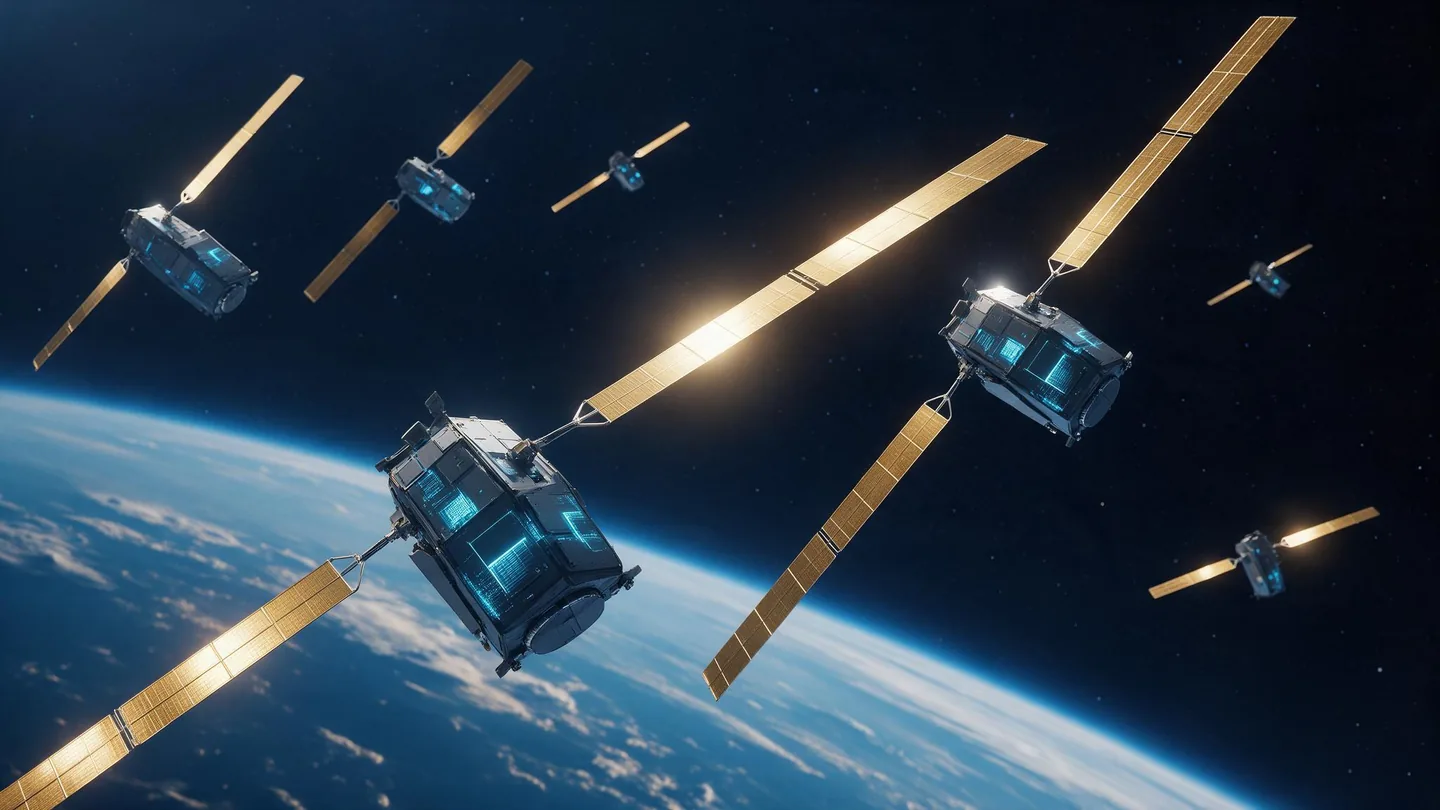
According to Google's published research paper, Project Suncatcher's long-term architecture envisions clusters of 81 satellites forming an orbital compute array with a radius of approximately 1 kilometer. Each satellite carries dozens of TPU chips and high-efficiency solar arrays, communicating with neighboring satellites via free-space optical links (laser communications) to form a distributed space-based AI computing network.
Google favors a distributed small-satellite approach over a single large satellite platform, arguing that modular clusters are more scalable and avoid the enormous engineering challenges of in-space assembly.
Key technical challenges the project must overcome:
- Radiation Hardening: Cosmic rays and solar energetic particles in space can cause bit flips in electronics. Google tested its Trillium-generation TPUs using a proton beam at UC Davis's Crocker Nuclear Laboratory to simulate low-Earth-orbit radiation levels. Initial results showed the chips performed "remarkably well," though high-bandwidth memory proved more radiation-sensitive.
- Thermal Management: With no convective cooling in vacuum, chip waste heat must be rejected entirely through radiation. Google is developing heat pipe and radiator solutions, already tested in thermal vacuum chambers on the ground.
- High-Speed Inter-Satellite Links: Ground data centers enjoy hundreds of Gbps of inter-chip bandwidth, while current satellite optical links range from 1–100 Gbps. Google expects close-formation flight (within hundreds of kilometers) to help reduce latency and power overhead.
Timeline: From Test Satellites to Full Deployment
- November 2025: Project Suncatcher publicly announced
- October 1, 2026: First AI processor test mission launched (confirmed by Scientific American, NPR, and other outlets)
- Early 2027: Two prototype satellites to launch in partnership with Planet Labs, validating on-orbit hardware performance
- Long-term: Full deployment of 81-satellite compute clusters
Google has confirmed it is in discussions with SpaceX and other launch providers for future missions. Planet Labs serves as the satellite manufacturing partner for the prototype vehicles.
The Economics of Space-Based Compute
Google's research team notes that the core advantage of space-based data centers is near-continuous solar power — in specific orbits such as dawn-dusk sun-synchronous trajectories, satellites can receive sunlight nearly 24 hours a day, completely free from the day-night cycles and weather constraints that affect ground-based solar generation, while also eliminating massive cooling energy demands.
However, cost remains the biggest bottleneck. Google's analysis suggests launch costs to low Earth orbit would need to drop to approximately $200 per kilogram for space-based compute to become roughly cost-comparable with terrestrial data centers on a per-kW basis. Current SpaceX Falcon 9 launch costs are roughly $2,000–$3,000 per kilogram — still an order of magnitude higher. With fully reusable rockets like Starship maturing, this cost curve is expected to decline rapidly.
Google is far from alone in this arena. Startup Starcloud has already launched a test satellite with an Nvidia H100 GPU; SpaceX is advancing its own "Heart of the Galaxy" orbital data center project; and Amazon founder Jeff Bezos has predicted gigawatt-scale space data centers within a decade. A global race for "space-based AI compute" is officially underway.
Hanxing Perspective
Google's Project Suncatcher signals that the deep convergence of commercial space and AI computing has officially begun. As global tech giants turn their gaze skyward, the role of small satellites is evolving from "data collectors" to "data processors" — the satellites of tomorrow won't just downlink imagery and signals; they may perform AI inference, data analysis, and even model training directly in orbit.
For the small satellite industry, this trend means on-board compute density, thermal management, and inter-satellite bandwidth will become new competitive dimensions. It also raises the bar for launch services: more frequent missions, lower per-kilogram costs, and more precise orbital deployment capabilities are all essential infrastructure for the space compute era.
Hanxing — Global Small Satellite China Launch Service Advisor — closely monitors cutting-edge developments in small satellite technology and business models worldwide. We are committed to providing professional China launch solutions, launch consulting, and small satellite constellation services for global small satellite customers. As the era of space-based computing dawns, the rapid iteration and cost reduction of Chinese commercial rockets will offer more cost-effective launch options for satellite operators worldwide, helping space innovation move from concept to scale.