
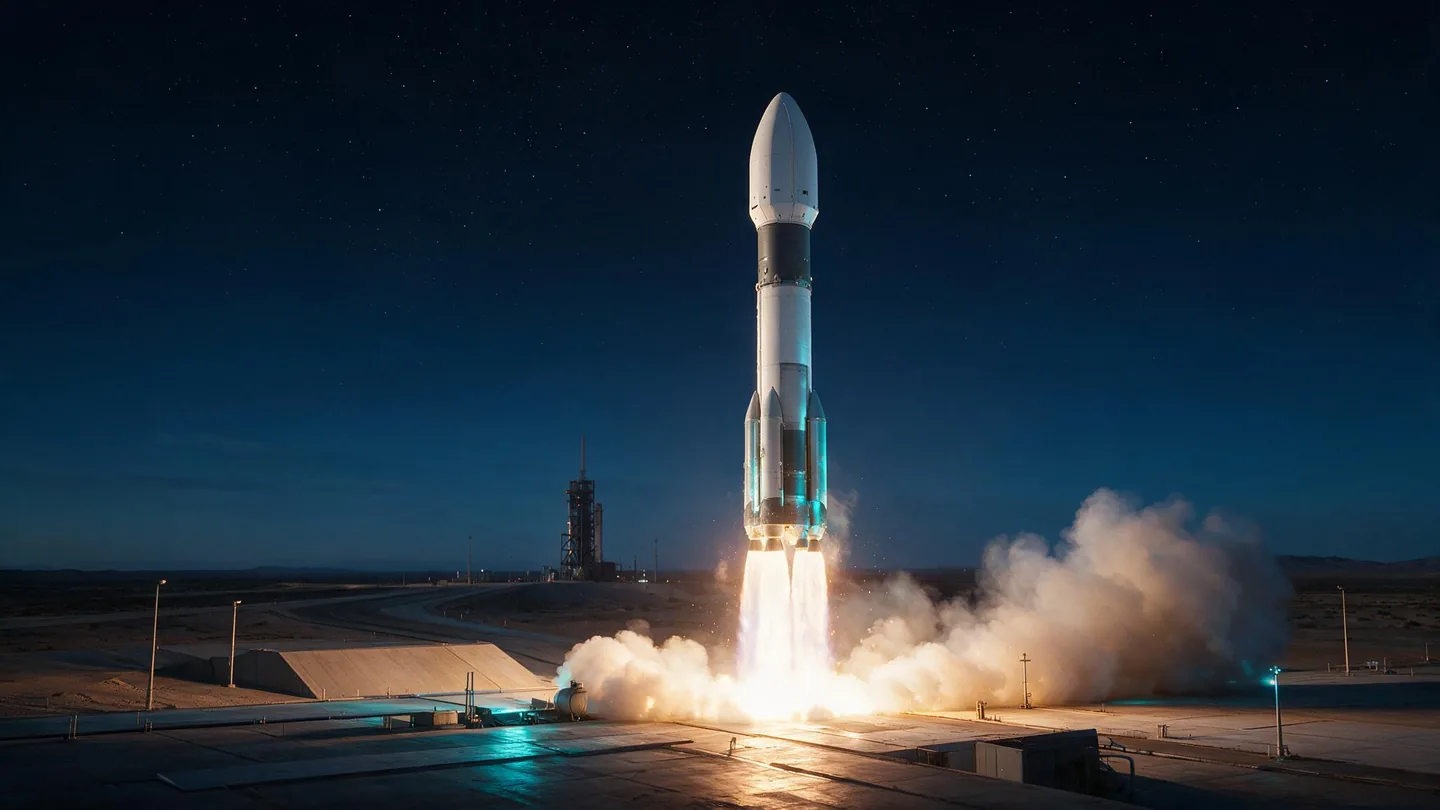
On September 1, 2026 (Beijing time), Beijing-based commercial launch provider Galactic Energy successfully conducted the maiden orbital flight of its new Pallas-1 (Zhìshénxīng Yīhào in Chinese, also rendered as Pallas 1) liquid-propellant rocket from the Dongfeng Commercial Space Innovation Pilot Zone at the Jiuquan Satellite Launch Center in northwest China. The 52-meter vehicle lifted off from its dedicated launch tower at 10:00 a.m. local time, flew a nominal profile, and delivered its upper stage into the planned sun-synchronous orbit. The vehicle carried no commercial payloads — the primary objective was to validate the overall design, propulsion, and guidance systems — making this a highly successful demonstration flight.
Pallas-1 is the 50th carrier-rocket model developed and flown by China, and the 12th built and operated by a private Chinese launch company.
Vehicle specifications
The Pallas-1 is a two-stage liquid-propellant launcher with an optional Eros kick stage for high-energy or multi-orbit missions. Its first stage is 3.35 meters in diameter, topped by a 4.2-meter payload fairing. Liftoff mass is approximately 283 metric tons and liftoff thrust roughly 350 tons.
- Seven CQ-50 pintle-injector LOX/kerosene engines on the first stage, each rated at about 50 tons of sea-level thrust
- A single vacuum-optimized CQ-50 powers the second stage, with multiple-restart capability
- Up to 7 metric tons to low Earth orbit and about 5 tons to a 500 km sun-synchronous orbit
- First stage designed for a minimum of 24 reuses
- CQ-50 engine family accumulated over 23,000 seconds of hot-fire testing before this debut
No first-stage recovery was attempted on this first flight; the booster followed a pre-planned expendable trajectory. Galactic Energy indicated that future missions will progressively introduce vertical landing and recovery of the first stage on the path to regular reuse.
Galactic Energy's growing portfolio
Pallas-1 joins the company's existing Ceres-1 (solid) and Ceres-2 (solid) smallsat launchers. The Ceres family has completed 24 launches to date, delivering nearly 90 satellites to a variety of orbits — one of the highest flight rates among Chinese private launchers.
The jump from solid-fueled small launchers to a medium-lift reusable liquid vehicle marks a significant step up in payload capacity and the company's addressable market. In its post-launch statement, Galactic Energy said the Pallas-1 will target orders for large-scale constellation deployment and launches of heavier satellites.
Industry context
2026 has been a banner year for new Chinese liquid rockets: LandSpace's Zhuque-3 achieved its first land-based booster recovery in August, Long March 6C made its debut, Jielong-3 flew successfully from a sea platform, and Long March 8A has continued to loft batches of Guowang (SatNet) satellites. According to industry trackers, China completed 44 orbital launches in the first half of 2026, 30 of them commercial — a 50-percent increase over the same period last year.
Demand from China's two megaconstellation programs — Guowang and Qianfan (G60) — is the dominant driver. Combined, they are on track to place more than 400 satellites into orbit this year and will require an estimated 700–800 launches over the next seven to ten years. That cadence strongly favors reusable, low-cost medium-lift vehicles of the kind Pallas-1 is designed to become.
Hanxing perspective
The successful debut of Pallas-1 adds another medium-lift, reuse-capable liquid rocket to China's commercial launch fleet and broadens the range of options available to satellite operators worldwide. As Hanxing — the global advisor for smallsat launch services from China, we closely track first flights and reusability milestones across every Chinese launcher so we can match international customers with the most suitable ride, schedule, and price point for rideshare and dedicated missions to LEO and SSO. As more reusable vehicles enter commercial service and the cost per kilogram continues to fall, Hanxing stands ready to connect constellation builders and individual smallsat operators with proven Chinese launch solutions, from early integration support through liftoff and on-orbit delivery.