
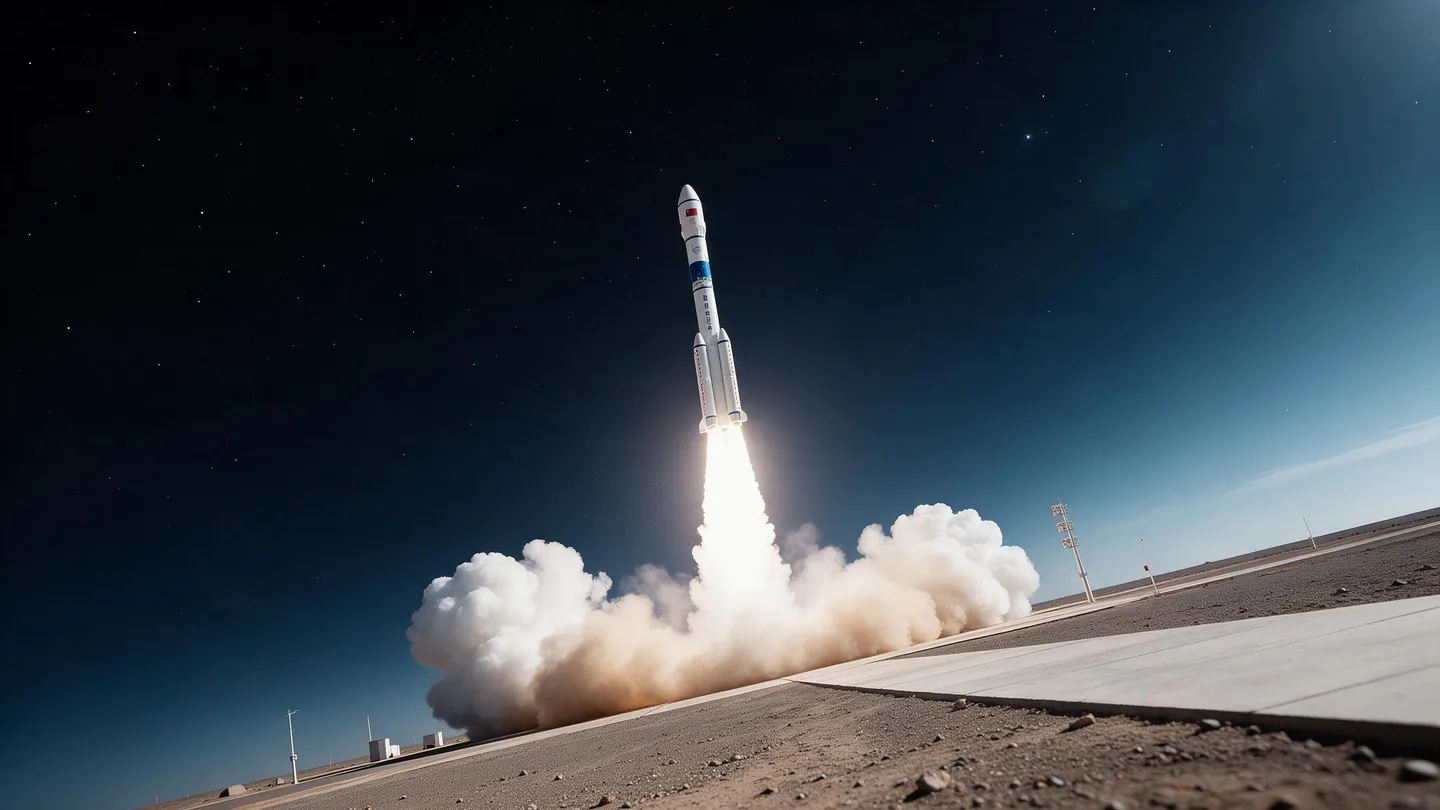
Maiden Success Opens New Chapter
At 10:00 a.m. on September 1, Pallas-1, a medium-lift reusable liquid-propellant rocket developed by Galactic Energy, lifted off from the company's dedicated launch pad at the Dongfeng Commercial Aerospace Innovation Test Zone in Jiuquan. The rocket followed its planned trajectory and successfully reached orbit, marking a fully successful maiden flight.
Notably, this mission was also the first use of the company-built "Pallas" launch complex (Phase I), which supports end-to-end integration, testing, propellant loading and launch operations — the first purpose-built commercial pad owned by a private Chinese launch provider.
Vehicle Specs and Reuse Roadmap
Pallas-1 is a two-stage rocket (with an optional upper stage), 52 meters long and 3.35 meters in diameter, with a liftoff mass of ~283 tonnes and liftoff thrust of 350 tonnes. Its LEO payload capacity is sized for batch deployment of megaconstellation satellites. The first stage clusters seven Cangqiong-50 (CQ-50) pintle-injector reusable LOX/kerosene engines developed in-house by Galactic Energy, rated for at least 25 reuses; CQ-50 demonstrated deep throttling from 32% to 105% of rated thrust and multiple restarts in ground tests — prerequisites for vertical landing.
Galactic Energy outlined a pragmatic three-step reuse roadmap:
- Step 1 (achieved): First flight to orbit, collecting full-flight data and validating propulsion/control baselines;
- Step 2: In upcoming missions, progressively enable first-stage reentry control, grid fins, braking burns, and pinpoint sea/land vertical landings;
- Step 3: Enter high-cadence reuse and commercial scale-up, streamlining refurbishment and shortening turnaround time.
Dual Product Line for Constellation Deployment
To date, Galactic Energy has completed 22 successful orbital launches, delivering 89 commercial satellites. With Pallas-1's debut, the company now operates a dual product lineup: the Ceres-1 family of small solid rockets for responsive, light-lift missions, and the Pallas-1 family of medium-to-heavy reusable liquids for megaconstellation deployment — extending its market coverage from small rideshares to large-scale constellation campaigns.
Against the backdrop of China's GW and G60 (Qianfan) megaconstellations accelerating deployment — together launching 143 satellites in H1 2026, 69% of all Chinese commercial satellites orbited — medium-lift reusable vehicles capable of multi-satellite rideshare are becoming the core capacity underpinning China's LEO build-out.
Hanxing Perspective
Pallas-1's successful debut adds another capable medium-lift reusable vehicle to China's commercial launch fleet, further expanding the menu of Chinese launch options available to global smallsat operators. Hanxing — Your Consultant for Small Satellite Launch Services from China closely tracks every capability milestone of Chinese commercial rockets. From the high-cadence Ceres-1 smallsat launcher to Pallas-1 targeting reusable megaconstellation missions, Chinese commercial providers are building a complete portfolio spanning payload classes and orbits. For international customers planning smallsat constellations, replenishment missions, or rideshare opportunities, timely access to Chinese launch slot availability, vehicle selection guidance, and end-to-end launch consulting on Chinese solutions is essential to reaching orbit efficiently. Hanxing continues to monitor each capability advance in the Chinese launch sector, offering professional China launch advisory services to help global smallsat customers ride China's high-cadence commercial launch windows.