
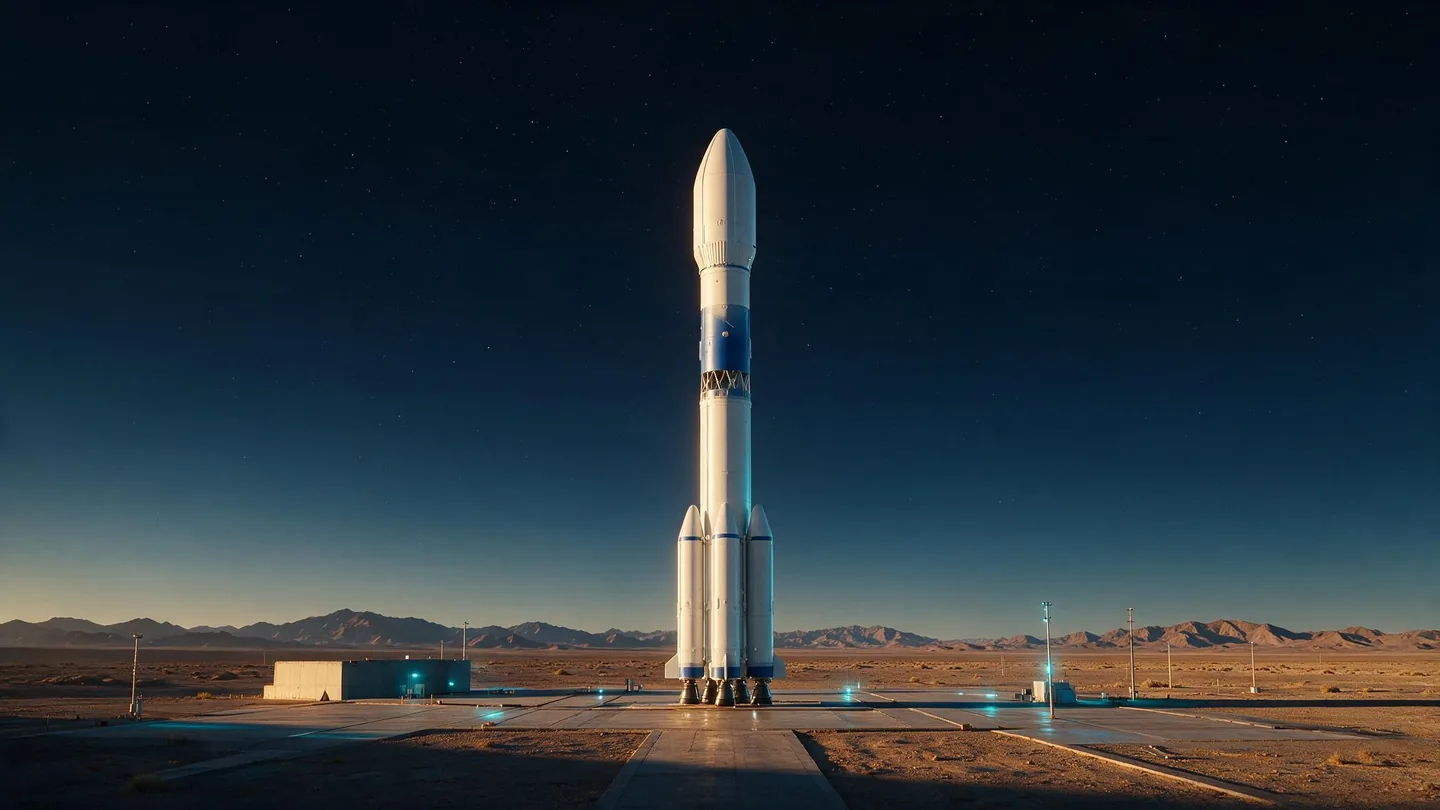
Chinese commercial launch company Galactic Energy is preparing for the first orbital flight of its Pallas-1 liquid-propellant launch vehicle, targeting September 1 from the Dongfeng Commercial Aerospace Innovation Test Zone at the Jiuquan Satellite Launch Center. The debut marks another addition to China's rapidly growing fleet of privately developed liquid rockets.
Rocket specifications and mission profile
Pallas-1 is a two-stage kerosene-liquid oxygen rocket with a body diameter of 3.35 meters, a fairing diameter of 4.2 meters, a liftoff mass of approximately 283 metric tons, and a liftoff thrust of roughly 350 tons-force. It is powered by Cangqiong-50 (CQ-50) kerolox engines and can deliver up to 7,000 kilograms to low Earth orbit. An optional Eros upper stage extends its mission envelope.
Airspace closure notices indicate a launch window opening late on August 31 Eastern Time (early September 1 UTC). The southbound trajectory, with drop zones over Gansu and Qinghai, suggests the rocket is targeting sun-synchronous orbit injection. No payloads have been announced for the demonstration flight, and no first-stage recovery will be attempted.
Reusability by design
Pallas-1 was engineered with reusability from the outset. Its first stage is designed for vertical recovery with a reuse count of 25 flights, employing a seven-engine parallel power system, deep-throttling reusable LOX-kerosene engine technology, and high-precision vertical recovery guidance for stage-level weak maneuvers. However, the inaugural flight will focus on validating orbital insertion capability, with recovery tests planned for subsequent missions.
Galactic Energy previously operated the Ceres-1 solid-propellant rocket and has initiated IPO tutoring. The company has raised over 336 million yuan in funding to date.
Looking ahead: Pallas-2 targets megaconstellation launch demand
The more ambitious Pallas-2 is under parallel development. According to company plans, Pallas-2 will be powered by the largely 3D-printed CQ-90 kerolox engine, with single-stick and tri-core configurations offering payload capacities ranging from 20,000 to 58,000 kilograms — positioning the vehicle to compete for launch contracts serving China's Guowang and Qianfan megaconstellations.
China's low-Earth-orbit constellation buildout is accelerating, with projections calling for hundreds of launches over the next seven to ten years. The entry of additional medium-lift, reusable-capable rockets will help alleviate launch capacity constraints and provide satellite operators with more options.
Hanxing perspective
As a full-chain launch service provider for small satellites in China, Hanxing closely monitors the continued expansion of domestic launch capacity. The addition of Pallas-1 means clients will have more launch vehicle options and scheduling flexibility in the medium-lift category. Hanxing will continue collaborating with the growing roster of Chinese rocket companies to match global small-satellite customers with the right launch solutions.