
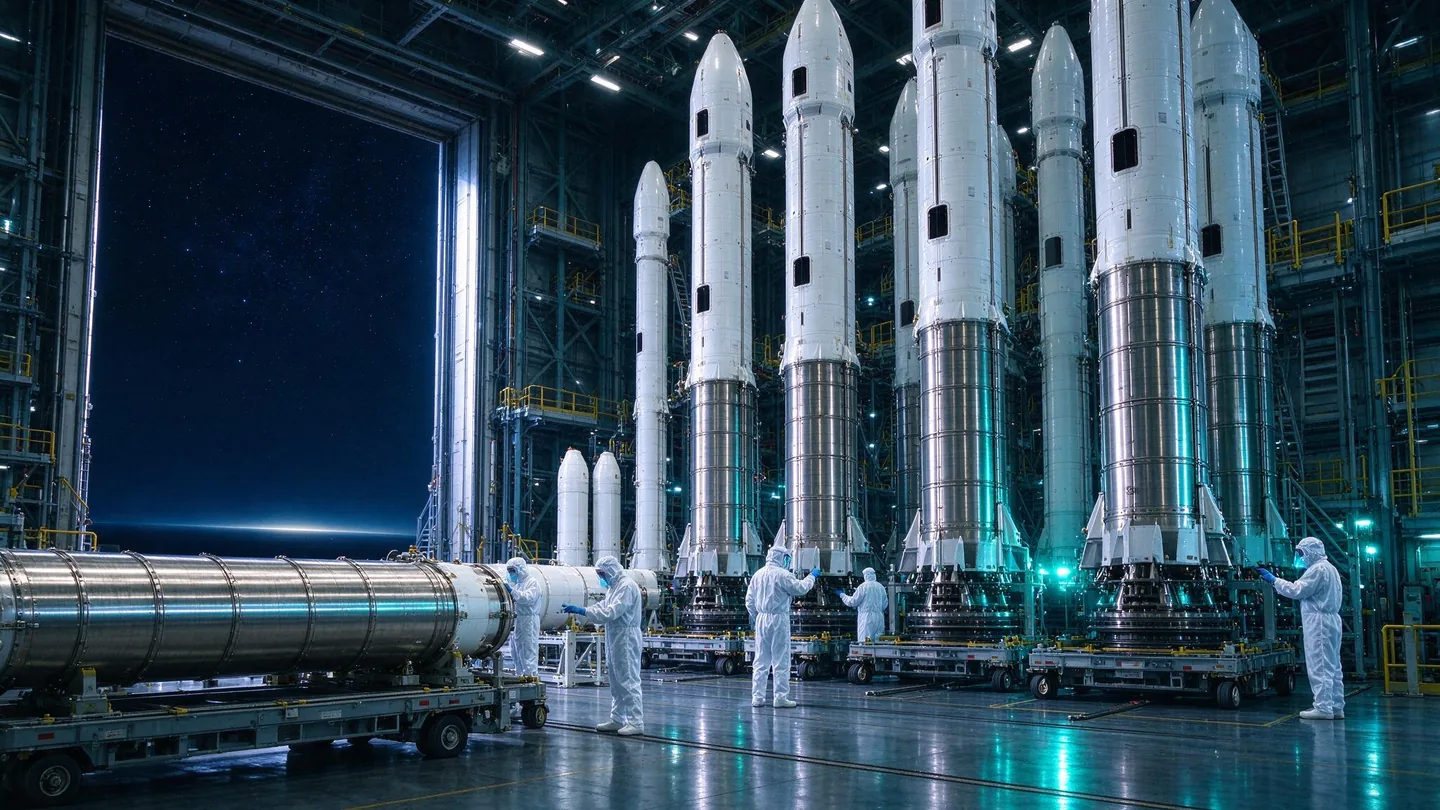
As of November 6, the queue of Chinese commercial-space companies lining up for listings on the STAR Market and Hong Kong's main board has grown from "a handful of rocket makers" into a full chain spanning launch vehicles, satellites, components, materials and ground operations. On October 27, Hubei-based Hangju Technology completed its pre-IPO tutoring filing in Hubei — the first member of that list that builds neither rockets nor satellites, but the layer most likely to burn away when a booster comes back through the atmosphere.
Three states of the queue
Public disclosures put the queue in three tiers.
In active review: LandSpace (seeking RMB 7.5 billion, accepted December 31, 2025), CAS Space (RMB 4.18 billion, accepted March 31, applying the STAR Market's second listing standard) and Minospace (RMB 5 billion, accepted May 11). All three flipped to "suspended — financial update" on the same day, September 30, because their audited accounts had expired.
Past the hearing: Guoxing Aerospace cleared the Hong Kong Stock Exchange main-board hearing on October 29. Its prospectus lists 37 AI satellites awaiting delivery worth RMB 1.231 billion, plus a "Stellar Computing" plan for a 2,800-satellite AI constellation.
In tutoring: Galactic Energy, iSpace, Space Pioneer, Galaxy Space, Spacety, Astage, Yixin Aerospace, Aerospace Trek and Hangju — nine companies. Origin Space is preparing a shareholding reform; Chang Guang Satellite has restarted an IPO push but has not completed tutoring.
A caveat: the widely cited "14 companies" figure comes from a tally by IPO Daily, part of International Finance News — a media count, not a regulatory disclosure. Statuses move month to month, so individual filings are the safer reference.
Why materials deserve their own lane
Hangju's positioning is worth spelling out. Its WS-series "in-situ ceramization" flexible reusable thermal protection material can be bent to fit irregular structures such as landing legs and grid fins at room temperature, then ceramizes under reentry heat. The company says it withstands above 1,400°C, supports more than 15 reuses, and costs roughly one-tenth of comparable international ceramic materials. It has flown on LandSpace's Zhuque-3 booster and entered the supply chains of iSpace and other leading rocket firms.
The valuation curve tells you what the market is pricing: Topstrong invested at a RMB 1.1 billion valuation in January 2025; in May 2026 Changjiang Venture Capital and Wuhan Venture Capital co-led a RMB 113 million round at a post-money valuation near RMB 4 billion — more than 2.6 times in 16 months.
The industrial logic is straightforward. On an expendable rocket, thermal protection is consumable. On a reusable one, it is a critical part that must be inspected and partly replaced before every reflight. The more reuses, the more the material shifts from a cost line to a cadence line — it decides whether a booster can fly again within weeks. That is why materials suppliers can see steady delivery and margin improvement earlier than vehicle integrators.
Two listing standards, two clocks
Running inside this single IPO wave are actually two rulebooks.
The STAR Market's fifth standard sets a precise milestone for commercial rocket firms: at the time of filing, the company must have achieved the first successful orbit of a payload by a medium-to-large launch vehicle using reusable technology. On public information, only LandSpace meets that bar — Zhuque-3 reached orbit and, in August, recovered its orbital-class first stage on land.
CAS Space took the other road: the second standard, requiring an expected market value of at least RMB 1.5 billion, revenue of at least RMB 200 million in the latest year, and three-year cumulative R&D spending equal to at least 15% of cumulative revenue. Its 2024 revenue was RMB 244 million and its 2022–2024 R&D ratio 184.05%, built on established solid-rocket commercial launches, with a reusable liquid vehicle such as Lijian-2 on the development side.
That fork determines who moves quickly and who must wait for one real orbital flight. It is not a question of better or worse, but of two yardsticks — technical milestones and operating numbers — measuring the same cohort at once.
The bottleneck is not technology but account expiry
The phrase that recurs most in this queue during 2026 is not "launch" but "suspended — financial update."
Audited financial statements cited in a prospectus are typically valid for six months, extendable by up to three. Data with a December 31, 2025 cutoff could be used only until September 30, 2026. Hence the synchronized suspension on that date for LandSpace, CAS Space and Minospace. This is a procedural refresh, not a rejection.
But the cost of an interrupted rhythm is real. LandSpace was accepted on December 31, 2025, entered questioning on January 22, was suspended on March 31, restored on June 29 after updating its accounts, then suspended again on September 30 — a full loop of "questioning, suspension, restoration, suspension" inside one year.
Market expectations of an October-end or early-November hearing were generated and dissolved inside that loop. As of November 6, the exchange had published no new listing-committee session, so any "date is set" claim remains expectation rather than fact. What is worth watching is the committee's meeting notice itself, not the rumour.
The money must become launch cadence
How the proceeds will be used says more than the headline size.
Of LandSpace's RMB 7.5 billion, RMB 2.77 billion goes to reusable-rocket capacity and RMB 4.73 billion to reusable technology. Of CAS Space's RMB 4.18 billion, RMB 2.183 billion funds reusable heavy-lift development, RMB 857 million reusable upper stages and spacecraft, and RMB 340 million a reusable liquid-engine industrial base. Almost all of it points at one thing: turning "can fly once" into "can fly on a schedule."
That matters most to constellation customers. After Lijian-2's second flight put 18 satellites into Qianfan's polar orbit on November 3, lifting the constellation to 274 spacecraft, the market's question is no longer whether a private rocket can serve a constellation, but when the next batch of 18 is scheduled, how long the interval is, and how fast a gap can be refilled after a failure. Those answers live in production capacity, engine deliveries and pad turnaround — not in valuation paragraphs.
Hanxing view
Seen whole, Chinese commercial space is solving two problems at once: where the money comes from, and where the rockets come from. The first is the capital market's job; the second depends on reusable technology and capacity build-out. Where the two meet is launch pricing and delivery schedules.
For satellite customers at home and abroad, the practical effect of this capital wave is not share prices but the supply curve for launch capacity over the next two to three years — more completed raises mean more pads, more batch production and more bookable windows. Hanxing — your China launch service advisor for small satellites worldwide — tracks every status change and every launch milestone in this queue, translating technical milestones into executable launch consulting: mission-window matching, multi-satellite dispatching for smallsat constellations, dedicated-vehicle block bookings and in-orbit delivery under China launch solutions, so customers can get their spacecraft up on time through the tightest years of capacity.