
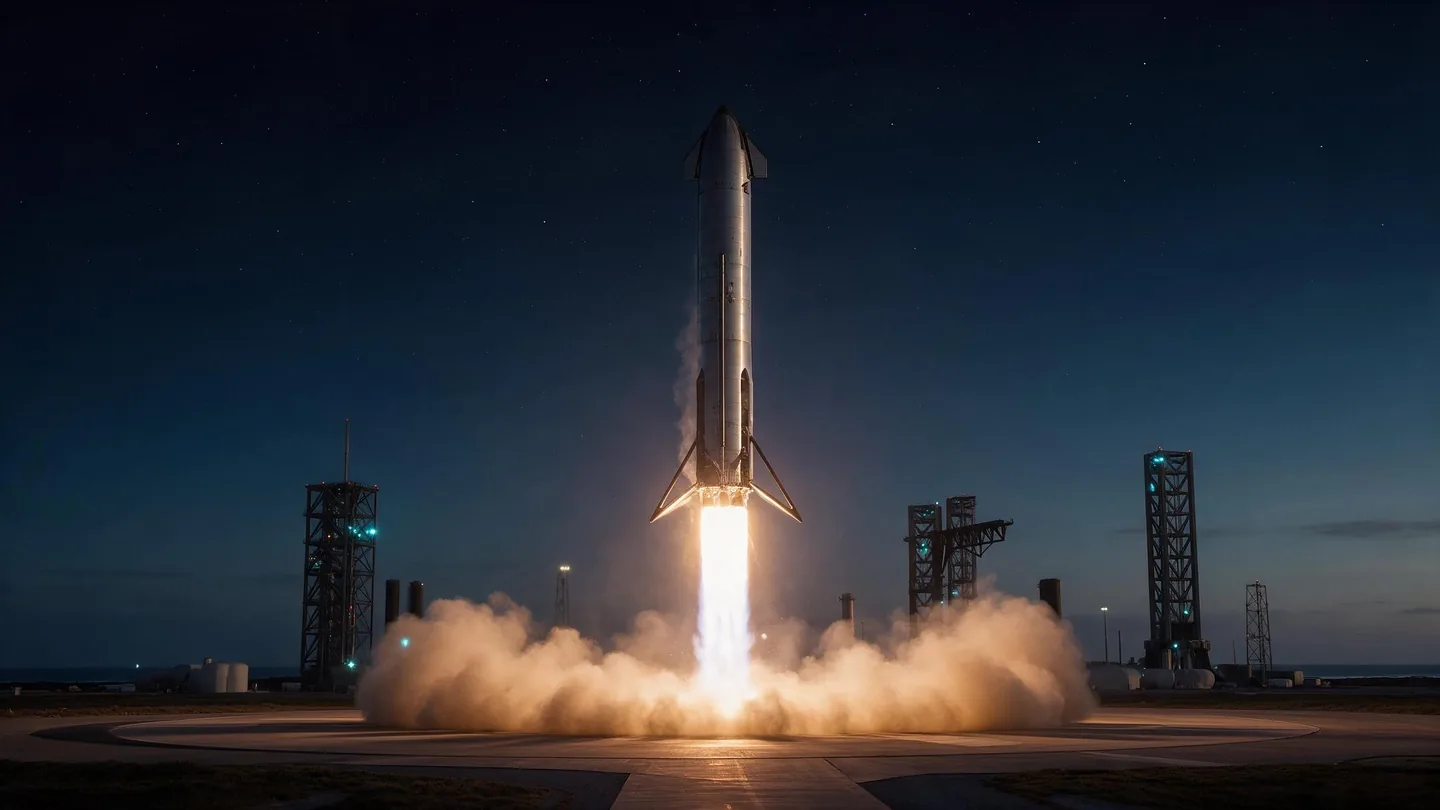
With the successful controlled recovery of the Long March 10A (长征十号乙) first stage and the Zhuque-3 (朱雀三号) booster, reusable rocket technology has reached a landmark moment in China. At the 2026 Pujiang Innovation Forum's commercial space session held in Shanghai on September 13, industry experts converged on a clear conclusion: China's commercial space sector has shifted its focus from "proving technical feasibility" to "pursuing scaled operations and profitability," with the competitive frontier moving from individual rockets or satellites to the integrated efficiency of a full "satellite–rocket–launch–tracking–operation" system.
From validation to operations
In 2026 China's reusable rockets made dense breakthroughs. On July 10, the Long March 10A launched from the Hainan commercial launch site and recovered its first stage via a sea-based net capture — the country's first controlled first-stage recovery and the world's first net-capture recovery. On August 19, the Zhuque-3 completed China's first land-based vertical landing of a first stage. Together these milestones signal the industry's shift from "can we recover it" to "can we reuse it cheaply and frequently."
Domestic strengths and gaps
China's commercial space sector now benefits from four enabling conditions — policy, market, technology, and business-model innovation. The country hosts 37 rocket companies clustered in the Beijing-Tianjin-Hebei, Yangtze River Delta, Greater Bay Area, and Chengdu-Chongqing regions, supported by a combined land-and-sea launch network. The Hainan commercial launch platform has completed 21 launches delivering 221 satellites; the Qianfan ("Thousand Sails") constellation has reached 238 satellites in orbit and aims for 324 by year-end for regional service, while Jilin-1 has grown into the world's largest sub-meter optical remote-sensing constellation.
Yet the gap with SpaceX remains clear. SpaceX has cut launch costs to a few thousand dollars per kilogram through reuse, completed hundreds of recoveries, and accounts for over half of global launches, building a vertical ecosystem spanning launch, constellations, and applications. By comparison, China's rocket reuse is still in its infancy, launch pads operate at roughly 10–12 missions per year with about 20-day turnaround, and commercial tracking-and-control still leans heavily on the national system. The core gap is not a single technology but the "from 1 to N" capability of scaled, systematic operation.
Three paths forward
Forum participants framed the way forward as "foundation, chain, and ecosystem." Foundation means engineering and scaling reusable rockets, targeting thousand-tonne annual payload capacity and launch costs of around RMB 10,000 per kilogram, plus two to four world-class space industry clusters. Chain means connecting satellite, rocket, launch site, tracking, and application links with unified standards and a commercial loop. Ecosystem means strengthening top-level planning with a national constellation master plan and steering capital from hype toward value-driven investment.
Hanxing's view
China's commercial space sector stands at a "constellation-pace versus launch-capacity" window. Whoever first closes the loop of "reusable launch + massive constellation deployment + integrated operations" will seize the lead in a trillion-yuan space economy. As "Hanxing — the global small-satellite China launch service advisor," we are watching closely: the low-cost, high-frequency launch capability unlocked by reusable rockets is precisely the most scarce resource for small-satellite customers building constellations, and it will open a far broader path for global small-satellite users to access China's launch solutions and achieve low-cost access to orbit.