
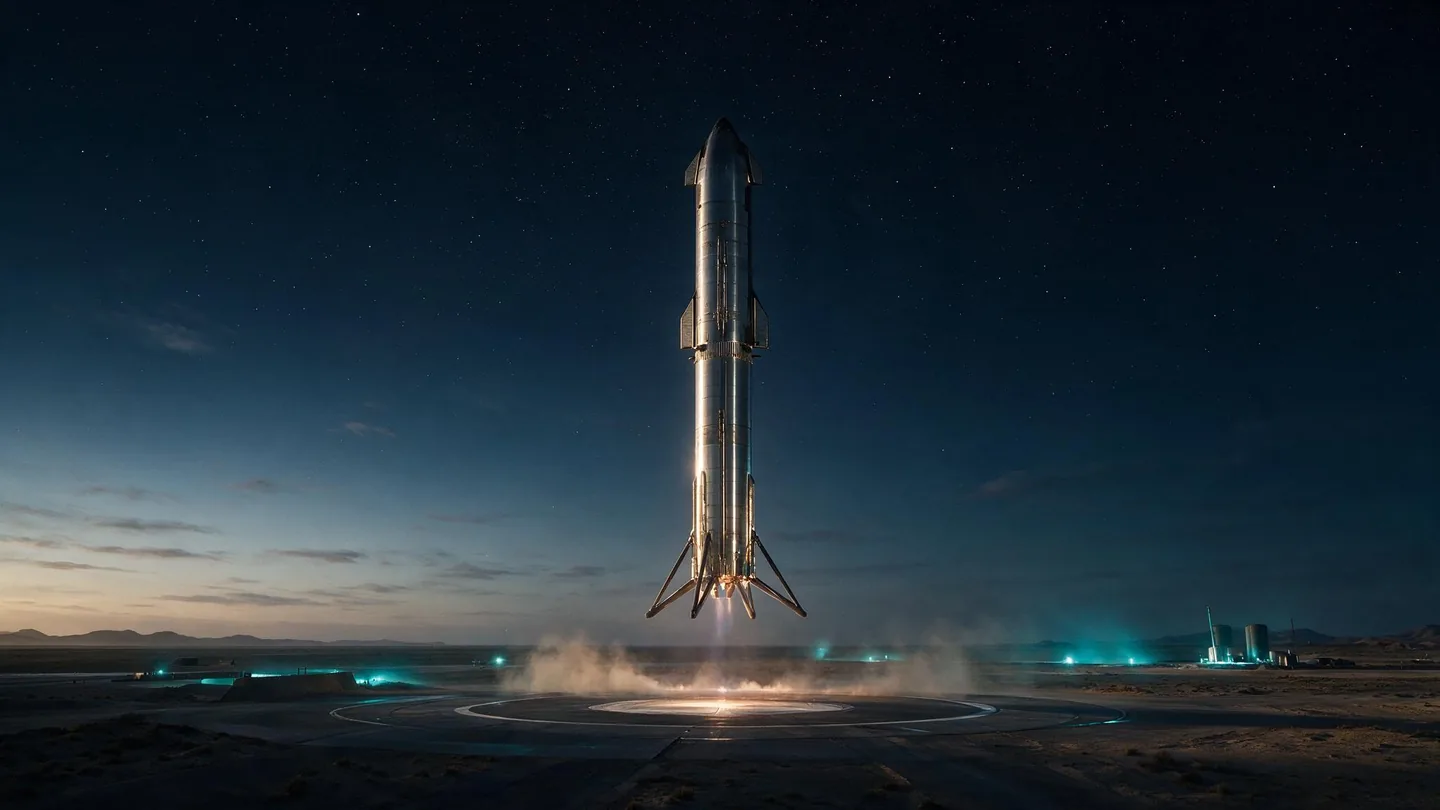
Between July and August 2026, China's commercial space sector achieved consecutive breakthroughs in reusable-rocket technology. On July 10, the Long March 10B -- developed by CASC's Shanghai Academy of Spaceflight Technology -- became the first Chinese orbital-class rocket to recover its first stage, caught by a net mechanism on an offshore platform in the South China Sea. Just 40 days later, LandSpace's Zhuque-3 (ZQ-3) Y2 lifted off from the Dongfeng Commercial Space Innovation Pilot Zone and landed its first stage on land using deployable landing legs -- China's first land-based propulsive recovery of an orbital booster.
Multiple routes in parallel: China's reusable-rocket lineup
Unlike SpaceX, which relied on a single vehicle (Falcon 9) to carry Western commercial launch for a decade, China is pursuing multiple recovery techniques simultaneously. The publicly disclosed reusable-rocket programs include:
- Long March 10B (CASC): offshore net-capture recovery, successfully demonstrated
- Zhuque-3 (LandSpace): land-based landing-leg recovery, successfully demonstrated, methane-fueled
- Long March 12A (CASC Shanghai): attempted recovery on maiden flight in December 2025, follow-up flight pending
- Tianlong-3 (Space Pioneer): failed on first test launch in early 2026, development continuing
- Hyperbola-3 (iSpace), Pallas-1 (Galactic Energy) and others in development
Demonstrating two distinct recovery methods within two months signals that China's reusability effort is shifting from isolated breakthroughs to a coordinated pipeline.
Why the acceleration? The megaconstellation imperative
Chinese officials project the country's two largest constellations -- Guowang and Qianfan -- will require 700 to 800 rocket launches over the next seven to ten years. Globally, Analysys Mason forecasts more than 37,000 satellites will need to be launched between 2023 and 2033. Meanwhile, SpaceX's Falcon 9 may wind down commercial operations after 2028, widening the Western launch-capacity gap.
This means demand for medium-lift, reusable, high-cadence rockets is acute -- in both domestic and international markets. China's series of reusable-rocket milestones arrives at exactly the right moment.
What it means for satellite operators
The core value of reusable rockets lies in lowering per-launch costs and increasing flight frequency. As China's reusable fleet moves from demonstration to engineering application, several trends merit attention:
- Capacity diversification: reduced reliance on a single rocket model, greater scheduling flexibility
- Cost reduction potential: LandSpace plans to reuse each booster at least 20 times, which should materially lower per-launch cost over time
- Faster constellation deployment: higher cadence means satellites reach orbit sooner, shortening the gap from production to insertion
- More international options: China's commercial launch services are gradually opening to foreign customers, offering an alternative to SpaceX and Arianespace
Hanxing take
As a full-chain launch service provider for small satellites from China, Hanxing closely tracks the progress and commercialization of domestic reusable rockets. China's multi-route approach to reusability not only raises the ceiling of national launch capacity but also gives satellite operators a wider range of launch options at more competitive pricing. Hanxing will continue integrating China's growing rocket fleet to help domestic and international small-satellite customers find the optimal orbital path and launch window for efficient constellation deployment.