
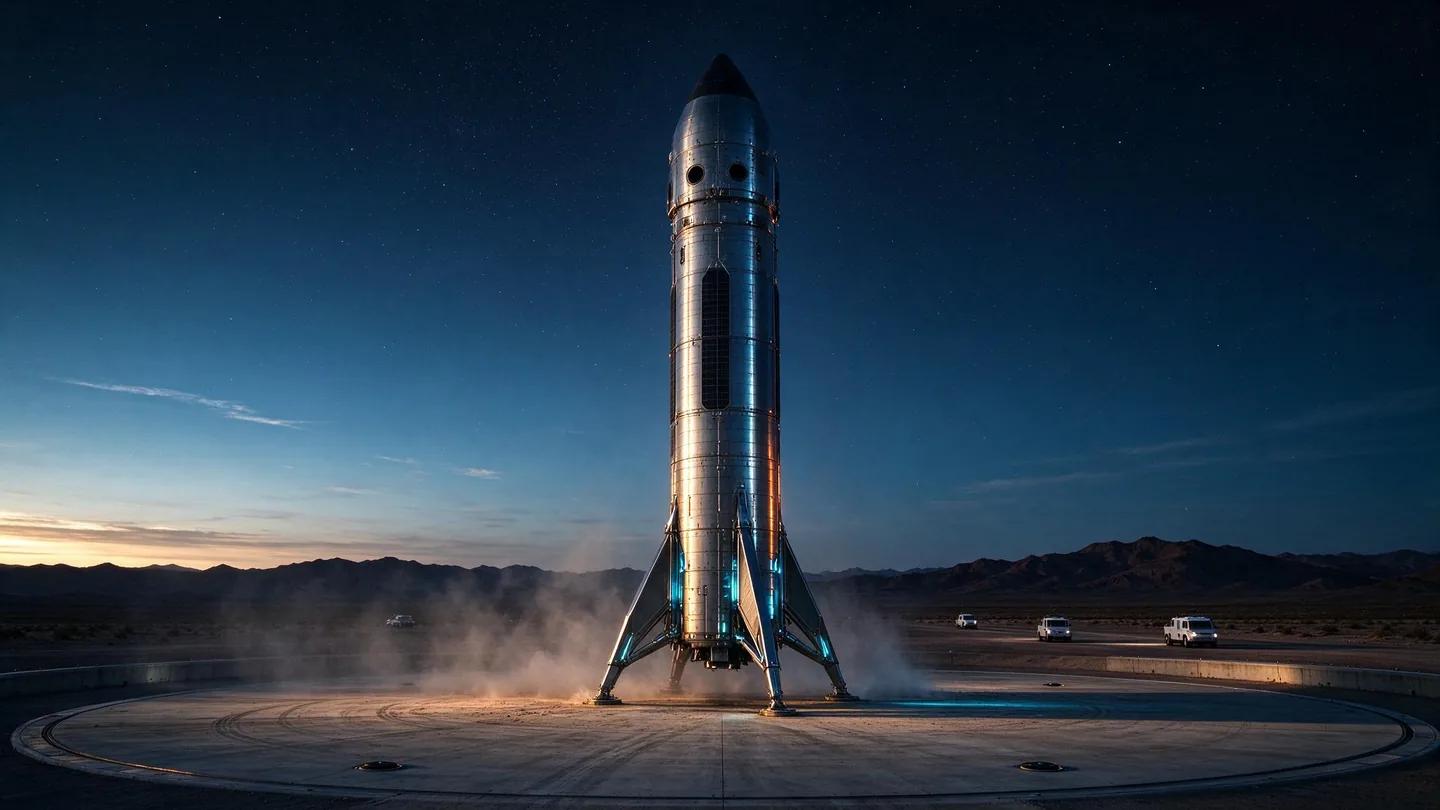
China's reusable-rocket progress in 2026 has been anything but even. One company has brought a first stage back from orbit to a land pad; another is still waiting for a second flight; a third is not in the reusability race at all. Putting the four main vehicles on one timeline makes "which step is it stuck on" a more useful question than "who leads".
Zhuque-3: past the landing test, now stuck at reflight
At 07:35 on 19 August 2026, LandSpace's Zhuque-3 Y2 lifted off from the Dongfeng commercial space zone. Its second stage delivered Hongqing Technology's Honghu-03 satellite to orbit, while the first stage flew the full profile — attitude control at altitude, reentry burn, aerodynamic glide, landing burn — and touched down in the centre of a landing pad in Minqin County, Gansu.
This was China's first controlled land recovery of an orbital-class first stage using landing legs. The only other Chinese vehicle to complete both orbit insertion and booster recovery is the Long March 10B, which caught its first stage in an offshore net on 10 July — just 40 days earlier.
Recovery, however, is not reusability. On the Y1 maiden flight of 3 December 2025, the first stage suffered abnormal combustion during the landing burn about three kilometres above the ground, and the debris came to rest 40 metres from the target centre. Over the following eight months LandSpace converted that failure into design changes: fewer engines lit for the landing burn, a predicted-impact-point function added to the autonomous flight-termination system, and a redesigned aft-bay thermal protection.
Deputy chief designer Dong Kai was notably restrained about the milestone: on a nine-level technology-readiness scale, LandSpace has just crossed level six and entered level seven — physical flight validation. Level eight is marked by reflight. Chief designer Zhang Xiaodong said in April that the company aims to attempt its first reuse flight in the fourth quarter.
In expendable mode Zhuque-3 can lift 21.3 tonnes to low Earth orbit, or 18.3 tonnes with downrange booster recovery, and the booster is designed for at least 20 flights. The open questions are turnaround time and refurbishment cost, and no Chinese company has published either.
Tianlong-3: stuck at return-to-flight, recovery not yet begun
Space Pioneer's Tianlong-3 sits two rungs lower. Its Y1 vehicle launched on 3 April 2026 and failed. The official failure report is specific: vented liquid oxygen was ingested toward the base of the vehicle, causing secondary combustion of first-stage turbopump exhaust; the aft heat skirt's joint structure was ablated and deformed, hot gas entered the aft bay and a fire broke out. One corrective measure moved the oxygen vent from vertical to lateral discharge to reduce ingestion.
On 12 September the company confirmed that the Y2 vehicle had completed final assembly and integrated testing, and that it expects to return to flight in the fourth quarter subject to a launch window. Tianlong-3 is 3.8 metres in diameter with 770 tonnes of liftoff thrust, 17 tonnes to LEO, and a first stage equipped with grid fins and landing legs.
It is stuck at a step well before recovery: it has not yet completed a second orbital flight, and no booster recovery attempt has taken place. For a 17-tonne-class vehicle, that order is the right one — prove reliability first, then talk about reuse. The cost is that it must compete for the same launch window as three other new vehicles.
SQX-3: stuck between an ambitious goal and a slipped date
Interstellar Glory's SQX-3 is 4.2 metres in diameter, with 14 tonnes to LEO expendable and 8.5 tonnes in recovery mode, designed for at least 20 flights. Its stated goal is unusually aggressive: achieve orbit insertion and an offshore booster recovery on the very first flight.
That goal also explains the slip. In December 2025 the plan was a first flight from Hainan in the first half of 2026; by 12 March 2026, at the Shanghai commercial space conference, vice president Xie Hongjun described it as expected by the end of 2026. Six months, and the target moved from mid-year to year-end.
Preparation has not stalled: in mid-to-late June the company completed a full-scale rehearsal of the first stage's offshore recovery process off Yangjiang, Guangdong, and in August closed the first tranche of a roughly 1 billion yuan Series E round earmarked for SQX-3 development, production and recovery infrastructure.
Kinetica-2: it flew, but it is not in this race
CAS Space's Kinetica-2 is easily misplaced on this table. At 19:00 on 30 March 2026 its Y1 vehicle flew successfully from the Dongfeng zone, delivering the Qingzhou prototype cargo spacecraft and other payloads to orbit. The vehicle uses a common-booster-core configuration with 12 tonnes to LEO, and it is expendable.
A reusable variant remains on the drawing board; public material describes a follow-on version with partial reusability targeted for a first flight no earlier than 2028. Kinetica-2's near-term job is launch cadence and international orders, not booster recovery.
For completeness: Galactic Energy's Pallas-1 reached orbit successfully on 1 September 2026, is designed for at least 25 flights, and plans to begin orbital-class recovery trials alongside its launch missions — a younger vehicle, but standing on the same ladder's bottom rung.
The real bottleneck, once you line them up
The ladder is clear: orbit insertion, then recovery, then inspection and reflight, then high-cadence production. Zhuque-3 stands between the second and third rungs; Tianlong-3 and SQX-3 are still at the door of the first; Kinetica-2 is not on the ladder.
One economic fact is easy to overlook: a first stage accounts for roughly 70 percent of a rocket's cost, while methane propellant is only 1 to 3 percent of launch cost. Reusability therefore is not about saving fuel — it is about converting 70 percent of the vehicle from single-use to amortised. Which means that after the applause at touchdown, two numbers decide the business case: the minimum interval between flights, and the cost of one refurbishment.
No Chinese company has published either. The first comparable sample will appear when Zhuque-3's recovered booster actually flies again. That is why the fourth-quarter window matters more than any single maiden flight.
Hanxing view
For smallsat customers, the value of this table is not knowing who is ahead. It is judging when a cheaper, denser launch contract becomes negotiable. Unit prices loosen only after recovery is proven and reflight data exists. Until then, the one reliable variable is window density — with constellation launches and several new vehicles stacked into the fourth quarter, rideshare opportunities on the main medium-lift vehicles are no longer bunched into a couple of months.
Hanxing — the global smallsat China launch service advisor — tracks every vehicle's verified milestones from orbit insertion through recovery to reflight, and re-runs its pricing model once reflight data appears. For operators planning a deployment cadence, we would rather explain when to sign, on which vehicle and for which window than quote a single number. Launch consulting, smallsat constellation planning and China launch solutions all rest on verifiable progress like the milestones above.