
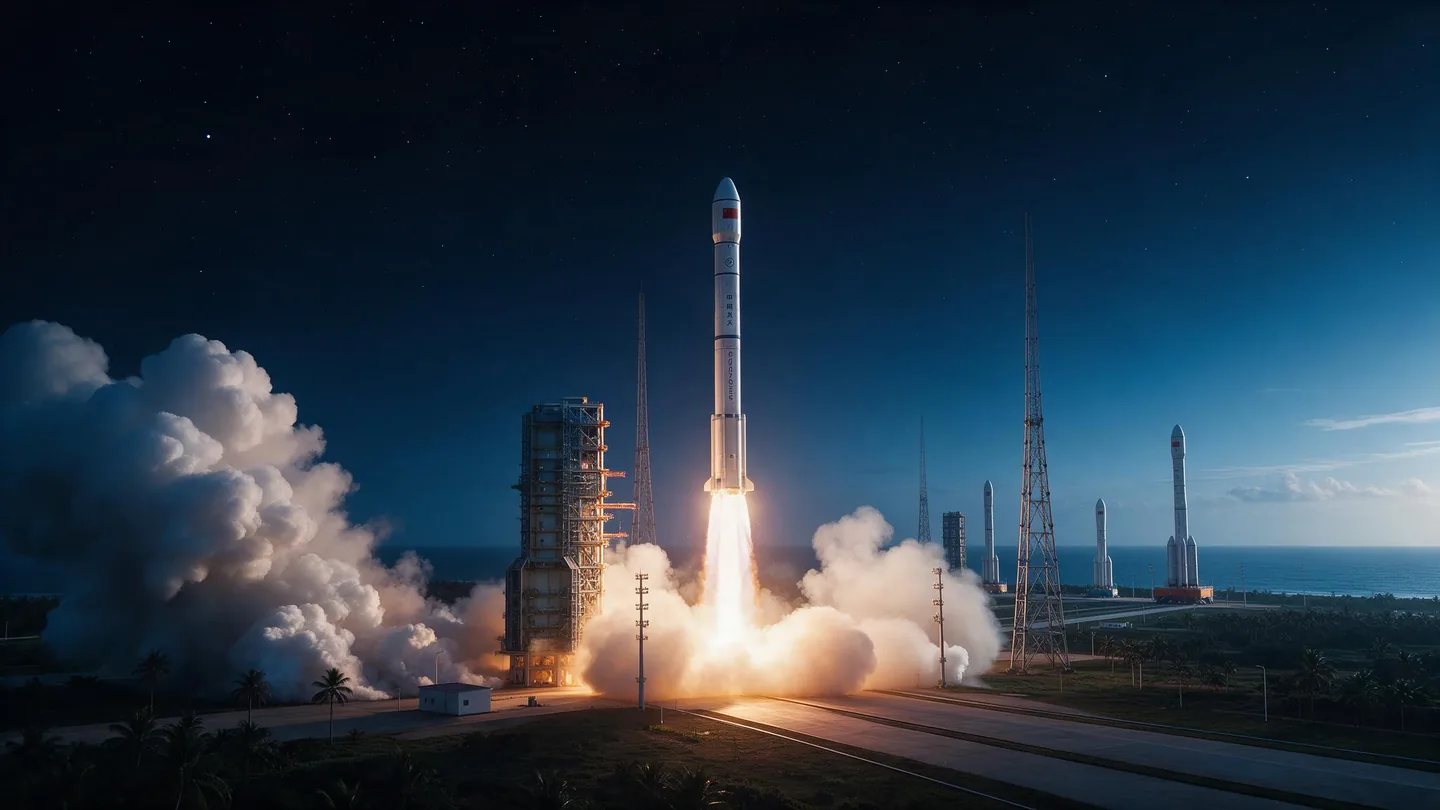
In late September 2026, China's space launch cadence shifted into high gear as the country approaches the final quarter of the year. Within a 48-hour window on Sept. 23–24, two different Long March rockets lifted off from the Hainan commercial spaceport and the Taiyuan Satellite Launch Center, orbiting the 26th batch of the national Guowang LEO internet constellation and the fourth group of Yaogan-40 electronic intelligence satellites — capping off a record month of ten orbital missions.
The Two Launches in Detail
Guowang Batch 26 — Long March 8A
At 13:32 UTC on September 23, a Long March 8A lifted off from the Hainan Commercial Space Launch Site carrying the 26th group of Guowang satellites. The spacecraft, developed under the overall leadership of the China Academy of Space Technology (CAST), were deployed into roughly circular 1,100-kilometer orbits inclined at 50 degrees.
The Long March 8A — which debuted in February 2025 — has become a workhorse for China's megaconstellation build-out, launching regularly from Hainan's dedicated commercial pads and providing a dedicated medium-lift capability optimized for constellation deployment.
Yaogan-40 Group 04 — Long March 6A
Less than 24 hours later, at 08:46 UTC on September 24, a Long March 6A launched from Taiyuan carrying three Yaogan-40 (04) satellites. According to Chinese state media, the triplet is primarily used for electromagnetic environment detection and related technology experiments — the standard language for China's Yaogan series of military reconnaissance satellites.
The satellites entered near-polar orbits at roughly 800 km altitude, joining three earlier Yaogan-40 groups. Analysis by Integrity ISR indicates the four Yaogan-40 groups are placed into orbital planes separated by approximately 72 degrees in right ascension of the ascending node, suggesting a fifth group will be needed to complete the constellation.
The Long March 6A — a kerosene-fueled core vehicle with solid strap-on boosters — has now flown 27 missions since its debut in March 2022, all successfully reaching orbit. It is one of CASC's primary vehicles for both Yaogan and megaconstellation missions out of Taiyuan.
A September Sprint
All told, China conducted ten orbital launches in September 2026 — among the busiest single months in the country's space history. The highlight came on Sept. 15–16, when four different rockets launched from three sites within a 48-hour window, demonstrating China's growing ability to run parallel launch campaigns across multiple spaceports.
Year-to-date, China has carried out 70 orbital launch attempts in 2026: 18 in Q1, 26 in Q2, and 26 in Q3. To reach its target of more than 100 launches in a single calendar year — a milestone that would mark another historic first — China will need to conduct at least 31 launches in Q4. Given the country's traditionally back-loaded annual manifest, that target appears within reach.
Why the Pace Is Accelerating
The Guowang constellation, operated by state-owned China SatNet (established in 2021), is planned to comprise roughly 13,000 satellites, placing it among the world's largest LEO internet projects alongside Starlink and OneWeb. China is pursuing a multi-vendor approach: satellites are built by multiple manufacturers across both CASC and CASIC, and launched aboard a growing fleet of Long March vehicles.
The Hainan Commercial Space Launch Site — China's first fully commercial spaceport — has been instrumental in enabling this pace, providing dedicated infrastructure for high-frequency commercial launches.
Hanxing Perspective
As a global consulting partner for small-satellite launch services from China, Hanxing closely tracks both the expansion of China's LEO constellations and the maturation of its launch vehicle fleet. The accelerating cadence of Long March 8A and other new-generation rockets translates directly into more frequent ride-share opportunities, more flexible slot availability, and increasingly competitive pricing for international small-satellite operators. Hanxing — your advisor for China-based launch solutions — stands ready to match your satellite mission with the right vehicle, the right window, and the right integration pathway from factory to orbit.