
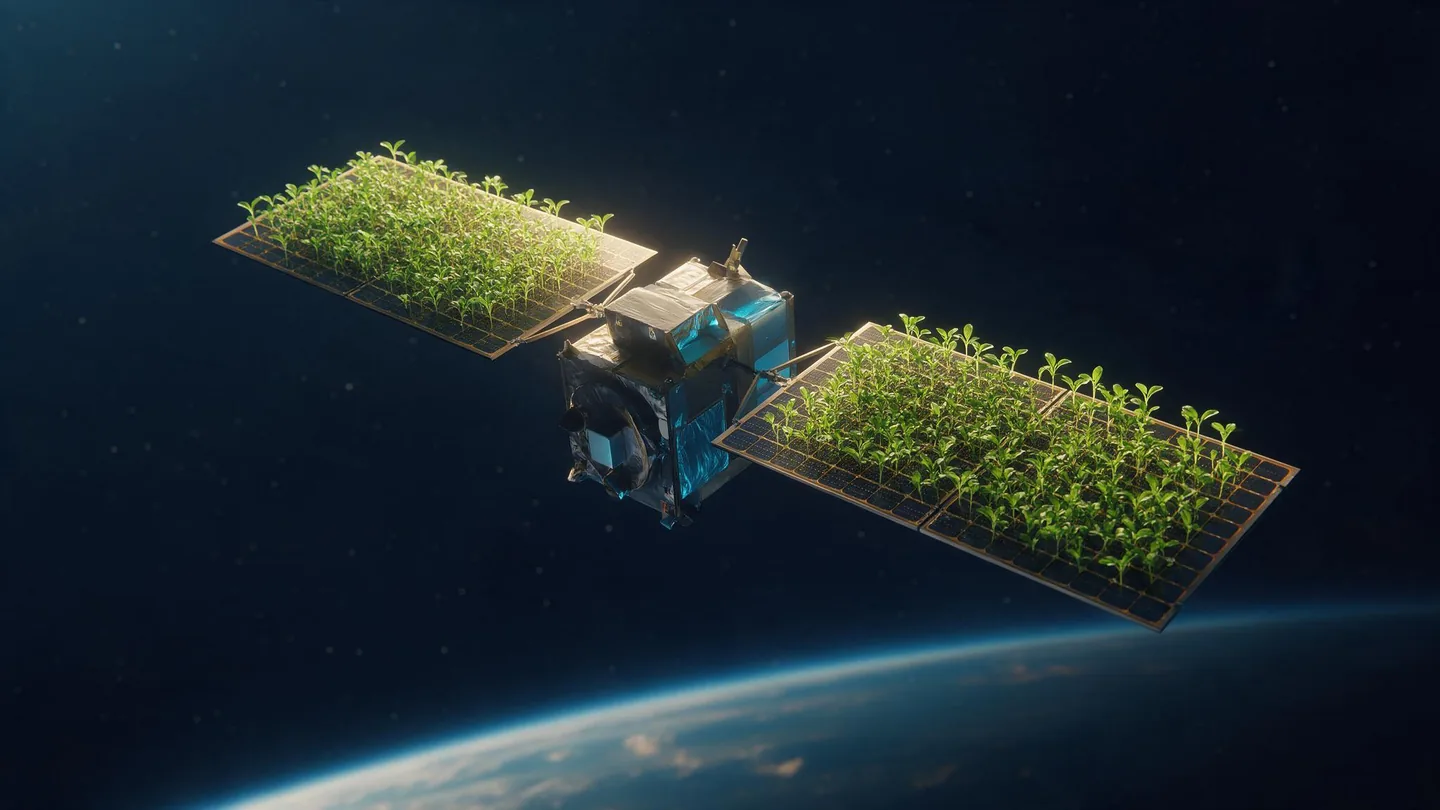
On September 27, according to the Shaanxi provincial information office, the Shaanxi Aerospace Breeding Engineering Research Center and Zhongke Satellite Technology Group signed a cooperation agreement at Xi'an Wenyi University to jointly build a joint laboratory for space biological mutagenesis, and announced the formal start of development of China's first commercial space-breeding satellite. From now on, seeds will have their own dedicated “shuttle bus” for their trips to space.
From piggybacking to a dedicated bus
For decades, China's space-breeding program relied on spare payload capacity on recoverable satellites and crewed spacecraft, making flight opportunities precious and schedules unpredictable. A dedicated commercial breeding satellite changes that: it can optimize orbit design, radiation exposure and lighting for breeding needs, offering a more stable and predictable in-orbit mutagenesis environment so more research institutes and breeding organizations can run space-exposure experiments on a regular schedule.
Under the agreement, the new joint laboratory will open its test resources to research institutes and breeding units nationwide, build an open shared platform for space-breeding innovation, foster joint talent training and joint research applications, and accelerate the commercialization of results.
China's space-breeding track record
China is one of the few countries mastering space-breeding technology. Since sending crop seeds into space in 1987, China has carried out more than 3,000 space-breeding experiments, created more than 40,000 mutagenic germplasm materials, and bred over 460 new crop varieties including rice, wheat, corn, soybean, cotton and vegetables, generating direct economic benefits exceeding 100 billion yuan. Varieties such as the Space Lotus 36 and Lunyuan 502 wheat have become leading varieties planted over vast areas.
Space breeding works by exposing seeds to conditions that cannot be reproduced on the ground — microgravity, high vacuum and cosmic ionizing radiation — to induce genetic mutations, followed by multiple generations of ground-based selection to develop high-yield, high-quality, stress-resistant varieties. Compared with conventional mutagenesis, space breeding offers higher mutation rates, wider variation, and faster stabilization, cutting the breeding cycle from about 8 years to about 4.
Commercial space empowers modern agriculture
With falling satellite manufacturing and launch costs, dedicated scientific satellites have become economically feasible. The start of China's first commercial space-breeding satellite marks space breeding moving from an engineering sideline to a commercial product, and satellite applications extending from communications, navigation and remote sensing into agricultural breeding — a field vital to food security.
Analysts see space-breeding satellites eventually forming a complete chain of in-orbit mutagenesis, ground-based selection and industrialized promotion, serving rural revitalization and modern seed-industry innovation.
Hanxing's take
A dedicated breeding satellite is a vivid example of satellite applications moving into niche markets. For small-satellite operators and scientific payload customers, missions like this need flexible, reliable and cost-effective launch arrangements. Hanxing — the world's consultant for small-satellite launches from China — provides launch advisory and launch-vehicle matching services for all kinds of dedicated small satellites and scientific payloads, drawing on China's diverse commercial rockets to plan suitable launch windows and orbit solutions for breeding satellites, test satellites and other emerging needs, and helping small-satellite constellation deployment take off.