
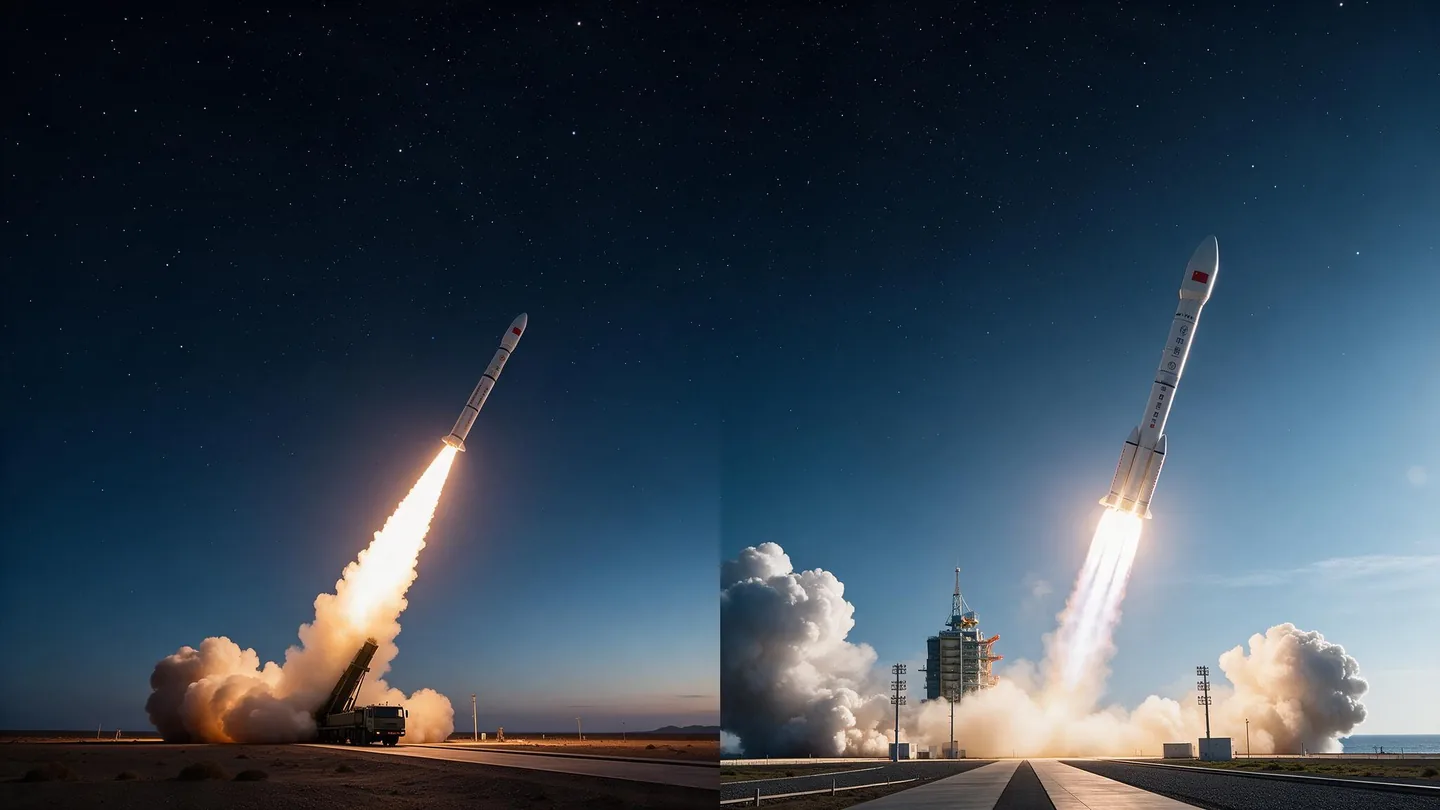
China carried out two orbital launches on September 17. At 08:32 Beijing time a Long March 12 rocket lifted off from the Hainan Commercial Spaceport and delivered a batch of low Earth orbit internet satellites into their planned orbits. Two hours later, at 10:40, a Kuaizhou-11 Y3 solid rocket rose from the Jiuquan Satellite Launch Center carrying the Tianyi-51 and Tianyi-52 satellites. Two launch sites, two rocket classes and two different mission profiles in a single day underline the accelerating tempo of Chinese launch activity.
Kuaizhou-11: the seventh flight of a responsive solid rocket
The Kuaizhou-11 Y3 mission flew a dual-satellite ride-share, placing both Tianyi spacecraft into orbit. According to Xinhua, the Kuaizhou-11 is developed by Kuaizhou Space Technology and can lift one tonne to a 700 km sun-synchronous orbit. It is characterised by high flight reliability, good insertion accuracy, short preparation time, low ground-support requirements and low launch cost. This was the seventh flight of the Kuaizhou-11 and the 40th flight of the Kuaizhou family overall - a milestone for a solid-propellant line that has become a go-to option for responsive launches in China's commercial market.
For satellite operators, solid rockets matter because of responsiveness: short preparation cycles and light ground support make them well suited to gap-filling launches, contingency missions and flexible additions to a constellation build-out.
The earlier flight: Long March 12 and LEO internet satellites
Earlier the same day, a Long March 12 launched from the Hainan Commercial Spaceport, orbiting a full batch of LEO internet satellites in a single mission. Multi-satellite batches of this kind show that domestic LEO constellation deployment is continuing at pace, while Hainan's growing launch cadence reflects broader use of China's newest commercial spaceport.
What a two-launch day signals
One mission flew from Jiuquan, a long-established inland launch centre; the other from Hainan, a site built for commercial missions. One used a medium-lift liquid rocket to orbit a batch of satellites; the other used a solid launcher for a dual-satellite mission. Completing both in one day requires launch-site resources, range support and rocket production capacity working together. For small-satellite customers, the practical result is a wider menu of launch windows and site-vehicle combinations, and more scheduling flexibility for constellation deployments.
Hanxing's View
Competition in launch ultimately shows up in the schedule slots, prices and insertion accuracy available to customers. China's commercial rocket portfolio is broadening, from medium-lift liquid vehicles such as the Long March 12 for batch deployment to solid rockets such as the Kuaizhou-11 for responsive and top-up launches. For international small-satellite operators, these are real options worth comparing. Hanxing - your China launch service advisor for small satellites worldwide - provides launch consulting, rocket selection, orbit and schedule matching, and end-to-end constellation deployment solutions, translating Chinese launch capacity into services customers can use directly.