
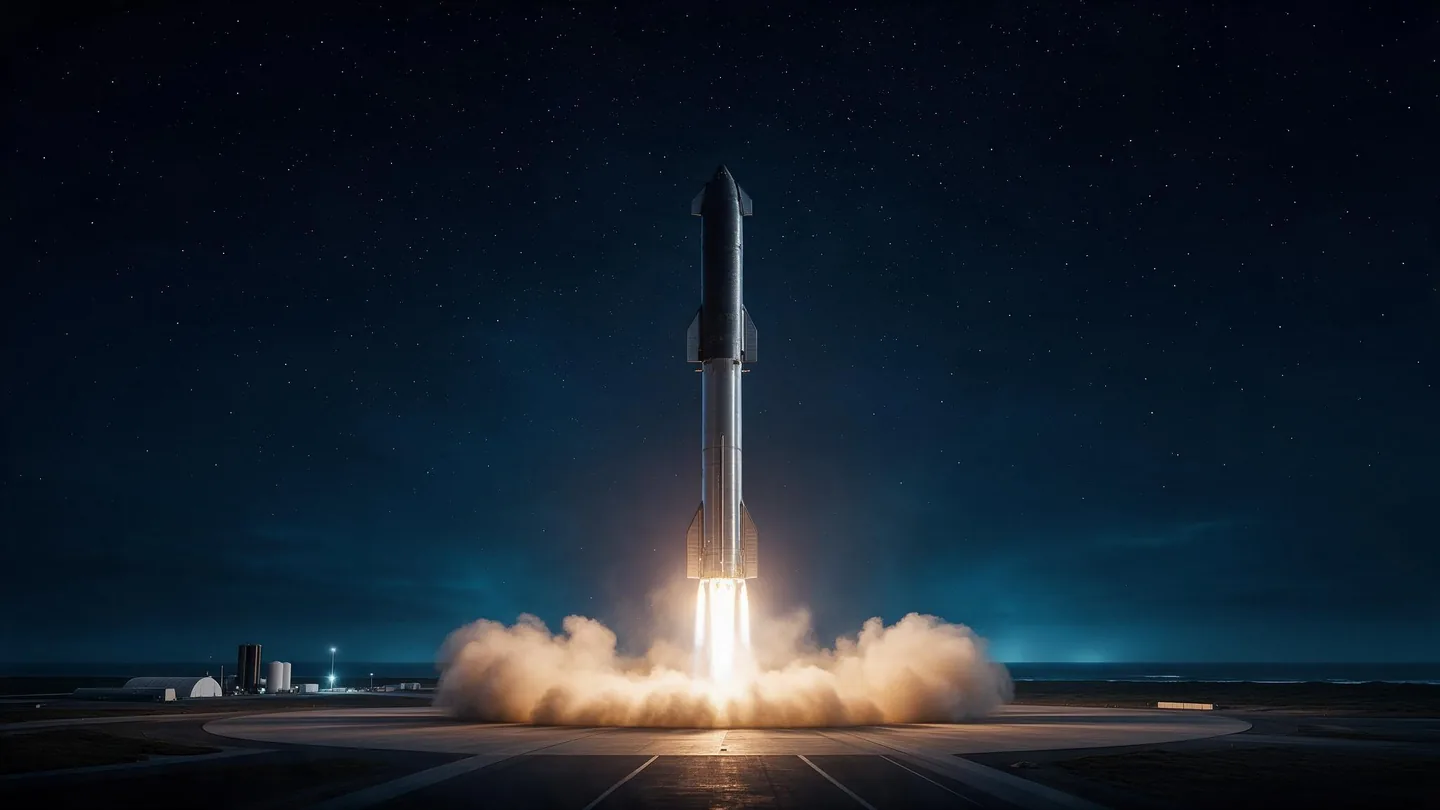
By September 2026, China's commercial space sector has delivered rapid progress across reusable rockets, vehicle manufacturing, liquid engines and supply-chain processes, with multiple recovery routes being validated in parallel. Competition is shifting from "can we reach orbit" toward "can we reuse, mass-produce and keep cutting cost."
Multiple reusable-rocket routes in parallel
LandSpace's Zhuque-3 became the first Chinese orbital rocket to recover its first stage with landing legs on land, touching down at Minqin on 19 August. Its Tianque-12A methalox engine throttles across a 40% to 110% range, providing the power needed for return control.
Galactic Energy's Zhishenxing-1 reached orbit on 1 September, powered by seven CQ-50 kerolox engines, designed for at least 25 reuses under an "orbit first, recover later" strategy, with entry and pinpoint-recovery tests to follow.
CAS Space's Lihong-1 suborbital vehicle completed parachute recovery and returned the country's first metal parts 3D-printed in space; Jianyuan Technology completed China's first offshore recovery of a full-scale stainless-steel test rocket; and iSpace's Hyperbola-3 plans a land launch with sea recovery, targeting a maiden flight in late 2026.
A tiered vehicle lineup
Medium liquid rockets now span 2 to 15 tonnes to low Earth orbit, with Lijian-2 completing its maiden flight and a dedicated factory built to support scale, airliner-like production. Large reusable rockets — Zhuque-3, Tianlong-3, Yinli-2 and Hyperbola-3 — target roughly 20 tonnes to LEO and are advancing through development and testing.
Engines and supply chain
Reusable rockets demand multiple ignitions and deep throttling; the Tianque-12A and Cangqiong-50 both deliver wide throttle ranges for return control. On the supply-chain side, the industry has mastered laser welding of large thin-walled stainless-steel tanks and refined soft-landing guidance, while private firms have broken foreign material bottlenecks in copper-chromium-niobium alloy powder and grid-fin welding. Around 70% of the commercial supply chain now comes from civilian cross-industry suppliers.
Remaining challenges
Most programs have so far achieved only a single successful recovery, not yet a reflight of the same booster. Recovery designs trade away payload efficiency, so real cost reductions depend on high-frequency, stable reuse backed by accumulated flight data.
Hanxing view
As reusable rockets mature, they will reshape both the cost structure and the supply of small-satellite launches globally. For overseas operators, Chinese rockets are shifting from one-off capacity toward reusable, scalable, high-frequency capability. As Hanxing — a China launch service advisor for global small satellites — we track this progress closely, helping overseas customers match the right rocket and constellation cadence to China's launch solutions.