
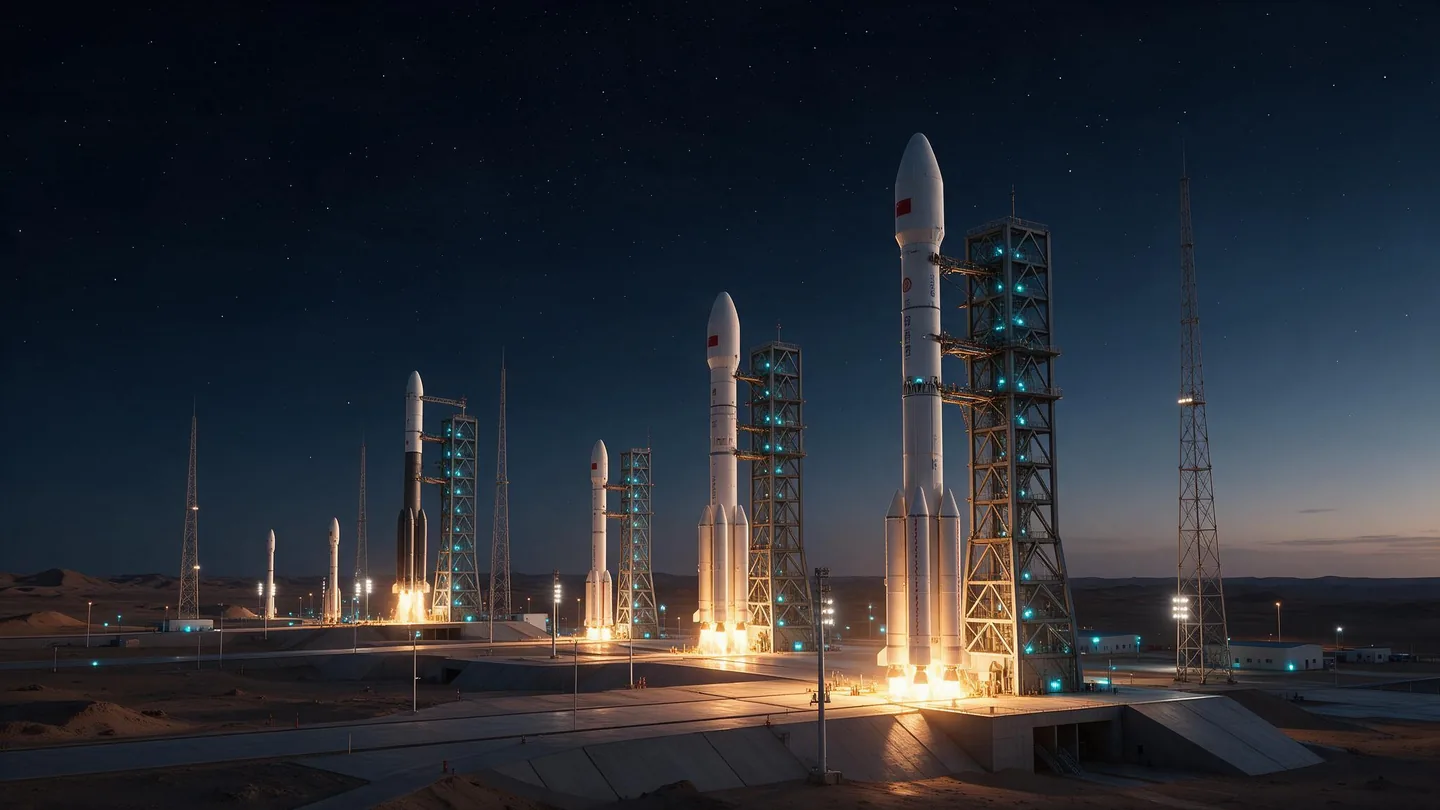
According to statistics from the China Securities Journal and other media, between September 14 and 20 China completed six rocket launches in a single week, sending more than 30 satellites into orbit. From low-Earth-orbit broadband constellation deployment to science experiments, national teams and commercial rocket firms worked in parallel, with land- and sea-based launch sites coordinated to sustain an unusually high launch cadence.
A week of launches
This week's launches spanned solid and liquid propulsion, land and sea. On September 19, a Long March 2D rocket sent the PIESAT-2 13-16 satellites into sun-synchronous orbit from Taiyuan. On September 20, Kinetica-1 Y18 lifted off from the Dongfeng Commercial Space Innovation Pilot Zone in a nine-satellite rideshare that placed Chaozhisuan-1, Qinling-01/02 and others into orbit.
- At sea, Gravity-1 Y3 delivered nine satellites, including Qianfan polar-orbit group 26 and an EUHT technology-demonstration satellite, on September 16.
- For constellation building, Zhuque-2E Y7 carried ten Qianfan polar-orbit group 19 satellites on September 15, further expanding the constellation's on-orbit fleet.
- Across the week, commercial solid and liquid rockets alternated with Long March national-team vehicles, spanning a broad range of vehicle types.
From "can launch" to "launches on schedule"
The high cadence reflects maturing mass production of commercial rockets and faster turnarounds at launch facilities. Coordination across multiple sites, including the Hainan commercial launch complex, the Dongfeng commercial zone and the East China Sea offshore platform, gives operators more flexibility in windows and drop zones. As reusable-rocket technology matures and costs fall, high-frequency constellation launches are becoming routine, providing steady launch capacity for low-Earth-orbit megaconstellations.
For commercial satellite operators, a denser and cheaper launch cadence shortens deployment timelines and makes replenishment more flexible, turning on-time on-orbit delivery into an executable schedule rather than an aspiration.
Hanxing's take
As the "Hanxing — global small-satellite launch service advisor in China," Hanxing tracks the capacity and cadence of China's commercial rockets. Six launches and more than 30 satellites in orbit in a single week underscore the scale and reliability of China's launch capability. For overseas customers looking to ride Chinese commercial rockets for their small-satellite constellations, this is not only an assurance of capacity but a signal that full-chain services — launch consulting, launch-vehicle matching and scheduling — are maturing rapidly. Hanxing will keep integrating China's commercial launch resources to offer global small-satellite customers one-stop Chinese launch solutions from requirements assessment to on-orbit delivery.