
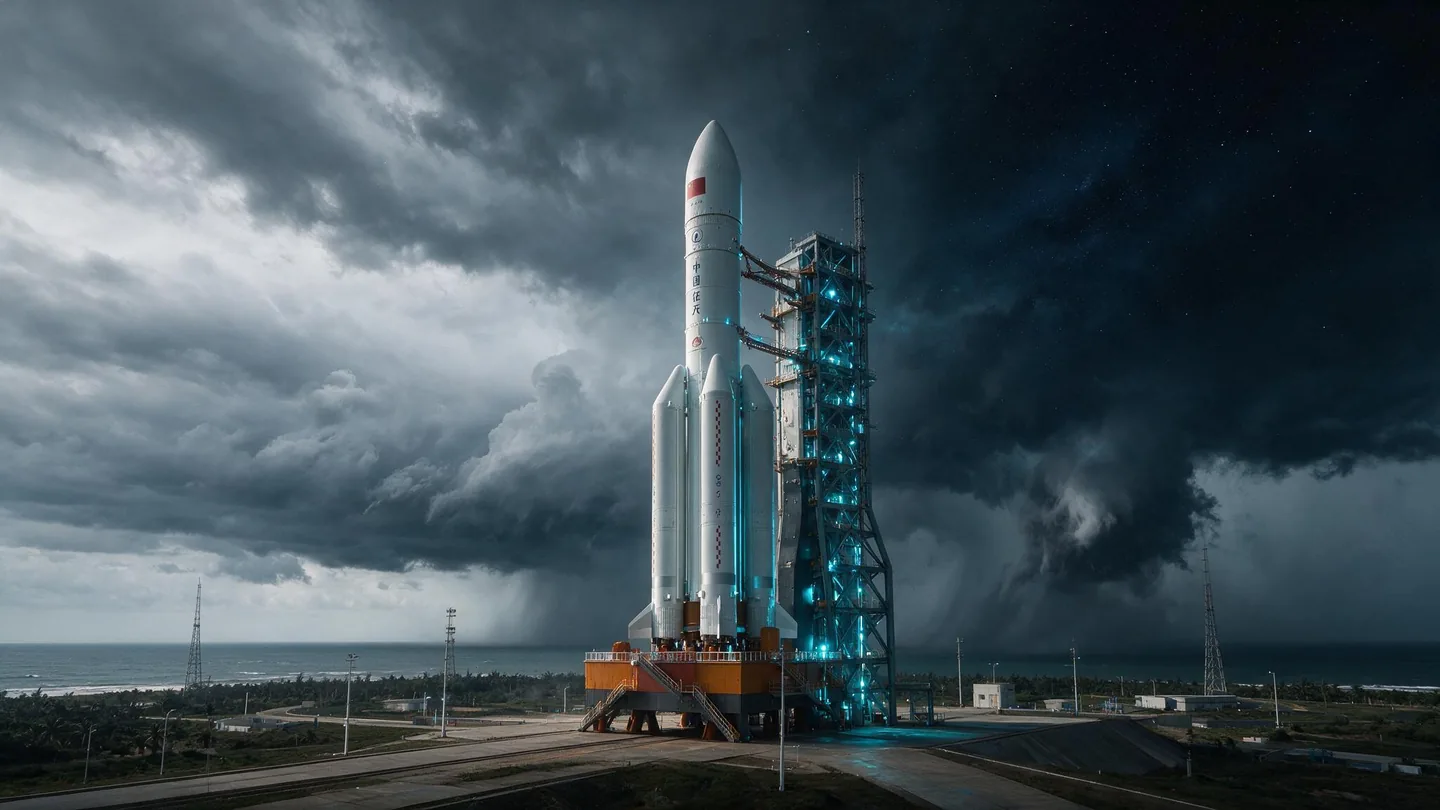
On August 23, China’s Manned Space Program office published a terse announcement on its website declaring the delay of the highly anticipated Chang’e 7 lunar exploration mission. The agency stated: “In keeping with the principle of proceeding prudently and reliably, and ensuring absolute success, after a comprehensive assessment it has been determined that the Chang’e 7 mission does not meet the conditions for launch and therefore cannot be carried out during the planned launch window this year.”
Mission Overview
Chang’e 7 is a key mission in the fourth phase of China’s Lunar Exploration Program, comprising a lunar orbiter, lander, rover, and a mini-hopping probe. The mission was originally scheduled to launch in August from the Wenchang Space Launch Site on Hainan Island aboard a Long March 5 rocket, targeting a landing near Shackleton Crater at the lunar South Pole — one of the most scientifically compelling regions on the Moon.
The high rims of Shackleton Crater create permanently shadowed regions known as “cold traps,” where scientists believe water and other useful materials may have accumulated in ice form over billions of years. In both NASA’s and China’s long-term lunar settlement plans, the few square miles at the lunar South Pole are the most coveted real estate. No country has yet achieved a soft landing in the lunar polar regions.
Analysis of the Delay
Chinese official sources provided no explicit explanation for the delay. However, multiple analyses suggest the most likely direct cause was Tropical Storm Narra, which had 45 mph winds and was meandering through the waterway separating Hainan Island from mainland China, likely creating inclement weather conditions at the Wenchang launch site.
Additionally, launch windows for lunar South Pole landing missions are constrained by multiple factors, including sunlight conditions in polar landing zones and the mission plan’s requirement for a 90-day lunar orbit reconnaissance period. Social media chatter indicated that the next suitable launch window might not open until February or March next year. Another possibility was a last-minute technical issue, but this seems less likely given that China had been actively proceeding toward launch in the days prior.
Notably, the Long March 5 rocket’s YF-100 engine is shared with the Long March 7A vehicle that was lost during ascent two weeks earlier. However, analysts considered it unlikely that the engine issue was the primary cause of the delay.
The Space Race Context
The Chang’e 7 delay comes amid a tight contest between China and the United States to establish a meaningful presence at the lunar South Pole. The mission is a precursor flight for human missions that could follow in the next two to four years.
The delay also opens the possibility that NASA could reach the lunar South Pole first, with the initial launch of Blue Origin’s Blue Moon Mark 1 vehicle. This large lander is planned to carry two NASA probes to the South Pole. Blue Moon was on track to launch this year before the loss of the New Glenn rocket and its launch pad during a static fire test in May. Blue Origin has been rebuilding its Launch Complex 36A at Cape Canaveral and aims to return New Glenn to flight before the end of the year. If Blue Moon launches in the first half of 2027 and Chang’e 7 launches in February and spends three months in lunar orbit before landing, the two could form a close South Pole race.
Hanxing Perspective
The Chang’e 7 delay underscores that deep space exploration missions impose extremely stringent requirements on launch windows, weather conditions, and technical maturity. As a commercial launch service provider, Hanxing understands that the principle of “better to delay than to rush” is paramount for high-risk missions. The lunar South Pole, as a strategic frontier for future deep space exploration, will continue to drive aerospace technology innovation as China and the United States compete in this region. Hanxing will continue tracking China’s deep space exploration progress and contributing to the advancement of China’s space endeavors.