
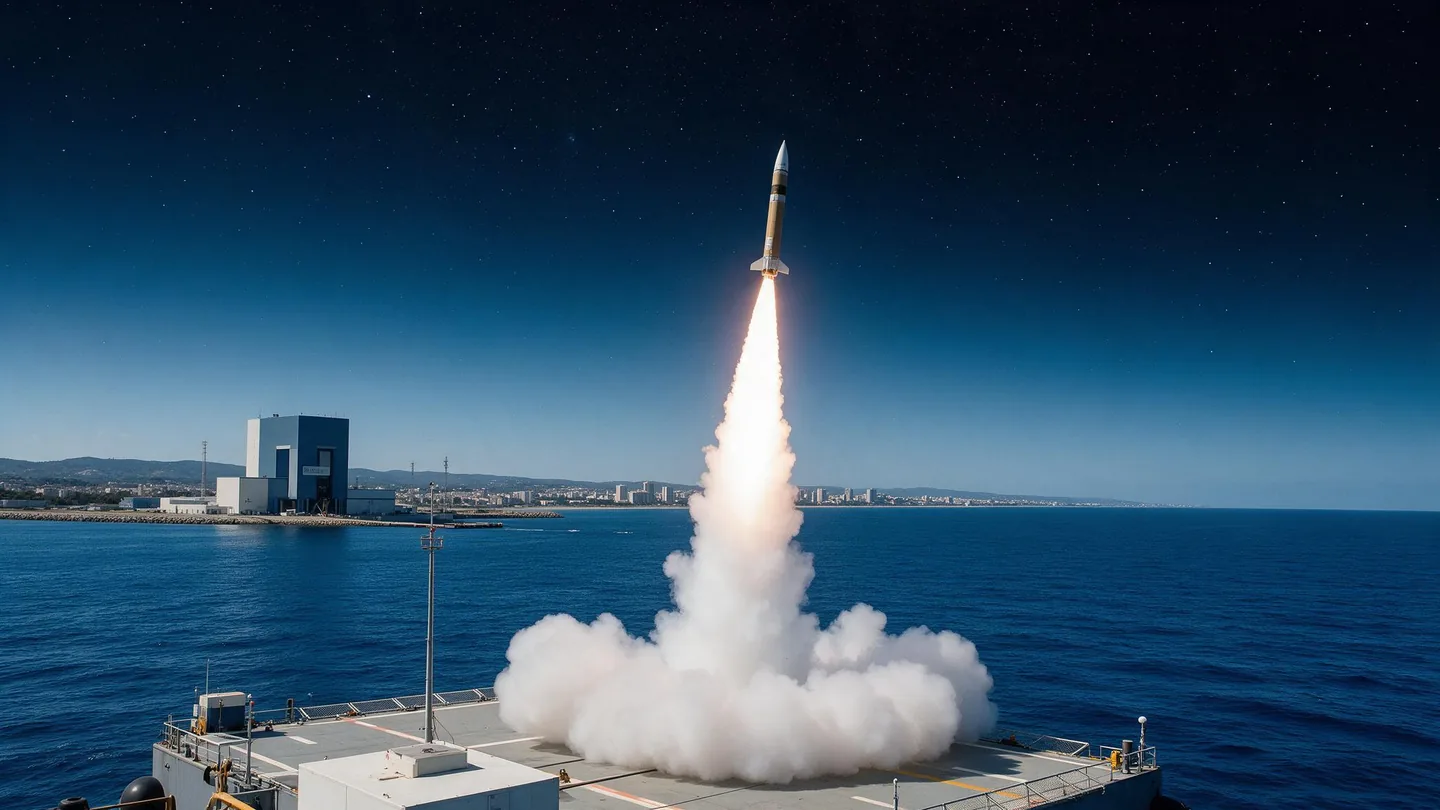
China's CERES-1 sea-launch vehicle is set to lift off from waters off Rizhao, Shandong province, between Oct. 21 and 23, with a target time around 11:30 a.m. Beijing time on Oct. 21. The solid-fuel rocket will fly from the "Dongfang Hangtian Gang" launch vessel in what will be Rizhao's second orbital launch this year — and, for the first time in China, a sea launch commanded from land.
Land-based command, sea-based launch
A new command and control center built by Shandong Haishangfa in Rizhao will serve as the mission's "brain." Equipped with scheduling, display, satellite-communications and broadband links, the center receives real-time data from the sea platform and the rocket, runs pre-launch checks and the countdown, issues the ignition command, and monitors the ascent phase through to orbit insertion. Moving command functions ashore is expected to make launch organization more efficient and responsive than relying on the sea platform or off-site tracking assets alone.
One rocket, one satellite
The mission carries a single payload: Xiguang Si-hao 01, a remote-sensing satellite developed by Xi'an Zhongke Xiguang Technology Group. It will supply all-weather imagery with high spatial, temporal and spectral resolution to customers worldwide, along with application system solutions.
CERES-1 is a sea-launch-capable small rocket developed by Galactic Energy of Beijing, and it has already flown four sea missions from Rizhao. Together with the Jielong-3, launches from Rizhao's coastal waters have now delivered 50 satellites into orbit across seven missions. The upcoming flight will be the eighth sea launch supported by Shandong Haishangfa there.
From launch cadence to industry
After eight campaigns, Rizhao says its sea launch point has proven reliable and is now widely accepted by the organizations that run launches. The city plans to use the activity as a magnet for rocket and satellite assembly plants and aerospace materials projects, building out a wider space industry. Residents and visitors will be able to watch the flight from coastal viewpoints such as Wanpingkou and Dengta Square.
Hanxing view
Sea launches give smallsat operators flexibility in choosing a launch point without inland drop-zone constraints, while moving the command center ashore adds standardization and control. For constellation builders, more standardized launch organization means more predictable windows and schedules. As Hanxing — your China launch service advisor for small satellites worldwide — we track how the capability of China's launch sites and rockets evolves, and match customers with the most reliable ride to orbit, from rideshare missions to dedicated constellation deployment and end-to-end China launch solutions.