
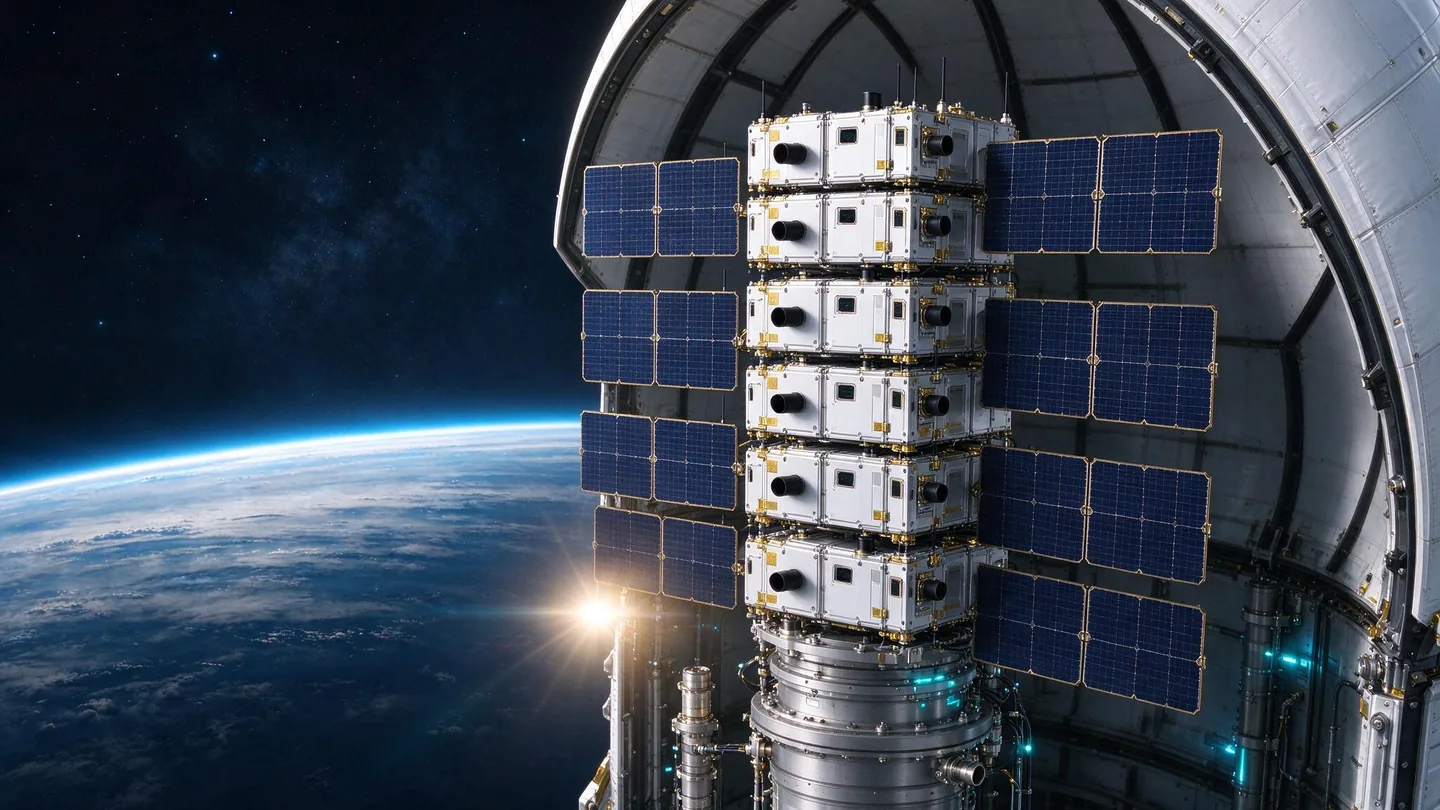
On October 26, Astranis announced it had upgraded its fourth launch contract with SpaceX — originally signed in late 2024 — into a dedicated mission: in 2028, an entire Falcon 9 will carry nothing but its own spacecraft, all six MicroGEO satellites of the Block 4 production run, serials 11 through 16. When the mission flies, the company's fleet grows from 10 satellites to 16.
What drove the upgrade is not the number six. It is the destination: geostationary orbit.
What actually changed
Astranis builds small geostationary communications satellites — far lighter than traditional large GEO platforms — with one satellite serving one customer's dedicated network. The company has bought a dedicated launch before: in December 2024, four MicroGEO satellites flew together on a single Falcon 9 straight to GEO, the first time a single manufacturer sent four of its own satellites to geostationary orbit on one launch.
This contract had been a rideshare-style capacity purchase. It is now amended to give Astranis the full payload capacity, with an Impulse Space Helios upper stage handling the last leg. According to the company, the six satellites will be injected directly into GEO rather than dropped into a transfer orbit to climb under their own propulsion.
A dedicated rocket costs more, but it buys three things
The rideshare logic is simple: pay by the kilogram, share spare capacity, save money. On a GEO mission, however, that saving gets amplified into three separate bills.
The first is time. Rideshares typically drop satellites into a transfer or intermediate orbit, and the spacecraft must then raise themselves to GEO using chemical or electric propulsion — a process measured in months. For a dedicated network already under a service contract and billing from activation, every month of drift is a month of missing revenue. Direct injection removes those months.
The second is configuration. Rideshare passengers come from different manufacturers, so shape, mass, interfaces and separation timing all have to accommodate each other; satellites often make structural compromises to fit a shared adapter. A dedicated mission lets the manufacturer design its own stack, set its own separation order and define its own mechanical environment — real mass and cost savings for a mass-produced bus.
The third is formation. GEO slots are scarce, and six satellites must land in their assigned positions; insertion accuracy and phasing determine whether extra propellant is burned later on station-keeping. A dedicated mission can set the phase differences during launch rather than spending months correcting them on orbit.
Why this is happening now
Astranis frames it as production ramping up: initial Block 4 customers are signed but not yet announced, and the company says it is working through a commercial backlog of more than $1 billion. The previous Block 3 batch is slated for launch in the first quarter of 2027 with customers including Thailand's Thaicom, Chunghwa Telecom, APCO Networks, MB Group and Saudi Arabia's stc group. Locking all of Block 4 into one dedicated rocket essentially aligns production cadence with launch cadence — satellites roll off the line in batches, the rocket flies a batch, and nothing waits in between.
It also explains the premise of the small-GEO route: satellites must be small and cheap enough that a single customer can buy out an entire medium-lift rocket. Traditional GEO platforms cost hundreds of millions each and fly one per rocket, so "dedicated" is normal there. For small satellites to reach the dedicated-launch stage, unit costs must first fall far enough that a whole batch can absorb the price of the vehicle.
A decision framework for small-satellite buyers
The news is a useful reference for constellation and single-satellite customers everywhere. Choosing rideshare or a dedicated mission comes down to three questions:
- Where are you going? For LEO remote sensing, IoT and technology demonstration, rideshare is almost always optimal — orbital tolerance is high and a few months' delay does not break the business model.
- What is time worth? If revenue starts when the satellite is on station, the orbit-raising period is pure loss, and the dedicated premium is often more than offset by months of cash flow.
- How big is the batch? Dedicated launches only dilute cost when satellites of the same type, bus and orbital slot can be grouped together. Buying a whole rocket for one small satellite is uneconomic anywhere in the world.
Hanxing View
Changes in China's commercial launch market over the past two years have filled in both ends of this trade-off. On one end are increasingly frequent rideshare departures — from the piggyback capacity Long March vehicles publish openly, to regular "shared rocket" slots on Kinetica-1, Zhuque-2E and Kuaizhou-11. On the other end are medium-lift liquid rockets such as Kinetica-2, Zhuque-3 and Tianlong-3, with 12-tonne-plus LEO capacity, which are turning "one entire rocket for one customer" into a negotiable contract.
For small-satellite customers abroad, that supply structure means the choice is no longer "cheap but slow" versus "fast but expensive." LEO batch missions can ride shared or buy whole fairings; mid-sized constellation batches can negotiate dedicated missions; and customers bound for GEO or medium-high orbits can now get direct-injection service through upper-stage combinations. That is precisely where Hanxing — your advisor for small-satellite launch services from China — adds value: instead of pushing a single rocket, we translate a customer's mission profile — orbit, window, batch size, budget, on-station date — into the matching China launch solution, so that the trade between "rideshare saves money" and "dedicated saves time" becomes a calculation rather than a gamble.