
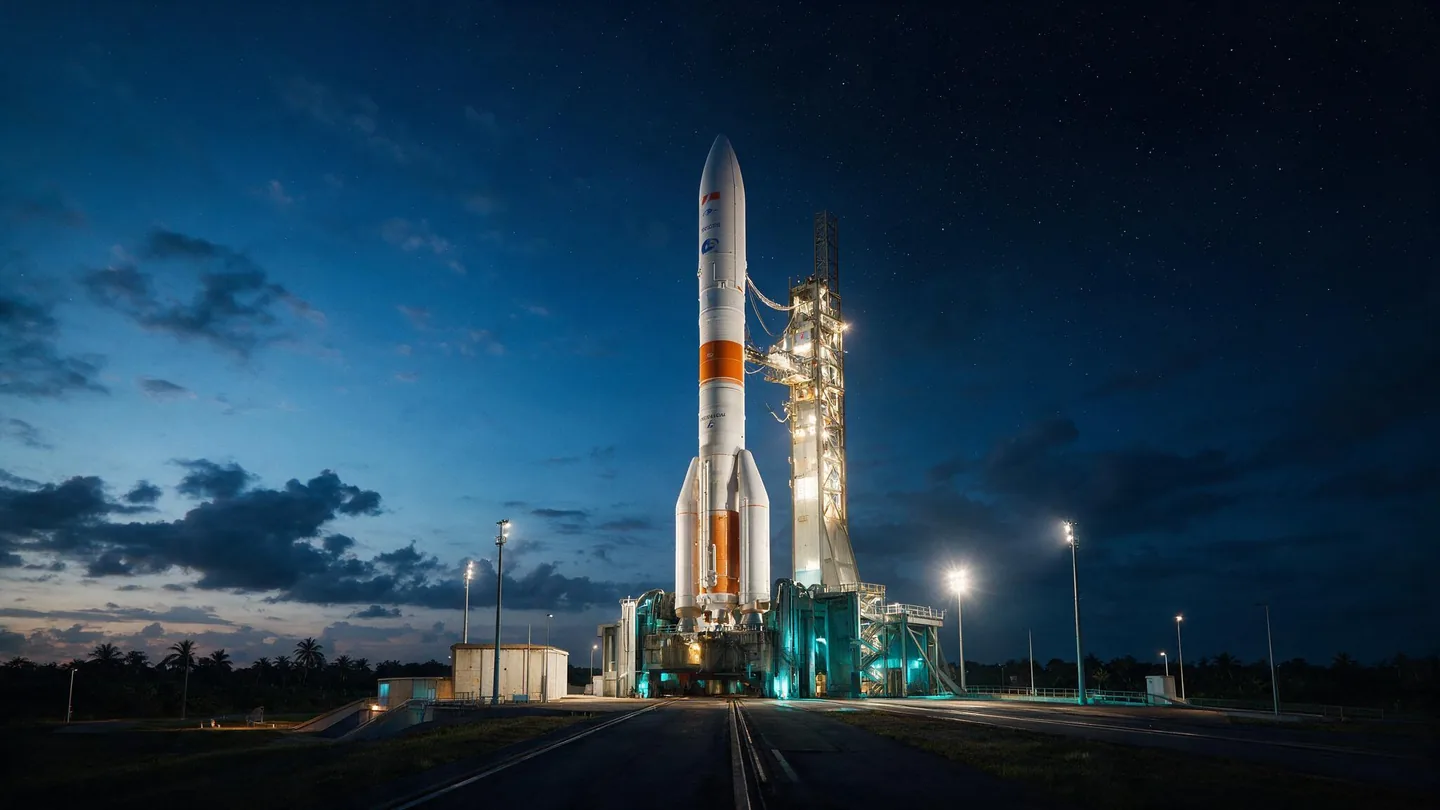
Europe's Ariane 6 rocket has completed eight orbital missions since its debut, all reaching orbit safely — a smoother entry into service than Blue Origin's New Glenn or ULA's Vulcan. But the program's future looks cloudier than its technical record suggests. European Spaceflight reported that the European Space Agency has shelved the planned "Block 3" upgrades for the rocket, a decision that may reshape Europe's long-term launch strategy.
The Block 3 upgrade is put on ice
The centerpiece of the Block 3 package was ICARUS, a lightweight upper stage that would have used carbon-composite structures to boost performance and mission flexibility. The cancellation is already forcing mission planners to reassess some ESA science missions, including a probe to Saturn's icy moon Enceladus, which had counted on the upgraded stage.
The Ariane 6 is a large, expendable launcher capable of lifting more than 20 metric tons to low-Earth orbit. It became Europe's workhorse after the war in Ukraine ended access to Russian Soyuz rockets and the continent sought to reduce reliance on SpaceX's Falcon 9. Technically it has delivered; commercially the picture is murkier.
More than €30 million in subsidies per flight
ESA director general Josef Aschbacher has publicly confirmed that, at a cadence of nine flights per year, European governments still subsidize each Ariane 6 launch to the tune of €32–38 million. When roughly €3.6 billion in development and launch-site costs are amortized in, European taxpayers are on the hook for more than €100 million per flight before Arianespace collects anything from customers.
Arianespace has not published per-launch pricing, but industry estimates put a single Ariane 6 flight in the €80–100 million range. Even its biggest commercial customer, Amazon — which booked 18 launches for its Kuiper constellation, three of which have flown this year — is likely flying at a loss for Europe.
To scale or not to scale
Ariane 6 is currently on track for roughly 10 flights next year. Aschbacher says scenarios are being studied to push annual production to 12, 15, or even 20 flights, with a decision requested from European ministers by the end of this year.
For an expendable vehicle, increasing cadence means scaling production of every element — solid boosters, first-stage engines, upper stages, fairings — and investing heavily in factories and supply chains. With every flight already subsidized, higher cadence simply means a larger total subsidy bill.
The strategic question ministers face is straightforward: with reusable vehicles from the US and China rapidly driving down per-kilogram launch costs, is pouring more money into an expendable workhorse a defensible long-term bet? Many observers argue the funds would be better directed toward a next-generation, partially reusable European launcher that can actually compete on cost.
Hanxing Perspective
At Hanxing we track global launch-market dynamics closely. The shelving of Ariane 6's Block 3 upgrade is a symptom of a broader truth facing expendable rockets in the reuse era: when competitors are compressing unit launch costs through booster recovery, subsidy-funded legacy programs struggle to sustain commercial relevance. For smallsat operators, the bulk of new capacity in the coming years will come from reusable vehicles, reshaping pricing, schedule availability, and mission flexibility. Hanxing will keep monitoring real-world capacity and pricing across fleets to match customers with the most cost-effective ride to orbit.